
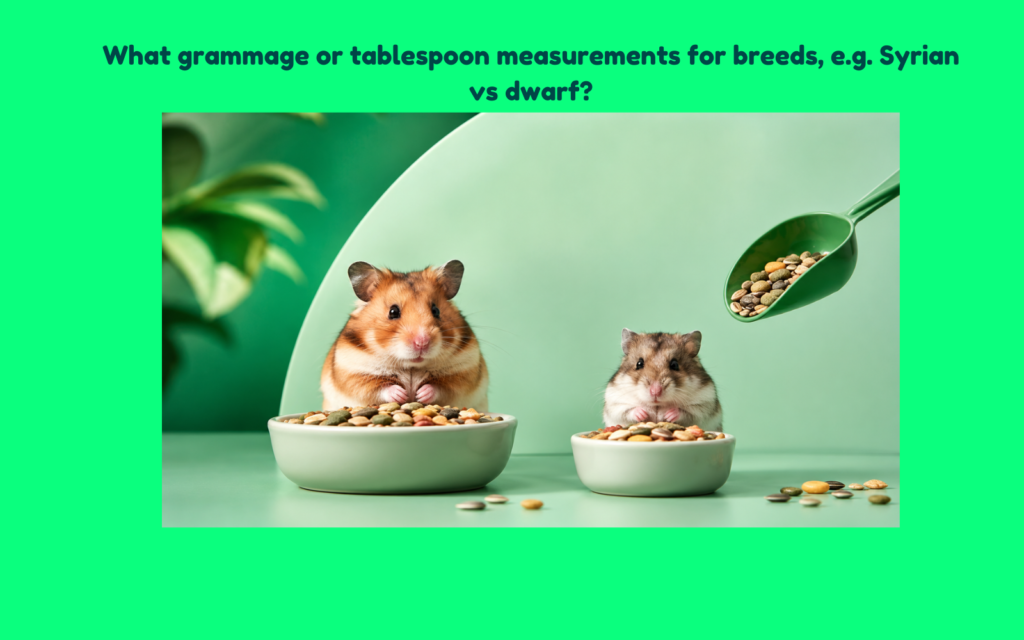
What Are the Exact Grammage and Tablespoon Measurements for Syrian Versus Dwarf Breeds?
Guessing your pet’s daily food portion using a random, rounded kitchen spoon is the fastest way to accidentally derail their entire dietary baseline.
We all do it. You grab whatever spoon is clean in the drawer, scoop a pile of food into the bowl, and figure it looks about right. But here is the stark physical reality: a Syrian and a dwarf are two radically different animals. Trying to use a “one-scoop-fits-all” approach is mechanically broken from the start.
We are going to break down exactly how many grams your specific breed actually needs, how that translates into flat metric tablespoons, and why you need to throw your uncalibrated measuring tools in the trash.
Think about it like trying to fill up vehicles. You would never try to pump the exact same volume of gas into a massive heavy-duty truck and a tiny compact car. The tank capacities are fundamentally different, and the exact same logic applies to the tiny animals sitting in your living room right now.
Visual Breakdown: A heaping, uncalibrated kitchen spoon introduces dangerous volumetric inconsistencies compared to a leveled, precise measuring tool.
Why do exact grammage and tablespoon measurements differ fundamentally between Syrian and dwarf breeds?
You have to scale the physical volume of food to the animal because the stomach capacities and daily energy requirements of these distinct species are drastically different.
You must completely abandon a uniform, one-size-fits-all feeding approach across different species. Applying an arbitrary volume to both breeds completely ignores their mechanical limits. A dwarf hamster simply does not have the physical stomach capacity to process the volume meant for a Syrian.
Let’s look at what actually happens when you use the same tool. If you give the same two-tablespoon scoop to both animals, you are setting up two entirely different failures. For the larger Syrian, that amount might barely cover their daily energy burn, guaranteeing severe underfeeding. For the smaller dwarf, dumping that much food into their cage creates a dangerous, system-overloading overfeeding scenario. The exact grammage and tablespoon measurements have to match the machinery processing them.
Biological Volume Map: A single universal scoop causes energy depletion in Syrians and dangerous system overload in dwarfs.
How do you calculate the required grammage and tablespoon volumes for a Syrian hamster?
Syrian Dietary Baseline: 10 to 12 grams of food translates mechanically to exactly 1 to 1.5 level metric tablespoons.
Because of their larger mass and faster metabolism, a Syrian hamster requires a daily dietary baseline of exactly 10 to 12 grams of food.
When you map that exact physical weight to a visual standard, 10 to 12 grams translates to roughly 1 to 1.5 level metric tablespoons of a standard seed or pellet mix. The key word here is “level.”
If you leave a heaping, rounded mound on top of the spoon, you instantly break the math and drastically increase the weight. Nailing these specific grammage and tablespoon volumes is how you ensure a larger breed gets the fuel it needs without tipping over into excess.
What are the strict grammage and tablespoon limits for dwarf hamster species?
Dwarf Dietary Limits: The strictly reduced 5 to 6 gram requirement translates to exactly 0.5 to 1 level metric tablespoon.
When feeding smaller species like Roborovskis, Campbell’s, or Winter Whites, you have to drastically cut that volume in half to hit their strict 5 to 6 gram baseline requirement.
This is a strict volumetric reduction from the Syrian baseline. A dwarf’s baseline maps out to exactly 0.5 to 1 level metric tablespoon per day. It is incredibly easy to get this wrong based on human perception.
Think of it this way: what looks like a tiny, insignificant sprinkle of food to you is actually a massive, filling feast to an animal that literally fits inside the palm of your hand. Respecting these grammage and tablespoon limits is non-negotiable for their small systems.
How do you fix volumetric inaccuracies caused by uncalibrated tablespoon measurements?
Calibration Protocol: Physically weighing your daily scoop on a zeroed digital kitchen scale is the only way to guarantee precise grammage output.
If you have been using a rounded soup spoon or a random coffee scoop, your daily volume is likely massively inflated and needs an immediate reset.
The Problem: You probably assume your designated “hamster spoon” is holding one tablespoon. You are completely unaware that the deep, rounded bowl of that everyday kitchen spoon often holds almost triple the required grammage.
The Solution: You need a strict re-calibration. Immediately stop using arbitrary tableware. You must pivot to using a precise digital kitchen scale. If you do not have one today, use standardized, flat-edged baking measuring spoons. This is the only way to re-calibrate the exact mathematical volume and stop accidentally overfeeding. You have to remove the guesswork from your tablespoon measurements entirely.
How do you audit your feeding tools to verify precise grammage measurements today?
You can actively protect your pet from volumetric overload by taking your current scoop and physically weighing its output on a digital kitchen scale today.
The Tool Calibration Audit Checklist
- Target Breed: Syrian
Required Measurement Metric: Exactly 10 to 12 grams.
Testing Action: Scoop your food exactly as you normally do, and dump it onto a zeroed-out digital kitchen scale.
Action: If the scale reads 18 grams, you are heavily overfeeding. Reduce your scoop until it hits the 10-gram target perfectly.
- Target Breed: Dwarf (Roborovski, Campbell’s, Winter White)
Required Measurement Metric: Exactly 5 to 6 grams.
Testing Action: Weigh your current daily serving on the scale.
Action: If the scale flashes anything over 7 grams, cut your portion size immediately to prevent daily volume overload.
Nailing down precise grammage measurements takes two minutes but fixes months of accidental overfeeding.
Use this quick scale audit to throw out the guesswork, and standardize your daily scoop strictly based on this calibrated weight.
References & Citations
Locking in the exact physical weight of their daily portion is a simple, mechanical fix that actively prevents overfeeding and protects their baseline health.