
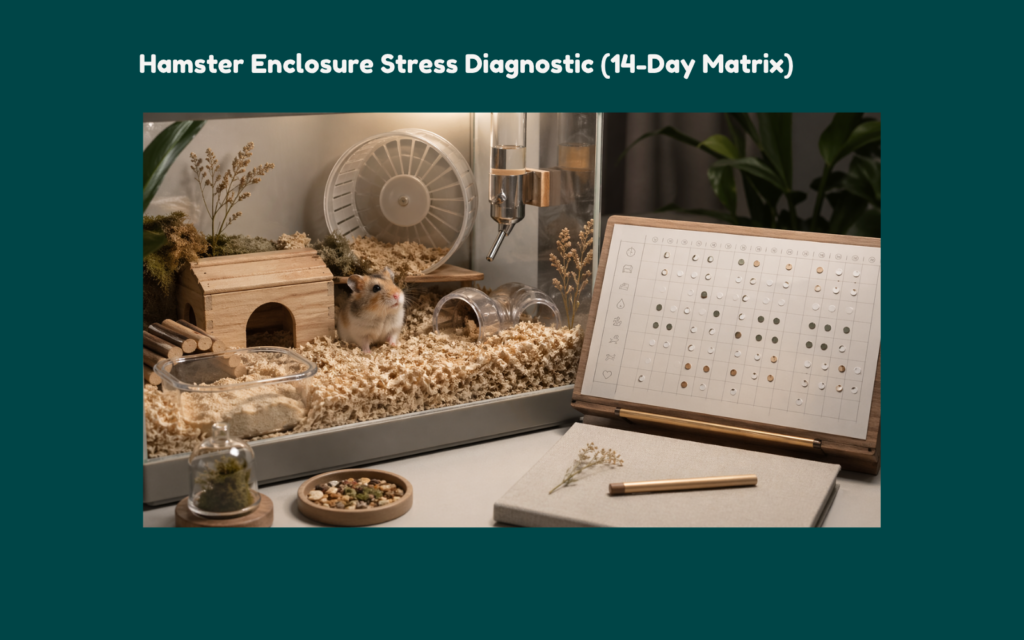
How to Use the 14-Day Enclosure Stress Assessment Tool to Stop Repetitive Behaviors
To effectively eradicate nocturnal pacing, bar-biting, and frantic wall-climbing, owners must deploy the 14-day enclosure stress assessment tool, a rigorous diagnostic protocol engineered to systematically map abnormal repetitive behaviors to exact environmental failures.
To effectively eradicate nocturnal pacing, bar-biting, and frantic wall-climbing, owners must deploy the 14-day enclosure stress assessment tool, a rigorous diagnostic protocol engineered to systematically map abnormal repetitive behaviors to exact environmental failures.
Spatial restriction chronically activates the hypothalamic-pituitary-adrenocortical (HPA) axis, inducing systemic distress. Furthermore, neuroanatomical mapping utilizing c-fos mRNA expression (a biomarker used to identify regions of intense neuronal activity following acute stress) proves that acute spatial and environmental stress causes intense activation in the medial amygdaloid nucleus and locus coeruleus, ultimately leading to immunosuppressive thymic involution. (Kollack-Walker, S., Watson, S. J., & Akil, H. (1997). Social stress in hamsters: defeat activates specific neurocircuits within the brain. Journal of Neuroscience, 17(22), 8842-8855. https://doi.org/10.1523/JNEUROSCI.17-22-08842.1997)
Diagnostic observation is useless if the core structural framework of the habitat is inherently abusive. For example, Hauzenberger et al. (Hauzenberger, A. R., Gebhardt-Henrich, S. G., & Steiger, A. (2006). The influence of bedding depth on behaviour in golden hamsters (Mesocricetus auratus). Applied Animal Behaviour Science, 100(3-4), 280-294. https://doi.org/10.1016/j.applanim.2005.11.012) proved that a 10 cm bedding depth yields severe stereotypic wire-gnawing (measuring 1773 seconds of ARB expression across 22% of subjects), while providing 80 cm of substrate completely eradicated the behavior. Additionally, Tierärztliche Vereinigung für Tierschutz (TVT) standards (Tierärztliche Vereinigung für Tierschutz e.V. (TVT). (n.d.). Leaflet No. 63: Keeping of Syrian Hamsters. TVT e.V. https://www.tierschutz-tvt.de/) mandate a 27 to 32 cm running wheel for Syrian hamsters to prevent permanent osteological deformities and severe spinal dorsiflexion (an unnatural, chronic upward curvature of the spine caused by running on an undersized wheel).
The Confounding Variable Checklist
- Untouched Bedding: Substrate must remain strictly uncleaned and un-manipulated during the 14-day period to preserve territorial scent markers.
- Biomechanical Wheel Access: A 27 to 32 cm continuous-surface wheel must be functionally verified and freely accessible 24/7.
- Static Room Location: The enclosure must not be moved to a different room, ensuring a consistent ambient thermal and auditory baseline.
Which Independent Variables Should You Track With the 14-Day Enclosure Stress Assessment Tool?
You should carefully track highly dynamic independent variables—such as out-of-enclosure enrichment duration, daytime noise severity, and evening light exposure—to pinpoint the precise catalyst of the nocturnal distress.
Selecting the correct variables isolates the exact neurobehavioral catalysts causing distress. You must explicitly contrast the neurological impact of spatial restriction, auditory trauma, and light pollution to successfully map the source of the behavioral collapse.
We track specialized environmental variables because external stimuli directly hijack rodent neurology. By tracking these distinct inputs, we eliminate guesswork and reveal the specific physiological pressure point breaking the animal’s behavior.
- Variable A (Spatial Restriction): Track playpen duration. Wild Syrian hamsters travel up to 8.3 kilometers a night, with burrows spaced 118 meters apart, making spatial playpen tracking biologically mandatory. (Gattermann, R., et al. (2008). Golden hamsters are nocturnal in captivity but diurnal in nature. Biology Letters, 4(3), 253-255. https://doi.org/10.1098/rsbl.2008.0066)
- Variable B (Auditory Trauma): Track daytime decibel peaks. Daytime noise exceeding 80 dBA triggers massive HPA axis activation and fragments Slow-Wave Sleep (SWS) and Rapid Eye Movement (REM) phases. (Muzet, A. (2007). Environmental noise, sleep and health. Sleep Medicine Reviews, 11(2), 135-142. https://doi.org/10.1016/j.smrv.2006.09.001)
- Variable C (Light Exposure): Track ambient room lighting. Artificial Light at Night (ALAN) at just 5 lux alters core clock proteins (PER1, PER2, BMAL1) via the suprachiasmatic nucleus (SCN), suppressing melatonin, confusing the intrinsically photosensitive retinal ganglion cells (ipRGCs) (specialized eye photoreceptors that directly regulate circadian rhythms), and inducing severe chronodisruption. (Fonken, L. K., & Nelson, R. J. (2014). The effects of light at night on circadian clocks and metabolism. Endocrine Reviews, 35(4), 648-670. https://doi.org/10.1210/er.2013-1051)
How Do You Execute the 14-Day Enclosure Stress Assessment Tool to Log Severity?
Accurate grading prevents subjective emotional panic from ruining the dataset. The 1-5 severity scale utilized here is conceptually analogous to the 0-6 psychopharmacological behavioral scales used to grade amphetamine-induced neuro-motor deficits in laboratory rodents (Fray, P. J., Sahakian, B. J., Robbins, T. W., Senker, E. P., & Iversen, S. D. (1980). An observational method for quantifying the behavioural effects of dopamine agonists. Psychopharmacology, 69(3), 253-259. https://doi.org/10.1007/BF00433096), providing an objective framework to measure distress without inducing a data-ruining observer effect (the phenomenon where the mere presence of a human observer alters the animal’s natural behavior).
Interactive Granular Data Log & Analyzer
Fill out this live session log daily. Click “Run Clinical Analysis” to automatically detect environmental triggers and severity correlations.
| Day | Playpen (Mins) | Noise Event | Light Intrusion | Severity (1-5) | Notes |
|---|
Diagnostic Results
Severity Scale Key:
- 1: Mild pacing; easily broken by foraging introduction.
- 2: Moderate pacing; localized to one specific corner.
- 3: Active wall-climbing or frantic digging at smooth surfaces.
- 4: Intermittent bar-biting or severe stereotypic back-flipping.
- 5: Severe, continuous bar-biting causing dental trauma; unbreakable loop.
How Do You Analyze 14-Day Enclosure Stress Assessment Tool Data to Find Triggers?
Identify all instances where the animal scored a 4 or 5 and trace the timeline backward 12 to 24 hours. The prolonged half-life and enzymatic clearance of glucocorticoids validate the delayed manifestation of ARBs. (Touma, C., Palme, R., & Sachser, N. (2004). Analyzing corticosterone metabolites in fecal samples of mice: a noninvasive technique to monitor stress hormones. Hormones and Behavior, 45(1), 10-22. https://doi.org/10.1016/j.yhbeh.2003.07.002) Furthermore, analyzing the data across multiple days accounts for compounding variables, as it is clinically proven that 72 hours of continuous 5-lux light exposure induces compounding, severe chronodisruption that a single-night analysis would miss. It is vital to understand the pharmacokinetics (the precise timeline of how the body absorbs, distributes, metabolizes, and excretes chemical substances like stress hormones) of the animal to decode the lag between the environmental insult and the stereotypic response.
- If: The tracking log shows consecutive High-Stress Nights following specific daytime disturbances or a lack of spatial enrichment.
- Do: Cross-reference the timeline, accounting for the prolonged half-life and enzymatic clearance of glucocorticoids that validate the delayed manifestation of ARBs.
- Result: You will isolate the precise trigger, such as identifying that 72 hours of continuous 5-lux light exposure has induced compounding chronodisruption.
How Can You Fix Habitat Deficiencies Using the Assessment Tool’s Upgrade Mandate?
You can definitively fix habitat deficiencies by translating your diagnostic data into a permanent Upgrade Mandate that eradicates the intersection of identified stress variables.
Applying bitter deterrent sprays or relying on physical interruption is biologically abusive and fundamentally ineffective. Only permanent structural mandates work to resolve these crises, as you must mechanically eliminate the environmental deficits forcing the animal into distress.
If scores remain at a 4-5 continuously despite mitigating noise and light, a total structural overhaul is mandated: upgrading to a solid-walled enclosure exceeding 5000 square centimeters with a 30 cm wheel and 40 cm of highly compacted substrate to physically break the stereotypic feedback loop and restore physiological homeostasis (the state of stable, optimal internal biological and neurological functioning, free from chronic stress activation).
The Upgrade Mandate Template
- Insight Statement: “Data reveals Severity 5 bar-biting occurs exclusively following days with zero out-of-enclosure spatial enrichment and high daytime auditory stress.”
- Upgrade Mandate Output: “Mandate immediate relocation of the enclosure to a low-traffic room to minimize HPA axis activation, and institute a mandatory 45-minute minimum daily playpen protocol to address spatial restriction.”
Frequently Asked Questions
Your questions about our clinical assessment protocol, answered.
To ensure clinical validity, it is critical to address questions regarding deep cleaning protocols and understand how olfactory trauma destroys assessment data.
You must view the habitat not as a cage, but as an intricately mapped chemical territory relying on the animal’s sebaceous scent glands (specialized exocrine glands used to deposit chemical markers that establish spatial territory and promote neuro-chemical security).
Why does deep cleaning the enclosure ruin the assessment data?
Direct Answer: Executing a chemical deep clean causes catastrophic olfactory erasure. Hamsters navigate primarily by scent, and removing these chemical anchors instantly induces severe physiological panic, artificially spiking Severity Scores to 5 for the next 48 to 72 hours due to acute territorial stress.
Rule: You must never perform a full substrate replacement during the 14-day observation window.
Can I use bitter deterrent sprays to stop bar biting?
Direct Answer: No. Applying bitter deterrent sprays or relying on physical interruption is biologically abusive and fundamentally ineffective. Only permanent structural mandates work to resolve these crises, as you must mechanically eliminate the environmental deficits forcing the animal into distress.
Why must I log observational data the following morning?
Direct Answer: Entering the room at night introduces micro-seismic vibrations and unpredictable olfactory shifts that artificially break the stereotypic loop. This ruins the integrity of your data collection by inducing an observer effect.
How Can You Finalize Your 14-Day Enclosure Stress Assessment Tool Setup Tonight?
You can finalize your 14-day enclosure stress assessment tool setup tonight by strictly securing your wheel and substrate baselines, selecting your target variables, and printing your granular tracking log.
Locking in your static thermal baselines and securing olfactory maps tonight is absolutely vital. This immediate execution guarantees your subsequent 14-day data will generate a definitive, empirically valid map of the animal’s exact environmental vulnerabilities and triggers.
By securing these controls, you ensure that any observed stress is genuinely linked to your tracked variables, rather than basic biomechanical deficits (structural inadequacies in the habitat, such as undersized wheels, that physically force the animal into unnatural, damaging postures).
- Verify and lock your substrate depth to an undisturbed 40+ cm.
- Measure your wheel to confirm it meets the 27-32 cm safety threshold.
- Print out your granular tracking matrix and prepare to log your day-one variables.
To begin gathering your empirical data, download your printable 14-day tracking log today. For deeper analysis of the behavioral manifestations you record, utilize our tools:
Key Attributes and Values for Enclosure Stress Assessment
The following standardized metrics must guide your clinical environmental diagnostics. These baseline parameters are explicitly framed against the empirical data of Hauzenberger et al. (2006) and authoritative TVT veterinary standards to validate your clinical measurements.
| Attribute | Value / Explanation |
|---|---|
| Minimum TVT Syrian Wheel Size | 27 to 32 cm (prevents spinal dorsiflexion) |
| Minimum TVT Substrate Depth | 20 to 30 cm |
| Optimal Substrate Depth (Hauzenberger) | 40 to 80+ cm (eradicates wire-gnawing) |
| Acute Auditory Stress Threshold | > 80 dBA (triggers HPA axis) |
| Chronodisruption Light Threshold | 5 lux (suppresses melatonin / core clock proteins) |
| Stereotypic Severity Scale | 1-5 (1 = mild pacing, 5 = severe continuous bar-biting) |