
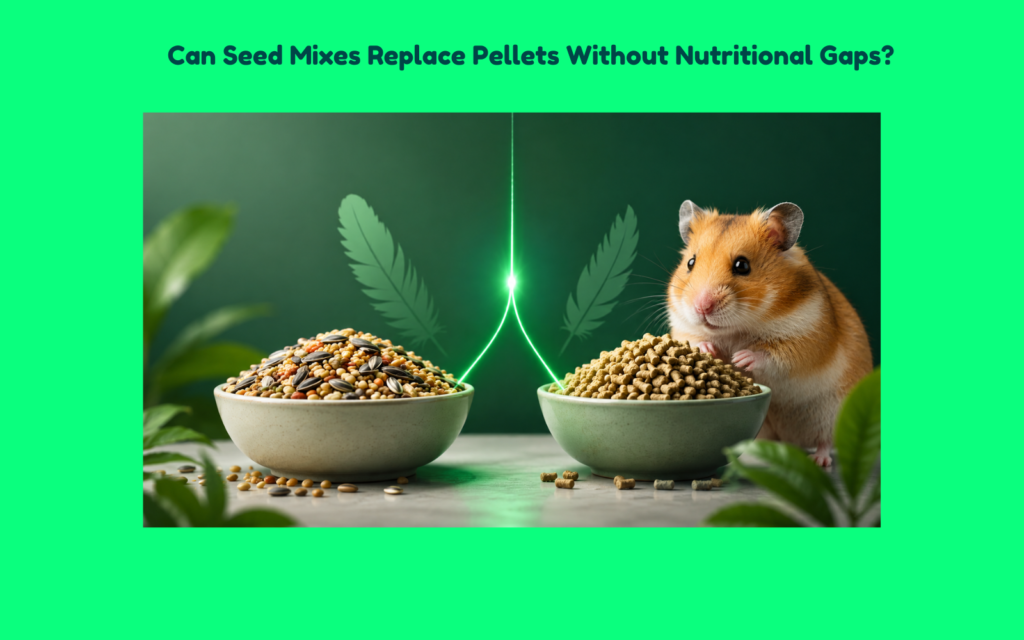
Can Seed Mixes Replace Pellets Without Nutritional Gaps?
Switching your pet entirely to a loose, varied diet sounds incredibly natural, but it quietly opens the door to severe, invisible nutritional gaps.
You look at those plain brown pellets and think they look boring. A bag of loose seeds, dried veggies, and grains looks like a feast. Foraging is fantastic for their mental enrichment. But letting your hamster completely drop their uniform base diet is highly dangerous.
Think of it like throwing away your daily multivitamin to live entirely on handfuls of trail mix. You get plenty of energy. But you have absolutely no guarantee you hit your baseline iron or calcium targets for the day.
We are going to break down exactly how loose diets allow your pet to cheat their macros, why natural seeds alone cannot hit trace vitamin targets, and how to safely put the balance back into their bowl.
Why does the seed mix format inherently risk severe nutritional gaps when used as a complete replacement?
The strict biological reality is that this loose, varied dietary category inherently allows for selective eating, meaning your hamster will naturally pick out high-fat items and leave behind the pieces required to maintain their core daily nutrition.
Relying solely on this physical format fundamentally disrupts the guaranteed macronutrient baseline that uniform blocks are designed to lock in. Hamsters are biologically wired to hoard the most calorie-dense, high-fat items first. It is pure survival instinct.
If you force a hamster to eat a perfectly balanced pellet, they get everything they need. Hand them a bowl of loose seeds, and they instantly eat all the fatty peanuts. They leave the protein-rich grains behind. Over time, this selective feeding quietly creates nutritional gaps driven by pellet rejection and seed preference.
How do loose foraging blends compare to extruded blocks in delivering daily macronutrient balance?
There is a massive physical difference between how a hamster’s body processes a mathematically precise block versus how it handles an independently sorted meal.
When they consume a mathematically precise laboratory block, the format delivers a steady, predictable stream of protein and carbohydrates. Every single bite works to fuel their body evenly. Loose foraging blends are completely different.
The daily macro intake becomes highly erratic and unpredictable. On Monday, they might eat mostly fat because they dug out the sunflower seeds first. On Tuesday, they might eat mostly carbs. Their metabolism is left constantly guessing, and that daily instability quietly chips away at their overall health.
Daily Macronutrient Stability Comparison
What specific micronutrient gaps occur when the whole-seed category is used as a total replacement format?
Beyond just proteins and fats, this unfortified, natural food category physically cannot independently supply the guaranteed levels of trace minerals required for daily survival.
The whole-seed category simply lacks baked-in fortification. Yes, seeds have natural vitamins. But those amounts vary wildly based on the soil they grew in and how old the bag is.
Relying solely on this specific natural format creates immediate nutritional voids. You might start noticing a dull, thinning coat. Worse, they can suffer a dangerous drop in bone density because they are missing the stabilized calcium and Vitamin D that a pellet usually guarantees.
How do you fix dietary deficiencies caused by exclusively feeding a seed mix format?
If your pet is showing signs of macro-imbalance—like sudden obesity from eating only fats or muscle loss from missing protein—you have to safely reintroduce a stable, uniform food source.
The problem is obvious. Your hamster refuses to look at a brown pellet because they are addicted to picking through their loose seeds. To fix this, you need a strict portion-control strategy. You have to slowly phase the vital pelleted format back into the daily routine.
Start by mixing 75% seeds with 25% pellets. After a few days, move to a 50/50 split, and finally to 25% seeds and 75% pellets. But here is the most important part. You must wait until the bowl is completely empty before refilling it. This tough-love approach forces the animal to eat the balanced blocks without shocking their digestive system.
Phase 1
25% Blocks
Phase 2
50% Blocks
Phase 3
75% Blocks
How do you audit your feeding routine to verify seed mix replacement safety today?
You can actively protect your pet from invisible deficiencies by physically inspecting their food bowl and cross-referencing your loose food bag today.
The Bowl Check
Physical Indicator in the Bowl: A bowl that looks “empty” at a glance but is actually lined with untouched oat groats, millet, or plain pellets.
Nutritional Gap Created: The hamster is actively missing essential fiber and baseline protein.
Action: Stop topping off the bowl. Wait until they finish the less palatable grains.
The Label Check
Physical Indicator on the Bag: A bag that says “100% natural foraging mix” with an ingredient list containing only raw seeds and nuts.
Nutritional Gap Created: Complete absence of added trace vitamins, leading to calcium and iron voids.
Action: Check for words like “fortified” or “added vitamins.” If absent, the diet is incomplete.
Use this quick bowl and bag audit to identify exactly what your pet is missing, and begin integrating a high-quality pelleted block back into their diet to bridge those gaps.
Treating their loose mix as a wonderful supplement rather than a total replacement is a simple fix that actively protects their bone density and ensures long-term metabolic stability.
Sources & Clinical References
VITAL DISCLAIMER: The dietary transition strategies and nutritional guidelines outlined in this article are designed for general hamster welfare and husbandry. Always consult with a certified exotic veterinarian before making significant modifications to your pet’s diet, particularly if they are currently managing any pre-existing health, weight, or digestive conditions. This information is purely educational and does not replace professional veterinary diagnostics.