
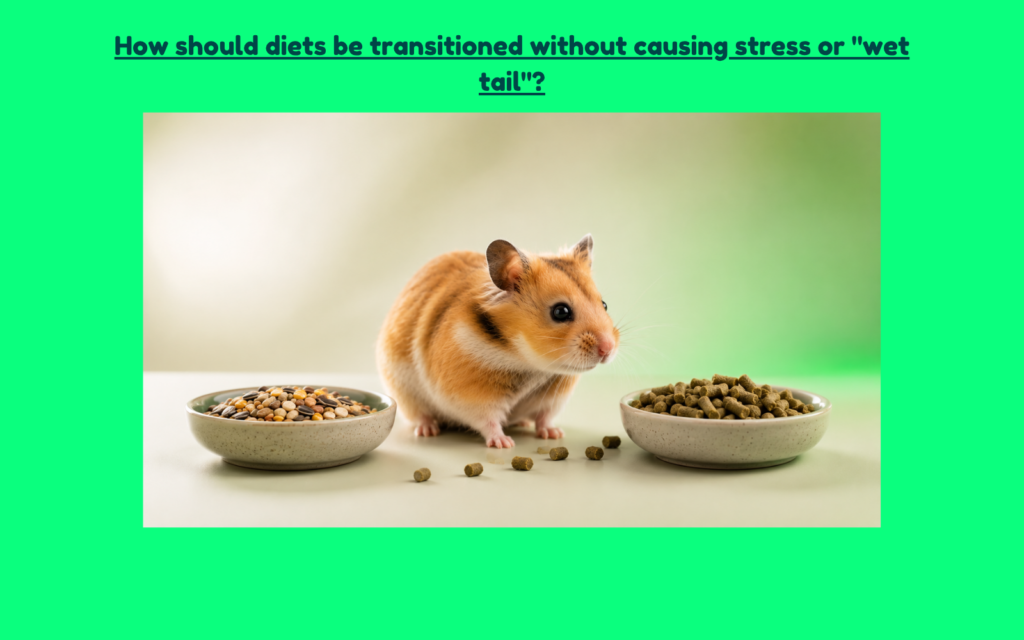
How Should Diets Be Transitioned Without Causing Stress Or “Wet Tail”?
Dumping a completely new food formulation into the bowl immediately violates the required pacing schedule, directly causing the exact transition problems you are trying to avoid.
We see it happen all the time. You bring home a bag of premium, high-quality food. You are excited to upgrade your hamster’s meals right away. So, you toss the old bag in the trash, fill the bowl with the new formulation, and assume you have done a good thing. But by rushing that process, you skip the vital formulation adaptation period entirely, shocking their digestive routine.
We are going to break down exactly how to step through the mixing phases, the physical techniques to stop them from picking out their favorite pieces, and how to execute a strict 14-day pacing schedule.
Think of it like driving a manual transmission car. You cannot jump straight from first gear into fourth without stalling the engine. You have to step through every mechanical ratio in between to keep things moving smoothly. A diet change works the exact same way.
Diagram 1: The gear progression illustrates the necessary step-by-step ratio changes from 75% old diet down to the 100% new formulation, physically preventing digestive stalling.
Why must diets be transitioned gradually to prevent the onset of stress or “wet tail”?
A safe formulation adaptation period requires strict schedule pacing, because abrupt food swaps are the exact trigger for the transition problems owners are trying to prevent.
You must strictly execute a gradually paced, multi-week blending phase before delivering a 100% new formulation.
The reasoning is purely physical. Your hamster’s digestive system is precisely calibrated to process their old food. When you decide to skip the schedule pacing, you introduce a sudden, significant environmental stress factor. Their system simply does not have the time to adapt to the new ingredients. This is exactly why identifying dietary factors that contribute to digestive instability is essential during any transition period.
Dumping a new formulation into the bowl immediately violates the pacing schedule, directly linking that abrupt physical shift to the onset of stress-related digestive complications. When considering how diets be transitioned safely, you have to prioritize the physical reality of their digestion over the desire for an instant upgrade.
How do you execute a daily ratio schedule when diets are transitioned without causing stress?
Pacing the dietary shift requires a strict daily schedule, physically blending the old and new foods through predetermined phases rather than an immediate swap.
A “cold turkey” food swap is a guaranteed failure. It disrupts everything. Contrast that harsh reality against the success of a structured, phased approach. When diets are transitioned without causing stress, you are physically measuring out the changes over two weeks.
The daily ratio schedule is straightforward. For the first few days, you need a strict mix of 75% old food and 25% new food. Once that phase is complete and they are eating normally, you shift gears to an even 50/50 split for the middle phase. A few days later, you step down to 25% old food and 75% new food in the final phase. Only after successfully holding that ratio do you ultimately reach the 100% new target formulation without rushing the timeline.
Diagram 2: A visual breakdown of the 14-day transition schedule, showing the progressive 25% shifts across three distinct phases before reaching the target diet.
What specific blending techniques ensure diets are transitioned successfully without selective feeding?
Just pouring the new food on top of the old food guarantees selective eating, instantly defeating the transition schedule you just planned out.
You have the ratios written down, but execution matters. If you just loosely layer new pellets on top of an old seed mix, your hamster will just pick out only the familiar, favored pieces. They will cheat the phase-in completely, and you will think the transition is working when they are actually just ignoring the new ingredients.
To fix this, you have to take control of the physical preparation. Start by measuring the exact grammage needed for that day’s ratio. Combine both portions into a separate sealed container. Give it a thorough, aggressive shake to guarantee an evenly homogenized mixture. Pouring that blended mix into the bowl creates an inescapable daily distribution, ensuring diets are transitioned exactly as you planned, bite by bite.
Diagram 3: A comparison of preparation methods. Layering allows for selective feeding, while physically homogenizing the mix in a sealed container ensures the exact planned ratio is consumed.
How do you fix an accelerated schedule error when failing to transition diets without causing stress?
If you rushed the timeline and notice the bowl is being ignored, you must immediately execute a strict schedule rollback and recalibrate your ratios to a safe baseline.
Mistakes happen. Sometimes you get impatient, skip the 50/50 middle phase entirely, and jump straight to 100% new food. Suddenly, the transition is failing, and the hamster is refusing to eat.
Here is how you execute the Transition Reversion Protocol to fix the pacing error. First, acknowledge that the timeline was rushed. Second, immediately revert the daily mix back to the last successfully verified baseline—often that means rolling back to the 75% old / 25% new mix. Third, physically hold that specific, corrected ratio for several days until their digestive routine stabilizes and they resume normal feeding. Finally, execute a formal correction in your feeding log, committing entirely to the slower, safer timeline to successfully transition diets without causing stress.
Diagram 4: The Transition Reversion Protocol. If the timeline is accelerated and the animal refuses food, the schedule must immediately rollback to the last verified phase to restabilize digestion.
How do you audit your current food inventory to begin transitioning diets safely today?
You can actively guarantee a safe pacing schedule by physically weighing your remaining supply of the old diet before you even open the new bag.
Before you start mixing phases, you need to prove you have enough raw materials to finish the job. A rapid-fire inventory audit prevents you from running out of the old food halfway through the plan, which forces the exact sudden swap you are trying to avoid.
- The 14-Day Supply Check: A full formulation blend requires roughly 14 days. Look at the remaining physical weight of the old base diet in the bottom of your bag. Place that old bag on a kitchen scale to physically verify you possess the necessary grammage to fulfill the changing mix ratios over two weeks without running out prematurely.
- The Mix Ratio Check: You have to maintain the 75%, 50%, and 25% splits across the entire schedule. If your audit reveals only a few scoops of the old food left, immediately pause your transition plan. You cannot execute the required schedule pacing with insufficient inventory.
This physical check is how you ensure transitioning diets goes according to the math.
Diagram 5: The Inventory Audit requires physically weighing the remaining old diet to verify a sufficient 14-day supply exists before opening the new formulation.
Perform this physical inventory audit today, and secure one final bag of the old food if your current reserve is too low to support a complete 14-day phase-in protocol.
Locking down your exact blending ratios and inventory weight is a practical step that physically prevents schedule disruptions and ensures a perfectly paced swap.