
How Do I Stop My Hamster From Only Eating Sunflower Seeds?
Assuming your pet will naturally balance their own diet ignores the physical reality that unrestricted access to high-fat seeds completely ruins their standard daily nutrition.
It is a common living room scenario: you check the enclosure, see a bowl full of untouched base pellets, and realize every single sunflower seed is gone. This is not an emotional quirk; it is a practical feeding issue requiring a routine adjustment.
Think of the bowl this way: if you give a child a box of cereal with marshmallows, and continuously refill the box every time the marshmallows run out, the healthy grains are never consumed. We are going to break down exactly why continuously ‘topping off’ the bowl ruins their diet, how to execute a strict bowl-depletion cycle, and the exact steps to physically limit the seeds in your mix today.
Why must you intervene to stop your hamster from only eating sunflower seeds?
Allowing a pet to survive exclusively on high-fat ingredients completely unbalances their diet, demonstrating the strict necessity of enforcing a consistent feeding routine.
The Physical Reality of the Bowl
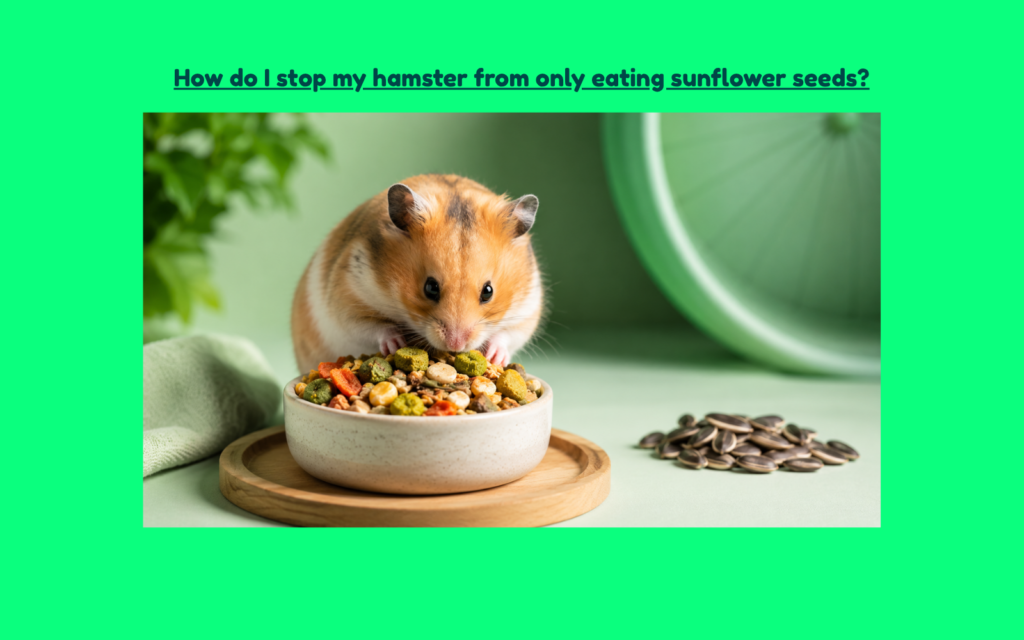
When you look into the enclosure, a bowl can visually appear “full” while the most important parts of the standard daily mix are actually being entirely ignored. It is very easy to glance at a dish containing a small mountain of base pellets and assume your pet simply has enough food. However, upon closer inspection, you will often find that the bowl is only full because they have excavated all the high-value items, leaving the rest behind.
The common mistake is assuming that because there is food remaining in the dish, they are already full and just picking at their meal. In reality, they have just methodically picked out their absolute favorite, high-fat items and left the rest. Recognizing the difference between a bowl that contains food and a bowl that is actually being used correctly is the first step.
Sunflower seeds contain high amounts of fat. Unrestricted access means the highly nutritious parts of the mix are entirely ignored. If the base pellets are piling up day after day while the seeds vanish in minutes, the diet is broken. Beyond reinforcing selective eating habits, consistently consuming large amounts of sunflower seeds can raise concerns about their long-term impact on body condition and weight management. You must step in to stop a hamster from only eating sunflower seeds so they do not miss out on the rest of their food.
Rule: Do not refill a bowl simply because the favorite pieces are gone.
Reason: Continuous refills teach the animal to wait for the best parts, guaranteeing permanent selective eating.
Example: A bowl that still has base pellets is not an empty bowl, and adding new seeds only reinforces the habit of ignoring the pellets.
How do you use a bowl-depletion cycle to stop constant selective eating?
Fixing a selective eating habit requires limiting the continuous availability of new high-value seeds to give the hamster a chance to use the remaining pellets in the bowl.
Chart Explanation: This flowchart outlines the daily decision-making process. It highlights the critical evening phase where the owner must observe the leftover base pellets and consciously decide to withhold a refill until the bowl is truly empty.
A continuously ‘topped-off’ strategy guarantees permanent selective eating. By constantly providing fresh seeds, you remove any reason for them to finish the rest of their meal. In contrast, a strict bowl-depletion cycle ensures the entire standard daily mix is consumed before a refill occurs. You must wait until the bowl is actually empty to stop the constant selective eating.
The Practical Routine Walkthrough
Implementing a strict schedule is a highly physical task. Start by checking the bowl in the morning. Note exactly what is left. Check it again in the evening before you even touch your food bag. You must actively determine whether new food should actually be added for the next feeding.
Too often, owners refill the bowl simply based on daily habit—a scoop goes in every night at 8 PM, regardless of what is currently sitting in the dish. This automatic refilling is exactly what causes the problem. By shifting your focus from an automatic schedule to observing the actual physical condition of the dish, you force the bowl-depletion cycle to work. Do not refill until the base pellets are gone.
How do you physically reduce the sunflower seeds in your standard daily mix?
You must physically limit the high-fat seeds in your commercial mix, deliberately reducing the amount before serving.
Chart Explanation: This diagram breaks down the manual intervention required before serving. It shows the physical separation of a commercial bag into two distinct categories: the standard base pellets that go into the enclosure, and the high-fat sunflower seeds that must be removed and strictly reserved.
This is a real, tactile task you can do in your kitchen right now. Take your standard daily mix and pour a portion out onto a flat tray or a clean counter. Visually identify the sunflower seeds scattered throughout the mix.
Physically separate the seeds from the rest of the mix and store the removed seeds in a separate container before serving. These separated seeds should only be used occasionally. By deliberately controlling the volume before it even enters the enclosure, you actively reduce the sunflower seeds available to be sorted in the first place.
How do you fix the routine when your hamster refuses to eat their base pellets?
Correcting a severe sorting habit requires implementing a strict dietary reset to break the preference for high-fat seeds and get them using the rest of the food in the bowl again.
The Selective Feeding Reset Protocol
1. Leave the base pellets in the bowl.
Do not throw away the untouched base pellets just because the seeds are gone. They are perfectly fine. Leaving them there establishes that the current meal is not yet finished.
2. Strictly withhold all new high-value seeds for 48 hours.
Do not panic and drop a seed in just because the bowl looks untouched. You must enforce a pause. By withholding new seeds, you remove the constant supply of high-fat items that sustains the sorting habit.
3. Visually verify the physical consumption of the remaining balanced food.
Actively observe the dish. You are waiting to see the physical pile of base pellets finally start to shrink. Patience is entirely required here; do not intervene until you see physical evidence that the pellets are being consumed.
4. Update your daily routine and note the adjustment in your simple feeding log to ensure you don’t over-serve seeds tomorrow.
Once the bowl is actually empty, you can resume normal feeding, but use your simple feeding log to track exactly how much you are serving. This ensures you do not immediately restart the cycle of over-serving high-fat items.
How do you audit your current feeding dish to verify if selective eating is happening today?
You can definitively identify a feeding error right now by physically inspecting your current food bowl to verify the exact amount of consumed seeds versus untouched base ingredients.
The Refill Habit Check
Observation: You approach the enclosure at your normal feeding time and notice the bowl still has a layer of base pellets, but no visible seeds.
Common Mistake: The trap is assuming the bowl is empty simply because the favorite foods are gone, and proceeding to dump a fresh scoop of the standard daily mix directly on top of the old pellets out of pure habit.
Correction: Stop the physical habit of refilling too early. You must actively check the remaining pellets and decide to skip the refill until those pellets are gone.
Quick-Reference Audit Checklist
- Target feeding error: Constant selective eating.
- Visual indicator: Dish containing exclusively untouched pellets while all sunflower seeds are missing.
- Required modification: Executing the strict bowl-depletion cycle immediately.
- Action to take: Physically remove excess sunflower seeds from your current reserve bag to prevent future sorting.
Perform this physical audit today to verify your bowl, and physically remove excess sunflower seeds from your reserve bag to prevent future sorting. Execute this feeding intervention immediately.
Conclusion
Bowl observation and routine are the ultimate keys to success. Base pellets should not be ignored, and sunflower seeds should not be allowed to dominate the mix.
By implementing a strict bowl-depletion cycle and physically removing excess seeds from the daily mix, you take direct control of what goes into the enclosure. Simple, practical consistency solves the problem.
You have the exact tools needed to manage your physical feeding routine and stop selective sorting today.
Disclaimer
The routine adjustments and strict bowl-depletion cycles detailed in this guide are intended exclusively for managing the standard physical sorting behaviors of adult hamsters. This information is purely educational and focuses entirely on physical feeding routines and visual observation. It is not a substitute for professional, hands-on evaluation. Always ensure your pet has continuous access to fresh water while implementing any physical changes to their daily feeding schedule.