

Should I Mix Higgins Sunburst With Mazuri Blocks? A Dietary Evaluation
Higgins Sunburst and Mazuri Blocks differ in physical format, ingredient composition, and reported nutrient profile. Whether combining them is appropriate depends on the exact current products, the proportion used, hamster-specific nutritional evidence, and what the hamster actually consumes.
No universal mixing ratio should be assumed. A mathematically estimated mixture is not the same as actual nutrient intake, and guaranteed-analysis values may be minimums or maximums rather than exact nutrient concentrations.
A block does not automatically “balance” a seed mix, and a seed mix does not automatically “improve” a block diet. The offered ratio can also differ from the consumed ratio if the hamster selectively eats, caches, refuses, or relocates components.
Evaluate:
- current product formulations
- current guaranteed analyses
- physical feeding formats
- the calculation basis for any proposed ratio
- ratio-dependent nutrient estimates
- hamster-specific nutritional evidence
- species-specific differences where relevant
- selective intake
- unequal consumption of seed-mix and block components
- practical feeding-management burden
Avoid giving a predetermined ratio because: the feeding decision must follow verified product data and hamster-specific evidence.
Avoid presenting a calculated nutrient percentage as actual intake because: the hamster may not consume both products in the same proportion they were offered.
How Do the Physical and Formulation Characteristics of Higgins and Mazuri Products Differ?
Before evaluating the combination, evaluate each product separately.
Keep three evidence layers distinct:
Physical structure = what the hamster is presented with
Formulation = what the product contains
Actual intake = what the hamster consumes
These are related, but they are not interchangeable.
Where the current product supports this description, Higgins Sunburst may present multiple visibly distinct components such as seeds, grains, and other ingredients. That heterogeneous format can create more opportunity for component-level selection, but it does not prove nutritional imbalance.
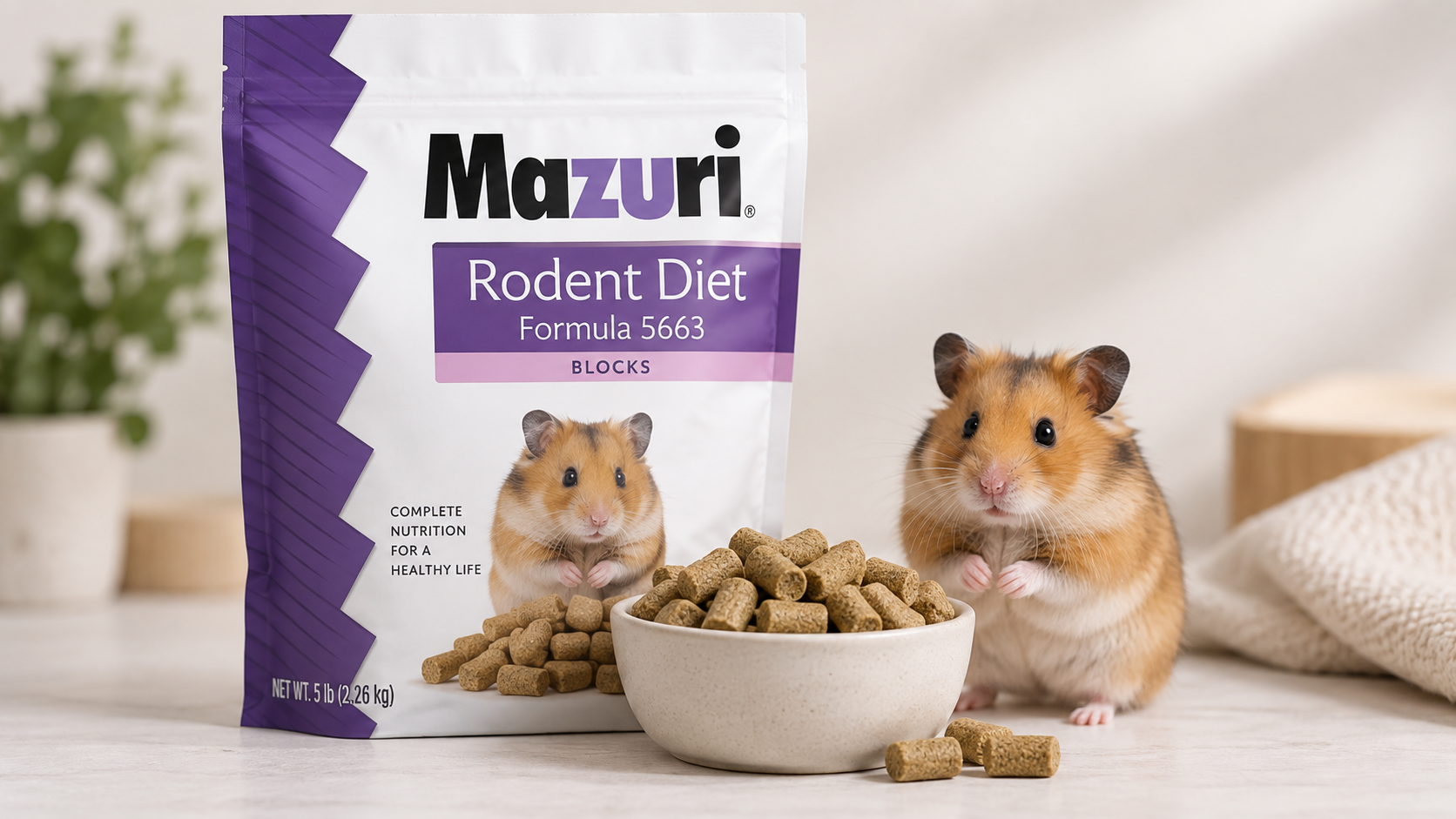
Relevant variables include:
- current product name
- visible component types
- ingredient list
- protein, fat, fiber, and moisture declarations
- protein, fat, and fiber sources
- fortified nutrients
- feeding directions
Do not infer nutrient adequacy or inadequacy from visible variety alone.
Where the current product supports this description, Mazuri Blocks may use a more uniform block-style presentation. A uniform block can reduce visibly distinct component choices within that product, but uniformity does not independently prove nutritional completeness.
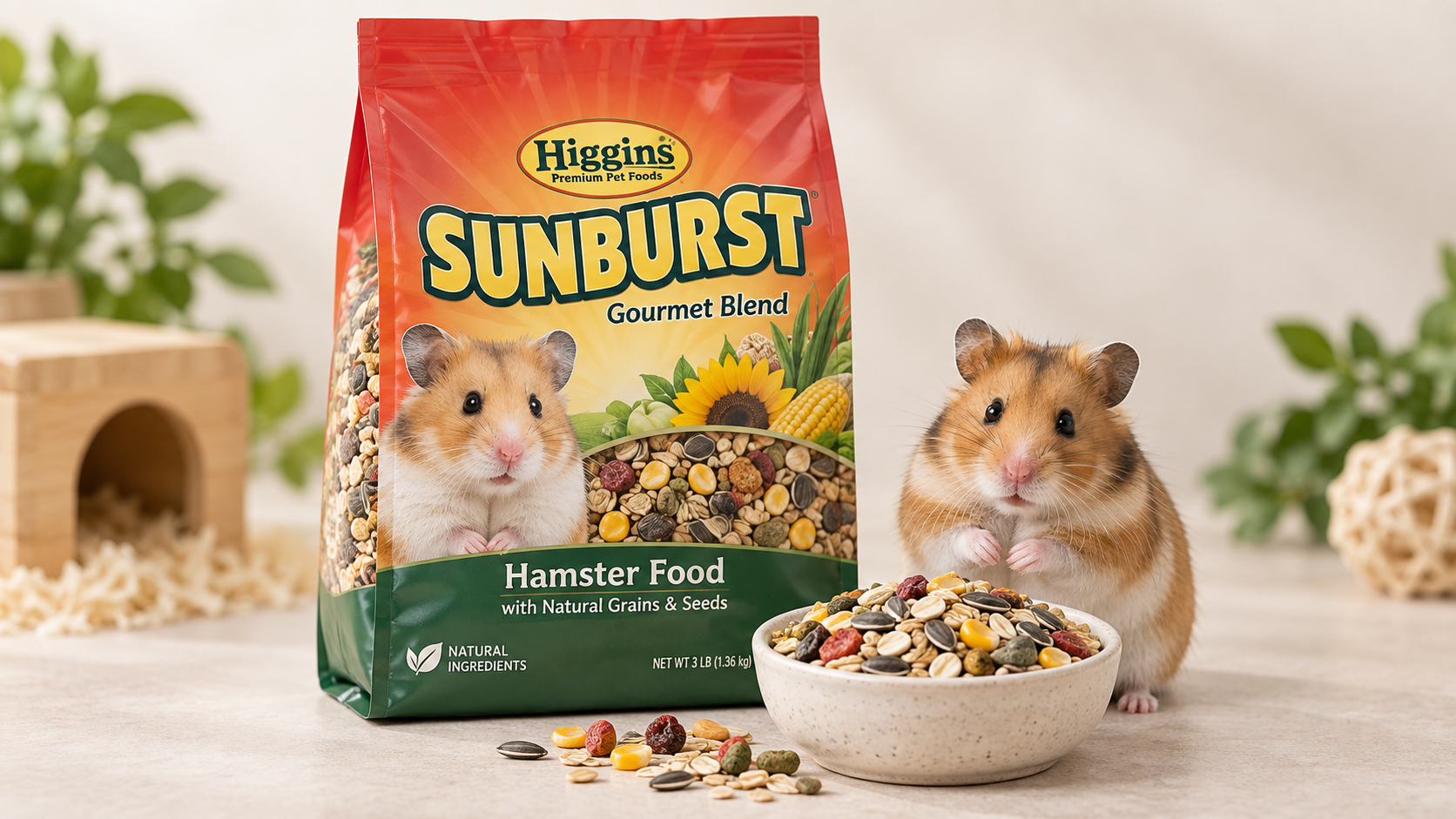
Before deciding whether to mix the two products, first verify whether the specific Mazuri Rat & Mouse block is suitable for hamster feeding.
Relevant variables include:
- current product name
- block size and physical structure
- ingredient list
- protein, fat, fiber, and moisture declarations
- protein, fat, and fiber sources
- fortified nutrients
- feeding directions
Refusal, pouching, caching, and incomplete consumption can still occur with a uniform product.
Use this sequence:
Product identity → physical format → ingredient composition → guaranteed analysis → hamster-specific relevance
Do not begin with:
seed mix + block = complementary diet
Complementarity must be demonstrated rather than assumed.
How Do Mixing Proportions Change the Combined Nutrient Profile?
A candidate ratio can only be interpreted if its basis is defined.
Before calculating any ratio, establish:
- 1. the exact products
- 2. the current reported nutrient values
- 3. whether each value is a minimum, maximum, or exact analytical figure
- 4. the ratio basis
- 5. whether both product values are expressed on a comparable basis
- 6. the limits of the calculation
Do not calculate from an undefined “50/50,” “60/40,” or similar ratio.
For a mass-based ratio, an explicitly weighted estimate can be used only where the underlying values are comparable.
Estimated combined nutrient value = proportion of Product A × reported value A + proportion of Product B × reported value B
This produces an estimate based on reported values. It does not necessarily describe the hamster's actual nutrient intake.
Do not convert minimum crude protein into exact protein, minimum crude fat into exact fat, maximum crude fiber into exact fiber, or maximum moisture into exact moisture.
Do not fabricate carbohydrate percentage, sugar percentage, metabolizable energy, digestible energy, amino-acid adequacy, calcium-phosphorus balance, or micronutrient intake without appropriate data.
Use this sequence:
Current label data → ratio basis → weighted estimate or bound → uncertainty → hamster-specific comparison
Avoid false precision because: guaranteed-analysis declarations often represent boundaries rather than exact composition.
| Mixing Proportion | Estimated Combined Nutrient Values / Bounds | Evidence-Supported Relevance |
|---|---|---|
| Candidate ratio — basis stated | Calculate from comparable current product data and preserve minimum/maximum constraints. | Compare with hamster-specific evidence without treating the estimate as exact intake. |
| Higher Higgins proportion | Recalculate each relevant nutrient using the same ratio basis. | Evaluate the resulting profile instead of assuming more seed mix is better or worse. |
| Higher Mazuri proportion | Recalculate each relevant nutrient using the same ratio basis. | Evaluate the resulting profile instead of assuming more blocks automatically improves the diet. |
| Ratio with unclear basis | Nutrient estimate is not reliably interpretable. | Define the basis before drawing a dietary conclusion. |
| Ratio with unequal component consumption | The theoretical offered profile may differ from effective intake. | Interpret the diet from actual consumption patterns where they can be established. |
The matrix is an analytical framework, not an “ideal ratio” generator.
How Do the Reported Nutrient Profiles of Higgins Sunburst and Mazuri Blocks Compare?
| Current Label Variable | Higgins Sunburst | Mazuri formula 5663 | Interpretation Limit |
|---|---|---|---|
| Physical format | Heterogeneous blend | Large block pellet | Format alone does not establish adequacy. |
| Crude protein | 15.0% minimum | 23.0% minimum | Minimum guarantee, not exact concentration. |
| Crude fat | 7.0% minimum | 6.5% minimum | Minimum guarantee, not exact concentration. |
| Crude fiber | 9.5% maximum | 6.0% maximum | Maximum guarantee, not exact concentration. |
| Moisture | 11.5% maximum | 12.0% maximum | Maximum guarantee, not exact concentration. |
| Product identity caution | Current Hamster & Gerbil Sunburst | Assumes “Mazuri Blocks” means formula 5663 | Confirm the exact Mazuri product before calculations. |
Use current first-party data and compare equivalent declarations only.
Potential variables include:
- crude protein
- crude fat
- crude fiber
- moisture
- other guaranteed nutrients where relevant
- energy information where valid and comparable
- major ingredients
For each value, identify whether it is a minimum, maximum, exact declared value, or unavailable.
Do not infer missing nutrient percentages from the ingredient list.
Avoid declaring one product nutritionally stronger from a single percentage because: dietary suitability cannot be reduced to one label value.
How Do Mixing Proportions Defined on a Consistent Basis Alter the Estimated Combined Nutrient Profile?
If analytical examples such as 70:30 by product mass or 50:50 by product mass are modeled, they should be labeled clearly as examples, not feeding prescriptions.
For every candidate proportion:
- 1. identify the proportion
- 2. state the basis
- 3. identify the product values used
- 4. perform the weighted estimate
- 5. label the result as estimated
- 6. retain guaranteed-analysis uncertainty
- 7. compare with hamster evidence separately
Do not switch between weight, cups, scoops, tablespoons, and individual pieces within one comparison.
Keep the distinction:
Offered ratio → theoretical estimated profile
versus:
Consumed ratio → effective intake
Avoid treating the theoretical mixture as the consumed diet because: hamsters may consume components unequally.
How Do Ratio-Dependent Results Compare With the Best Available Hamster-Specific Evidence?
For every benchmark or study, preserve:
- hamster species or population
- life stage
- study purpose
- diet type
- nutrient definition
- whether the value is a requirement, recommendation, experimental level, or observed formulation
- applicability to companion hamster husbandry
Do not convert one laboratory value into a universal pet-hamster target.
Do not assume Syrian-hamster findings apply identically to dwarf hamsters, or that one dwarf taxon represents all dwarf species.
Classify comparisons as broadly consistent, potentially inconsistent, uncertain, or not comparable where appropriate.
Avoid creating a false pass/fail threshold because: available evidence may be context-specific and incomplete.
What Formulation and Feeding-Behavior Considerations Apply to the Combined Diet?
The theoretical nutrient calculation is only one layer of the decision.
The next question is:
What happens when the hamster encounters and consumes the combined physical diet?
Relevant variables include:
- distinct food components
- different textures and sizes
- individual preference
- component selection
- refusal
- pouching
- caching
- unequal consumption
- leftovers
- changes in effective nutrient intake
Do not infer actual intake from the prepared bowl mixture.
Use this sequence:
Offered mixture → component choice opportunity → observed consumption → effective intake → dietary relevance
Avoid assuming mathematical mixing guarantees nutritional mixing because: the hamster determines the consumed ratio through actual food selection.
Avoid assuming the blocks prevent selective intake because: seed and block components remain physically distinguishable when combined.
How Do Mixing Formats Relate to Selective Feeding?
Selective feeding should refer to repeated preferential consumption of some available components while others are left.
Separate:
opportunity for selection
from:
observed selective intake
from:
nutritional consequence
Potential observations include repeated seed-component selection, repeated block avoidance, repeated seed avoidance, component-specific leftovers, pouching differences, and caching that complicates interpretation.
Do not diagnose selective feeding from a single bowl check.
Avoid saying the mixture prevents pickiness because: combining formats does not remove component-level choice.
Avoid saying mixed feeding automatically causes nutritional imbalance because: the actual consumption pattern and nutritional consequence must be demonstrated.
Does Unequal Consumption of Components Change the Effective Nutrient Intake?
Keep these definitions separate:
Offered ratio = proportion placed into the feeding environment
Consumed ratio = proportion actually eaten
Effective nutrient intake = nutrient exposure resulting from what is actually consumed
If one component is eaten disproportionately, the theoretical ratio-dependent estimate may not describe the actual diet.
Account for caching, pouching, hidden leftovers, component fragmentation, and food moved away from the original location.
Do not assume:
missing food = consumed
Use this sequence:
Offered ratio → observed component consumption → estimated consumed ratio where valid → effective nutrient interpretation
How Suitable Is the Higgins and Mazuri Combination for Hamster Feeding?
Suitability should be determined only after product verification, ratio modeling, evidence review, and actual feeding behavior are considered together.
Synthesize:
- current Higgins formulation
- current Mazuri formulation
- reported nutrient profiles
- candidate ratio estimates
- guaranteed-analysis limitations
- hamster-specific evidence
- species-specific applicability
- selective feeding where actually observed
- actual component consumption
- management burden
- remaining uncertainty
Use this sequence:
Verify products → evaluate individual formulations → evaluate candidate ratio → compare with evidence → evaluate actual intake behavior → determine practical suitability
Evidence-derived conclusions may include:
- the combination is reasonable under specific conditions
- one candidate proportion is more defensible than another
- no ratio can yet be recommended confidently
- the mixture creates a management issue that reduces practical suitability
- either product alone may be simpler under some conditions
- available evidence is insufficient to establish the combination as a primary diet
Do not force yes, mix them or no, never mix them unless the completed evidence review supports that result.
Avoid declaring the combination superior because: combining two formulas does not automatically produce a better diet.
What Are the Trade-Offs of a Blended Diet Compared With Single-Product Feeding?
Potential blended-diet considerations include:
- two distinct formulations
- ratio-dependent nutrient profile
- greater calculation complexity
- component-selection opportunity
- need to monitor actual intake
- uncertainty about consumed ratio
Potential single-product considerations include:
- simpler formulation interpretation
- simpler feeding implementation
- product-specific strengths or limitations
- fewer ratio calculations
- product-specific acceptance or refusal
Do not assume:
blend = more balanced
or:
single product = less complete
Use this chain:
Feeding strategy → formulation consequence → behavioral consequence → management burden → suitability
Which Feeding-Management Conditions Affect the Practical Suitability of the Combination?
Evaluate:
- ability to maintain a consistent ratio
- ability to measure on a defined basis
- acceptance of both products
- component-level selection
- caching
- uneaten components
- ability to monitor actual intake
- species-specific dietary concerns
- whether a genuine nutrient limitation has been identified
Do not automatically prescribe supplementation, component removal, extra protein foods, extra seeds, extra blocks, vitamins, or minerals to “correct” the combination.
Avoid using preference as a ratio-setting tool because: palatability and nutritional suitability are separate questions.
How Should You Establish a Feeding and Observation Routine for the Selected Combination?
Treat implementation as a monitoring framework, not a fixed recipe.
Track:
- exact products used
- chosen ratio
- ratio basis
- measurement consistency
- amount offered where evidence supports it
- component consumption
- leftovers
- pouching
- caching
- changes in acceptance
- actual consumed ratio where reasonably assessable
- body weight or body condition where appropriate
- species-specific observations
Do not invent universal daily grams, scoop ratios, tablespoons, transition periods, weighing schedules, percentage-weight thresholds, or maximum leftover amounts.
Use this sequence:
Verify products → define ratio basis → prepare consistently → offer → observe component intake → account for caching → compare actual intake with theoretical assumptions → reassess where needed
Avoid changing the ratio frequently because: inconsistent implementation makes nutrient estimation and behavioral interpretation less reliable.
- Confirm that the Higgins product matches the exact current formulation evaluated.
- Confirm that the Mazuri product matches the exact current formulation evaluated.
- Verify current ingredient lists and guaranteed analyses before using calculated values.
- Define the mixing proportion explicitly.
- State whether the ratio is by mass, volume, or another valid basis.
- Use the same ratio basis consistently.
- Do not treat a sample calculation as a recommended feeding ratio.
- Record which components are offered.
- Observe whether the hamster accepts both product types.
- Note whether particular components are repeatedly selected or left.
- Account for pouching and caching.
- Do not assume missing food was consumed.
- Distinguish the offered ratio from the apparent consumed ratio.
- Reassess theoretical nutrient estimates if actual intake consistently differs from the offered mixture.
- Do not automatically add supplements or complementary foods.
- Keep species-specific evidence visible.
How Should the Selected Mixing Proportion Be Implemented Consistently Where Evidence Supports One?
Use a specific proportion only if the evidence review supports selecting one.
Specify the exact products, ratio, ratio basis, measuring method, calculation assumptions, and whether nutrient values are estimated or bounded.
Do not use ambiguous instructions such as “half and half,” “one scoop each,” “mostly Sunburst,” or “a little Mazuri” without a defined quantitative basis.
If no evidence-supported proportion can be selected, state that clearly rather than manufacturing one.
Avoid translating an analytical example ratio into a feeding prescription because: modeling a proportion and recommending it are separate evidence steps.
How Should Consumption Be Monitored for Selective Intake or Uneaten Components?
Track:
- components offered
- components visibly consumed
- components left
- components transported
- components cached
- repeated patterns across feedings
Do not classify selective intake from one observation.
Do not assume seed disappearance equals seed consumption, block disappearance equals block consumption, leftover blocks equal block refusal, or leftover seeds equal seed rejection without accounting for caching and transport.
Use this sequence:
Offer → observe → inspect leftovers → account for caching → identify repeated pattern → reassess effective intake
If selective intake materially changes the consumed ratio, the theoretical nutrient estimate may no longer represent the actual diet.
The Higgins Sunburst + Mazuri Blocks combination should not be treated as automatically balanced, necessary, or superior simply because it combines a varied seed mix with uniform blocks.
First verify the current formulations and guaranteed analyses of both products. Then define any candidate mixing ratio on a consistent basis, estimate only what the data permit, and compare those estimates with appropriately contextualized hamster-specific evidence.
Keep species differences visible.
Most importantly, separate the offered ratio from the consumed ratio. Selective intake, pouching, caching, refusal, or unequal consumption can make the theoretical mixture different from the effective diet.
Recommend a specific combination or ratio only if the complete evidence review supports it.
Avoid forcing a specific mixing prescription because: the strongest result may be ratio-dependent, behavior-dependent, species-specific, or limited by available nutritional evidence.
Evidence gaps remain marked with [TODO: SOURCE NEEDED] rather than being replaced with invented product data, ratio recommendations, nutrient targets, intake patterns, supplementation needs, or feeding amounts.