
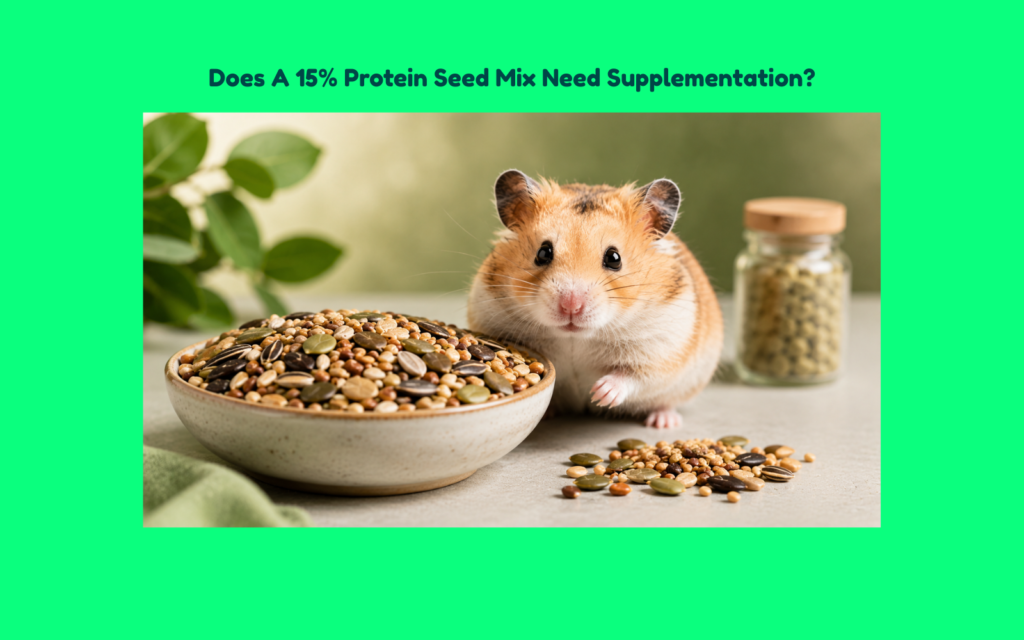
Does A 15% Protein Seed Mix Need Supplementation?
Assuming a 15% label is a universal solution completely ignores the fact that this specific printed label explicitly verifies the bag as a standard maintenance diet.
It happens all the time. You scoop out a reliable baseline diet but have absolutely no idea if that label is actually complete on its own. The reality is that 15% is not a guess. It is a strict maintenance label meant to safely verify a standard baseline.
We are going to break down exactly how to read the bag in your hands, how to verify if what the label is telling you actually demands additions, and how to check your guaranteed analysis panel before changing the bowl.
Think of a 15% diet like standard household paint. It is perfectly verified to cover a standard wall. But here is the catch. If you are painting a specialized surface, you have to read the can to verify if what the label is telling you indicates you need to add a primer first.
Why does a 15% label immediately identify a seed mix as a maintenance-only format?
A 15% baseline is the standard maintenance label, explicitly indicating that the bag is formulated to maintain stability rather than to serve as an unverified additive base.
You must physically verify what the bag is intended for before assuming the standard bag needs extra ingredients. The reason is simple. The 15% printed on the guaranteed analysis panel explicitly confirms it is built to keep a baseline stable.
Here is why that matters. Arbitrarily dumping high-protein treats into a verified 15% maintenance format ruins a perfectly good baseline. You disrupt the ratio the bag originally guaranteed.
Verified baseline stability level.
This demonstrates the strict necessity of reading the bag before altering the bowl. Recognizing your 15% protein seed mix as a complete base is the very first step. It is about understanding the core function of the bag before deciding if supplementation is required at all.
How do you verify the guaranteed analysis panel to confirm if a 15% protein seed mix needs supplementation?
Before you add anything to the dish, you must actively verify if the printed label actually misaligns with what the bag is intended for.
The urge to just eyeball a supplementary addition is strong. We see owners skip the fine print and just guess. Supplementing a bowl without checking what the label is telling you simply ruins a perfectly balanced diet. You end up stacking unverified nutrients on top of a base that was already stable.
Contrast that with taking ten seconds to read the guaranteed analysis panel first. Doing this ensures you only alter the 15% baseline when the printed label proves a physical addition is required.
This flow illustrates the verification process: label reading, checking for a mismatch, and then taking action.
It is exactly how you confirm if the supplementation needed for a 15% protein seed mix is real or just an assumption.
What label indications confirm you must supplement a 15% protein seed mix?
You have to verify your guaranteed analysis panel, as discovering a clear mismatch between your base bag and what the label is telling you acts as the strict trigger for re-evaluating the 15% format.
Finding a physical mismatch between the printed label and what the bag is intended for is the only valid trigger. This visual discrepancy tells you it is time to act.
You must strictly check the fine print before dropping or raising the protein. It is a strict visual check. This step definitively proves whether the maintenance-only format requires physical supplementation.
If the percentages on the back do not align with your specific situational needs, that visible gap is exactly what proves you require protein supplementation beyond a 15% protein seed mix.
How do you fix an unverified addition when attempting to supplement a 15% protein seed mix?
If you realize you started adding extras to the bowl without checking your guaranteed analysis panel first, you must immediately re-check your labels and isolate the base diet.
The scenario usually goes like this. You see a 15% label, assume it is “too low” based on internet rumors, and start dumping in high-protein treats without verifying a true label mismatch.
Here is how to fix it. First, isolate the 15% base diet entirely. Pull everything else back.
Second, physically verify the printed panel. If the baseline aligns with what the bag is intended for, acknowledge that additions are not actually necessary.
Third, immediately halt the unverified additives. Pull them out of the routine.
Finally, trust the 15% bag as the correct standalone maintenance base. Update your feeding routine to reflect this verified reality. This is the only safe way to supplement a 15% protein seed mix when you realize you skipped the initial label verification.
How do you audit your current pantry labels to safely execute this supplementation protocol today?
You can actively verify if you are prepared by physically inspecting your primary seed mix label and your current additive inventory today.
This audit flow outlines the two-step verification process.
The Maintenance Label Check
- Label Verification Target: Identifying your starting point.
- Guaranteed Analysis Indicator: Your primary bag reading exactly 15% crude protein on the back panel.
- Action: Acknowledge this is officially verified as a maintenance-only format, perfectly suitable as a standalone base unless what the label is telling you proves otherwise.
The Additive Verification Check
- Label Verification Target: Bridging an unverified label gap to verify whether additions are actually necessary.
- Physical Inventory Indicator: Checking your treat bins for pure, single-ingredient lean proteins versus unverified high-fat mixes.
- Action: If a label mismatch exists, verify your additive labels to ensure you are supplementing pure protein, not accidentally adding unverified ingredients.
You are now fully equipped to execute this supplementation protocol based on pantry verification rather than guesswork.
Perform this physical pantry verification today to check what the bag is intended for, and read your guaranteed analysis panel to see if extra ingredients are actually necessary before dispensing the next meal.
References
Important Nutritional Disclaimer
This guide is for educational purposes regarding food labeling, pantry audits, and nutritional verification only. It does not replace professional veterinary advice, diagnosis, or treatment. Every hamster has unique metabolic requirements based on age, activity level, and health status; always consult your veterinarian regarding your pet’s specific dietary needs. HamsterAtlas provides nutritional analysis guidance and does not offer individual veterinary medical recommendations.
Locking down your label reading and verifying your maintenance label is a practical step that helps keep the bowl perfectly aligned with what the label is telling you every single week.