
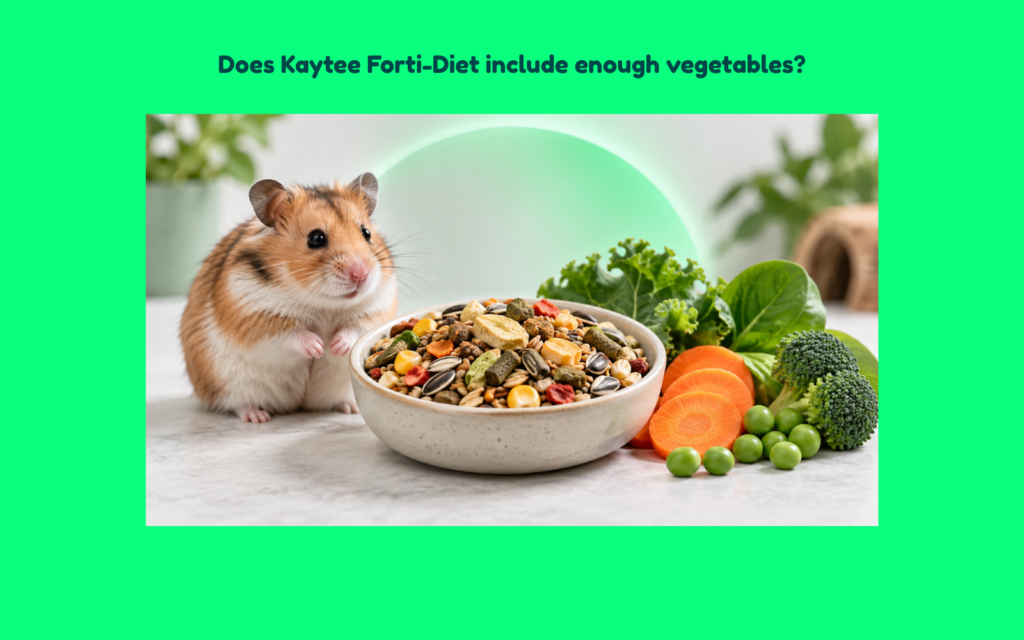
Does Kaytee Forti-Diet Include Enough Vegetables? A Dietary Evaluation
If the current verified Kaytee Forti-Diet formulation lists vegetable-derived ingredients, their presence alone does not establish their quantity, exact nutrient contribution, or whether the product contains “enough” vegetables.
The answer depends on the current formulation, which vegetable-derived ingredients are actually present, whether their quantities are disclosed, what the whole-product guaranteed analysis reports, what hamster-specific evidence defines as a meaningful dietary criterion, and whether fresh vegetable supplementation is supported by the evidence and feeding context.
- Vegetable ingredients being listed does not establish how much vegetable material the food contains.
- Ingredient order is not an exact percentage declaration.
- Guaranteed analysis describes the product as a whole.
- Guaranteed analysis does not normally identify how much protein, fiber, vitamins, or other nutrients came specifically from vegetable ingredients.
- “Contains vegetables” does not automatically mean “nutritionally adequate.”
- A small number of named vegetables does not automatically mean “nutritionally deficient.”
- Fresh vegetables should not automatically be added merely because dehydrated ingredients differ physically from fresh produce.
- No fixed vegetable percentage, serving volume, or supplementation frequency should be invented.
Avoid answering the H1 from ingredient count alone because: the query asks about dietary adequacy, not merely whether vegetable names appear on the label.
Avoid treating fresh supplementation as the default correction because: supplementation is a separate dietary-management decision that requires its own evidence.
Citations: Kaytee
Citations: NRC · Merck · RSPCA
Citations: RSPCA · PetMD · PetMD Dwarf Hamster
Citations: NRC · Merck · RSPCA
Current formulation → vegetable ingredients present → quantitative disclosure → hamster dietary evidence → supplementation decision
What Vegetable Ingredients Are Present in the Kaytee Forti-Diet Formulation?
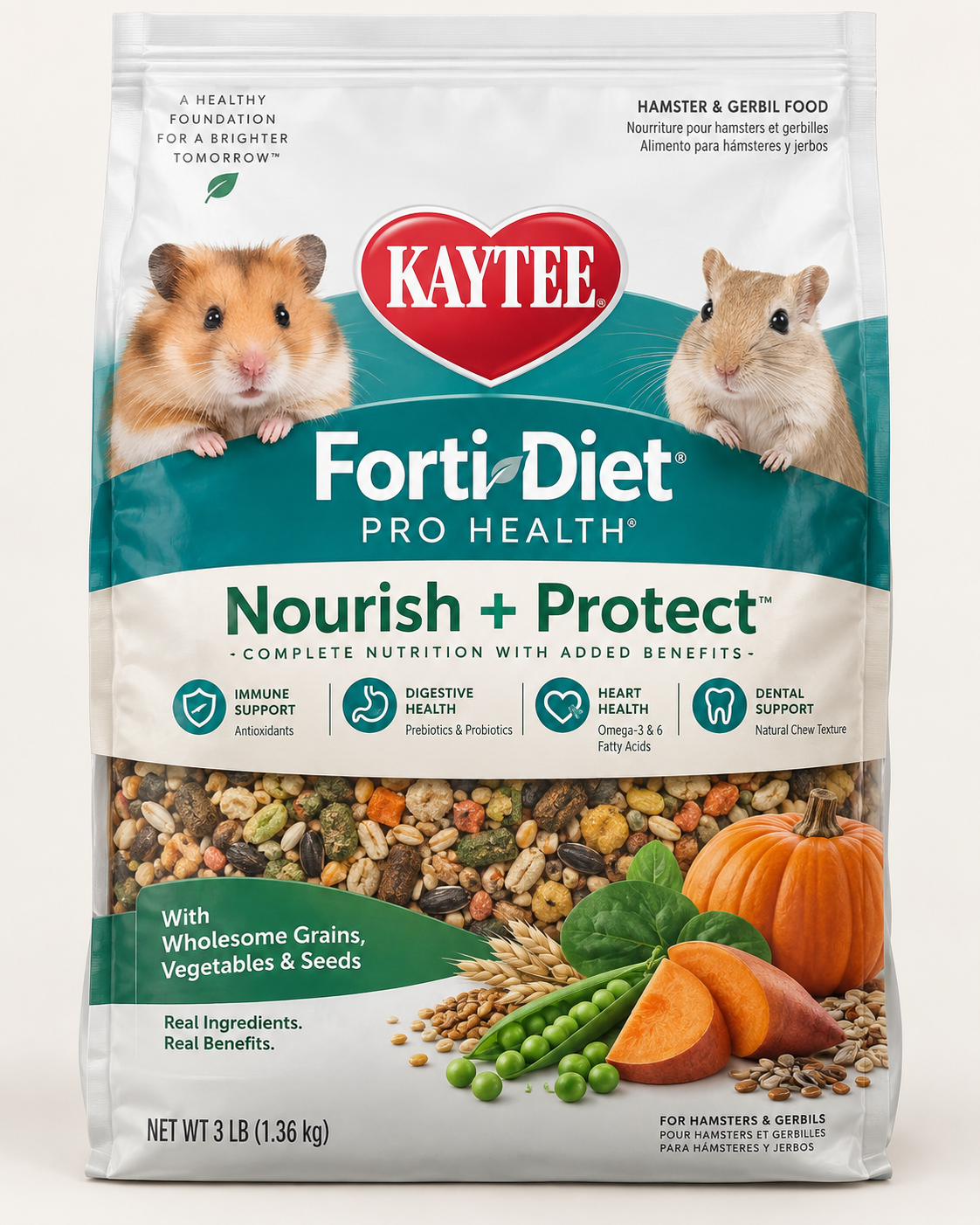
Start with the current official ingredient list and identify only vegetable-derived ingredients that are actually present in the verified formulation.
For each identified ingredient, establish where possible:
- exact label wording
- physical form
- whether it is dehydrated, dried, meal, flake, powder, or another form
- where it appears in the ingredient list
- whether the manufacturer discloses an inclusion percentage
- whether its individual nutrient contribution is disclosed
Do not invent percentage inclusion, fresh-weight equivalent, vitamin contribution, mineral contribution, fiber contribution, caloric contribution, or sugar contribution from ingredient-list presence alone.
Ingredient name = evidence of presence
Ingredient order = relative predominance by formulation weight under labeling rules, where applicable
Ingredient percentage = unknown unless disclosed
Nutrient contribution = unknown unless quantitatively supported
Then distinguish the commercial ingredient form from fresh produce. Potential physical differences may include water content, texture, concentration by weight, storage characteristics, handling, and feeding presentation.
Avoid saying dehydrated vegetables are nutritionally equivalent to fresh vegetables because: equivalent nutrient delivery has not been established merely from ingredient identity.
Avoid saying dehydrated vegetables are nutritionally inferior because: dehydration itself does not establish the overall dietary value of the final commercial formulation.
Citations: Kaytee
Citations: AAFCO Labels · AAFCO Ingredients
Current ingredient label → vegetable-derived ingredient identified → physical form established → quantitative disclosure checked → allowable inference
Do not move directly from vegetable listed → enough vegetables.
Is Vegetable Inclusion a Relevant Criterion for Hamster Diet Adequacy?
Before judging Kaytee Forti-Diet’s vegetable content, determine what the nutritional evidence actually requires.
- a required vegetable percentage
- a required daily quantity of vegetables
- a required number of vegetable types
- a defined role for fresh vegetables
- a defined role for plant-derived nutrients
- a general recommendation for supplementary fresh produce
- no formal vegetable-inclusion threshold
Keep nutrient requirement, food-based husbandry recommendation, manufacturer feeding guidance, and common feeding practice separate.
Do not convert a food-based recommendation into a nutrient requirement. Do not convert evidence that hamsters can consume suitable vegetables into proof that every commercial diet must contain a certain vegetable percentage.
Hamster-specific evidence → actual adequacy criterion → relevance of vegetable inclusion → product evaluation
Avoid inventing a vegetable threshold because: nutritional adequacy may be defined through total nutrient supply rather than a specific ingredient category.
Citations: NRC
Citations: RSPCA · Merck
| Vegetable Source | Nutritional / Formulation Consideration | Evidence-Supported Relevance for Hamsters |
|---|---|---|
| Verified vegetable-derived ingredient in Kaytee Forti-Diet | Ingredient presence is established, but quantity may not be disclosed. | Do not equate presence with adequate inclusion or meaningful nutrient contribution without quantitative evidence. |
| Dehydrated vegetable ingredient | Lower moisture than fresh produce; processing or form may differ. | Physical form alone does not establish superiority, inferiority, or equivalence. |
| Fresh suitable vegetable | Adds a separate food item with different moisture and physical characteristics. | Evaluate as supplementation rather than proof that the baseline commercial diet is deficient. |
| Ingredient with no disclosed inclusion percentage | Exact amount remains unknown. | Do not estimate vegetable percentage from list position alone. |
| Whole-product guaranteed-analysis value | Describes the commercial formulation as a whole. | Do not attribute the value specifically to vegetable ingredients without formulation data. |
| Evidence with no vegetable-inclusion threshold | Cannot establish a required percentage from that source. | Preserve uncertainty rather than creating a target. |
Do not turn this matrix into Commercial vegetables = insufficient / Fresh vegetables = better.
Source/form → what is known → what remains unknown → dietary relevance
Does Hamster-Specific Nutritional Evidence Define a Vegetable-Inclusion Threshold?
Search specifically for evidence that establishes a threshold rather than assuming one exists.
- a defined quantitative vegetable recommendation exists
- only qualitative vegetable guidance exists
- relevant nutrient requirements exist but not ingredient-specific vegetable requirements
- species-specific recommendations differ
- evidence is insufficient to define a threshold
If no direct threshold exists, state that clearly.
Do not manufacture minimum vegetable percentages, grams per day, teaspoons per day, daily piece counts, or weekly vegetable quotas from unrelated nutrient data.
Avoid treating a nutrient as proof that a specific food category must supply it because: multiple dietary ingredients may contribute the same nutrient.
Citations: NRC
Does Nutritional Adequacy Rely on Whole Formulation Rather Than Specific Ingredients?
Evaluate whether dietary adequacy is determined from overall nutrient profile, digestibility where available, protein quality, fat contribution, fiber, micronutrients, energy, life stage, total formulation, and actual intake rather than a simple ingredient checklist.
Do not state that whole-formulation analysis proves Kaytee Forti-Diet is adequate. The narrower task is to determine which evidence standard should be used to judge adequacy.
ingredient-category presence versus nutritional adequacy
Avoid ingredient-list scoring because: the number or prominence of recognizable ingredients does not independently establish nutrient adequacy.
Citations: NRC
What Can Be Inferred Regarding the Nutritional Contribution of Included Vegetables?
This section asks a narrower question: What can the label actually prove?
The ingredient list may establish presence, identity, formulation order where labeling conventions apply, and a physical descriptor where included in the ingredient name.
It may not necessarily establish exact percentage, exact nutrient contribution, exact serving contribution, or exact fresh-weight equivalent.
Guaranteed analysis may establish current whole-product guarantees for specified nutrients.
It does not automatically establish which ingredient supplies each nutrient, how much fiber or protein comes from vegetables, how much vitamin content comes from vegetables, or how much of the formula consists of vegetables.
Where available, quantitative formulation or laboratory data may support stronger ingredient-specific conclusions. Do not imply such data exist unless they are actually obtained.
Label statement → scope of statement → allowable inference → unsupported inference blocked
Avoid reverse-engineering the formula because: ingredient order and guaranteed analysis generally do not provide enough information to calculate individual ingredient inclusion or nutrient contribution.
Citations: Kaytee
Citations: AAFCO Labels · AAFCO Nutritional Labeling
How Can Ingredient Presence Be Distinguished From Quantified Nutrient Contribution?
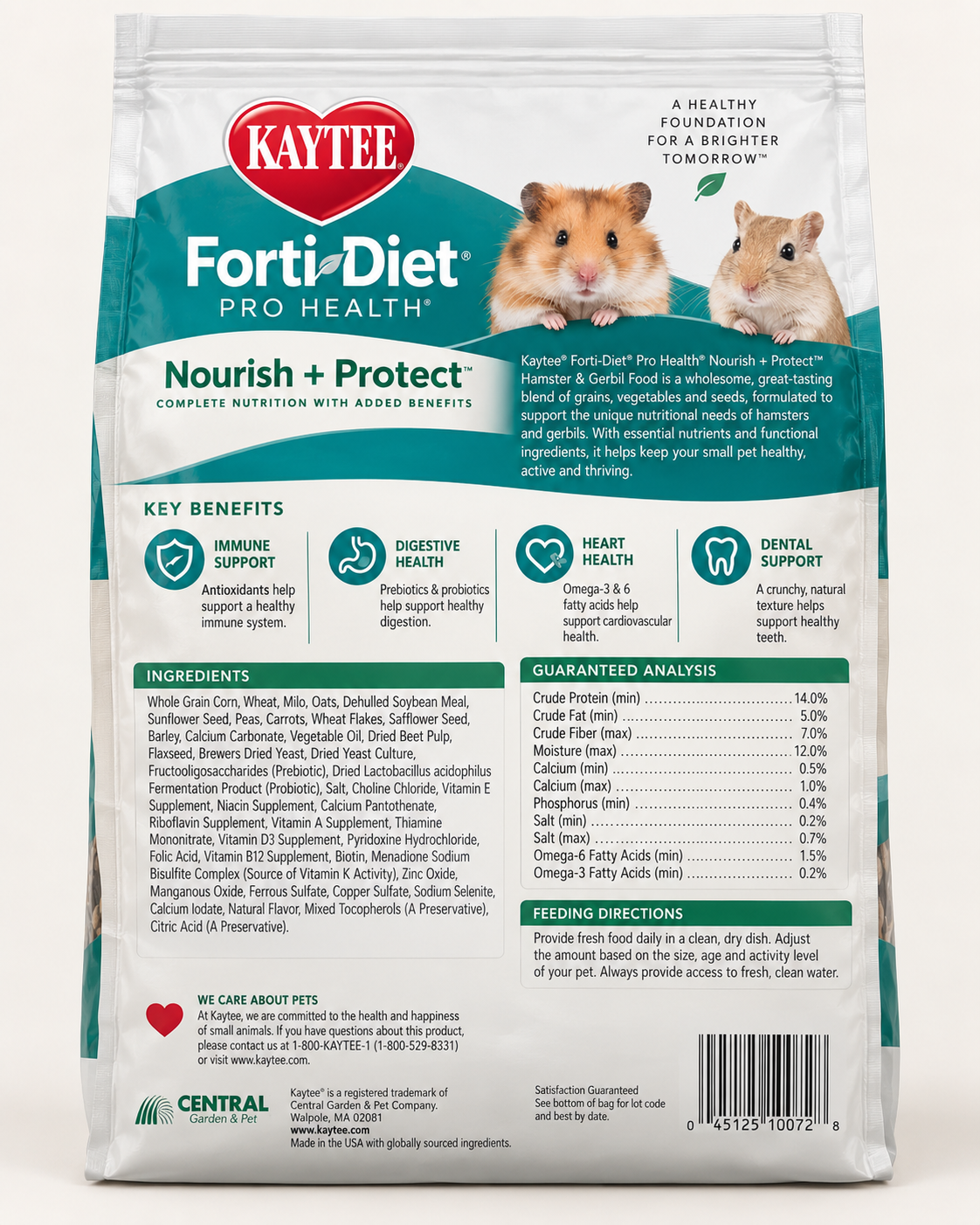
For every vegetable ingredient identified, separate Present? from How much? from What nutrients does it contribute in this finished product?
A named vegetable may establish presence. It does not automatically establish material percentage, nutritional significance, fiber contribution, vitamin contribution, mineral contribution, antioxidant contribution, or moisture contribution to the finished dry food.
Do not use the general nutrient profile of the raw vegetable to estimate its contribution to the commercial food unless inclusion amount is known, processing is accounted for, formulation basis is compatible, and appropriate analytical methodology exists.
Avoid importing USDA or generic vegetable nutrient data directly into the finished-food calculation because: raw-food composition does not reveal contribution without knowing how much processed ingredient is present.
Citations: Kaytee
What Can the Guaranteed Analysis Attribute to Vegetable Ingredients, and What Can It Not?
Use the current guaranteed analysis only for the product as a whole. Identify whether values are declared as minimum, maximum, or exact or supplemental declarations where applicable.
Do not attribute whole-product values directly to the vegetable fraction. Do not calculate total vegetable percentage from crude fiber or calculate vegetable nutrient contribution by subtracting other named ingredients.
Whole-product value → formulation-level evidence
not
Whole-product value → ingredient-specific contribution
Avoid component attribution from whole-product analysis because: multiple ingredients can contribute to the same guaranteed nutrient.
Citations: Kaytee
Citations: AAFCO Labels · AAFCO Nutritional Labeling
How Suitable Is Fresh Vegetable Supplementation for Hamsters Fed Kaytee Forti-Diet?
Fresh vegetable supplementation should be evaluated without assuming the commercial formula is inherently deficient or that supplementation is universally required.
- what vegetables the commercial product currently contains
- whether hamster evidence establishes vegetable supplementation as desirable or necessary
- whether the individual hamster’s species or feeding context changes the decision
- whether the fresh vegetable itself is suitable
- its physical form and moisture
- total diet context
- current commercial-food intake
- selective intake where applicable
- practical leftover management
Baseline commercial diet → evidence for supplementation → suitable fresh-food candidate → individual context → management burden → decision
Evidence-derived outcomes may include supplementation being appropriate, optional rather than required, appropriate only under defined conditions, limited by vegetable-specific restrictions, or unsupported as a fixed routine.
Avoid presenting supplementation as nutritional repair because: the commercial formulation has not automatically been shown deficient.
Avoid assuming “fresh” means superior because: freshness and moisture are physical characteristics, not complete nutritional evaluations.
Citations: RSPCA · PetMD
Is the baseline diet appropriate? → Is vegetable supplementation evidence-supported? → Is the candidate vegetable suitable? → What does it add? → What feeding or moisture-management burden does it create? → Is supplementation justified?
What Are the Trade-Offs of a Commercial-Only Baseline Compared With a Supplemented Diet?
Potential commercial-only considerations include a simpler feeding routine, reliance on the existing formulation, no additional fresh-food moisture, fewer perishable leftovers, and no assumption that lack of supplementation equals deficiency.
Potential supplemented-diet considerations include additional suitable food items, possible nutrient contribution where evidence supports it, different physical characteristics, added moisture, individual acceptance, selective consumption, leftover management, and changes to total dietary intake.
Do not assume supplemented = more balanced or commercial-only = incomplete without evidence.
Avoid judging the two strategies by variety alone because: food diversity and nutritional adequacy are not interchangeable.
Citations: RSPCA · PetMD
Are Differences in Physical Form and Moisture Relevant to Supplementation Decisions?
Compare verified physical characteristics of dehydrated vegetable ingredients within the commercial formulation and fresh vegetable supplements.
- water content
- texture
- perishability
- residue
- substrate contact
- caching
- retrieval
- serving practicality
Do not infer that higher moisture is inherently beneficial or harmful.
Avoid treating moisture as a proxy for nutritional quality because: water content does not establish overall dietary suitability.
Citations: PetMD · RSPCA
Which Feeding-Management Conditions Affect the Practical Suitability of Supplementation?
Evaluate species where relevant, current diet, candidate vegetable suitability, amount where supported, preparation requirements, individual acceptance, selective intake, caching, presentation method, leftover retrievability, bedding contact, and ability to monitor overall intake.
Do not automatically recommend daily fresh vegetables, rotating vegetables, mixing several vegetables, removing commercial food to encourage fresh intake, vitamin supplementation, mineral supplementation, or reducing pellets or seed mix unless evidence supports the intervention.
Avoid increasing fresh vegetable intake merely because it is readily accepted because: palatability does not establish dietary need.
Citations: RSPCA · PetMD
How Should You Establish a Feeding and Observation Routine for Vegetable Supplementation?
Only apply this routine if supplementation has already been supported. Keep it as a husbandry framework rather than a universal recipe.
- chosen fresh vegetable
- dietary suitability
- preparation
- amount where supported
- introduction method
- presentation
- observed acceptance
- amount apparently consumed
- pouching
- caching
- leftovers
- localized moisture
- overall commercial-food intake
- evidence-supported concerning changes
Do not invent universal grams, teaspoons, cube sizes, daily frequency, weekly rotation requirements, transition periods, leftover-removal times, or weight thresholds without appropriate evidence.
Verify suitability → prepare appropriately → offer → observe intake → account for caching → retrieve leftovers according to evidence → reassess feeding response
Avoid changing multiple dietary variables simultaneously where practical because: doing so makes the response harder to interpret.
Avoid assuming disappearance equals consumption because: hamsters may pouch and cache food.
Citations: RSPCA · PetMD
- Confirm that the Kaytee Forti-Diet product matches the exact current formulation evaluated.
- Verify the fresh vegetable is independently suitable for the hamster.
- Confirm that supplementation has an evidence-supported dietary or husbandry rationale.
- Do not assume supplementation is required because the commercial food contains dehydrated vegetables.
- Do not infer a vegetable quantity from ingredient-list position.
- Follow evidence-supported serving guidance where quantitative guidance exists.
- Prepare the vegetable according to evidence-supported guidance.
- Record which fresh vegetable is offered.
- Observe whether the hamster accepts it.
- Distinguish apparent consumption from pouching or transport.
- Account for caching where relevant.
- Monitor whether supplementation changes consumption of the commercial baseline diet.
- Inspect for uneaten high-moisture leftovers.
- Manage directly affected bedding or residue according to evidence-supported husbandry guidance.
- Do not automatically increase supplementation because the hamster prefers the fresh food.
- Do not automatically add vitamins, minerals, or other supplements.
- Keep species-specific evidence visible where relevant.
- Reassess the feeding approach if an evidence-supported nutritional or intake concern emerges.
How Should the Selected Supplementation Approach Be Implemented Consistently Where Evidence Supports One?
Only use this section after the evidence review supports supplementation.
Specify where supported: vegetable identity, preparation, amount, presentation, frequency, and monitoring requirement.
If no evidence-supported amount or frequency exists, do not manufacture one.
If fresh vegetable supplementation is appropriate, the next step is to determine the evidence-supported fresh vegetable feeding frequency rather than assume a daily or fixed schedule.
Evidence-supported recommendation → consistent implementation → observation
Avoid converting an example serving into a universal rule because: suitability and quantity may depend on species, vegetable, total diet, and source context.
Citations: RSPCA · PetMD Dwarf Hamster · PetMD
How Should Consumption Be Monitored for Selective Intake or Uneaten High-Moisture Leftovers?
- commercial diet offered
- fresh vegetable offered
- fresh vegetable visibly consumed
- commercial diet visibly consumed
- fresh leftovers
- pouching
- transport
- caching
- affected substrate
- repeated selection patterns
Do not assume fresh food missing = consumed or commercial food remaining = rejected because fresh vegetables were offered without repeated evidence.
If supplementation appears to displace consumption of the baseline diet, treat that as a feeding-management observation requiring evaluation rather than immediate proof of imbalance.
Do not invent one-hour limits, four-hour limits, overnight rules, or universal spoilage times. Use source-supported retrieval guidance only.
Offer → observe → account for transport/caching → inspect leftovers → manage affected material → reassess
Avoid converting perishable-food management into clinical prediction because: leftover retrieval and disease causation are separate evidence questions.
Citations: RSPCA · PetMD
- verify the current Kaytee Forti-Diet formulation
- identify the actual vegetable-derived ingredients
- distinguish dehydrated commercial ingredients from fresh vegetables physically without ranking them automatically
- determine whether hamster-specific evidence defines vegetable inclusion as a dietary adequacy criterion
- do not infer vegetable quantity from ingredient presence
- do not attribute whole-product guaranteed-analysis values to the vegetable fraction
- evaluate nutritional adequacy at the appropriate whole-diet level
- consider fresh vegetable supplementation only if evidence and feeding context support it
- evaluate moisture and physical-form differences separately from nutritional superiority
- implement supplementation consistently only where supported
- monitor actual intake, caching, selective consumption, and leftovers
Do not conclude universally that Kaytee Forti-Diet contains enough vegetables, contains too few vegetables, or requires fresh vegetable supplementation unless the completed evidence review supports the exact conclusion.
Avoid forcing a yes/no vegetable-quantity verdict because: “enough” must first be defined by hamster-specific nutritional evidence rather than by ingredient-list appearance.