
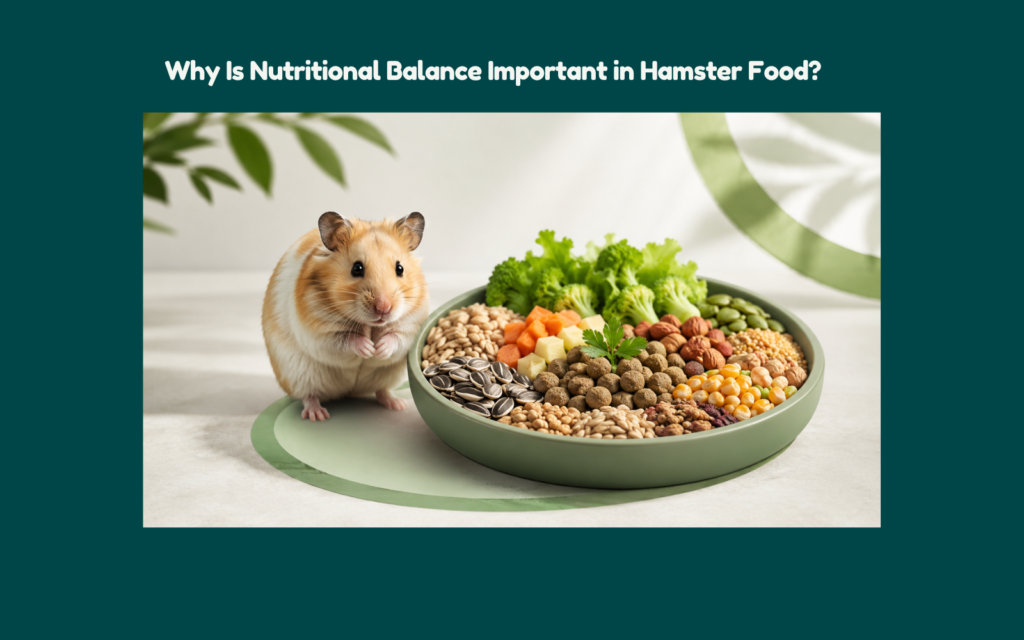
Why Is Nutritional Balance Important in Hamster Food?
To ensure your pet thrives on a safe, enriching, and species-appropriate diet, owners must understand why nutritional balance in hamster food is a central foundation of long-term health.
With so many commercial options and conflicting opinions available, determining what genuinely supports a small pet’s health can feel incredibly overwhelming.
Nutritional & Medical Disclaimer
The information provided in this guide is for educational and informational purposes only, grounded in recognized biological standards (NRC, BSAVA). It is not a substitute for professional veterinary medical advice, diagnosis, or treatment. Every hamster is an individual with unique health requirements; always consult a qualified exotic animal veterinarian before making significant changes to your pet’s dietary regimen or if you suspect a medical issue.
This comprehensive guide breaks down the biological and behavioral reasons behind proper feeding, covering how precise dietary ratios support organ health, encourage natural foraging, and help prevent common conditions.
What is the biological foundation of nutritional balance in hamster food?
The biological foundation of nutritional balance in hamster food rests on providing an appropriate ratio of proteins, fats, and fibers to support everyday well-being.
A high-quality diet must prioritize a sensible macro-nutritional balance rather than focusing purely on high-calorie, aesthetic treats.
Small mammals require steady, measured levels of protein to maintain healthy tissue and specific fat ratios to support long-term organ function.
A heavily processed diet often causes energy spikes and lethargy, whereas a well-proportioned diet steadily fuels their activity and overall daily energy.
According to the National Research Council (NRC) Nutrient Requirements of Laboratory Animals[1], meeting these baseline macronutrient requirements is essential for supporting the fundamental biological functions of small rodents.
Ideal Macronutrient Distribution
How can nutritional balance in hamster food help prevent common diet-related conditions?
You can actively help protect your pet’s future, as proper nutritional balance in hamster food helps prevent common diet-related conditions.
Feeding a diet with excess sugars and empty calories often leads to unhealthy weight gain and an increased risk of diabetes, particularly in sensitive dwarf species.
Conversely, a predictable, healthy stability is achieved by providing a well-proportioned, species-appropriate diet tailored to their specific metabolic limits.
Standard veterinary metabolic studies, alongside demographic data from the Royal Veterinary College (RVC) VetCompass[2], confirm the genetic predisposition of certain dwarf species to dietary-induced diabetes, emphasizing the critical need for strict carbohydrate management.
Blood Sugar & Energy Response
Why is nutritional balance in hamster food important for continuous dental health?
Beyond internal organ support, proper nutritional balance in hamster food is highly important for continuous dental health.
A complete diet must incorporate appropriate, tough, fibrous textures alongside its baseline nutrients.
Hamsters possess continuously growing incisors that must be mechanically worn down through the daily act of chewing structurally dense foods.
Providing hard, fibrous blocks or tough, natural seeds contributes to necessary continuous dental wear and helps prevent painful overgrowth and subsequent eating difficulties.
Clinical findings from the British Small Animal Veterinary Association (BSAVA) Manual of Exotic Pet and Wildlife Nursing[3] confirm that physical dietary composition directly impacts rodent incisor attrition and overall oral health.
Mechanics of Continuous Attrition
How does optimal nutritional balance in hamster food support the immune system?
A carefully calibrated diet supports natural resilience, demonstrating how optimal nutritional balance in hamster food actively supports the immune system.
A balanced, varied intake of essential micronutrients, such as Vitamin E and trace minerals, supports a healthy, resilient immune response.
Standard small-animal clinical nutrition guidelines clearly outline the supportive role of dietary micronutrients in maintaining robust baseline rodent immunity.
How does proper nutritional balance in hamster food encourage natural foraging behaviors?
In addition to physical wellness, proper nutritional balance in hamster food actively encourages vital natural foraging behaviors.
An unbalanced, treat-heavy mix often encourages selective feeding, where the hamster quickly picks out only the fattiest, sweetest pieces and ignores the rest of their meal.
A properly formulated, textured diet promotes engaging, whole-meal foraging that aligns with their species-specific needs and keeps their mind active throughout the night[4].
How do you audit your current mix to verify nutritional balance in hamster food today?
You can take immediate action to protect your pet’s health by conducting a quick audit to verify the nutritional balance in hamster food today. Use the hamster food analysis tool to check your ingredient list, guaranteed analysis, and species-specific risk signals.
The Nutritional Audit Checklist
Protein
- Recommended Range: 17-19% (Adult maintenance; up to 22% for growth).
- Label Red Flag: Generic “meat derivatives” or reliance on low-bioavailability plant isolates.
- Action: Ensure high-biological-value animal proteins (e.g., dried mealworms) are present.
Fats
- Recommended Range: 4-7% (Prioritizing Omega-3 to Omega-6 balance).
- Label Red Flag: Excessive high-fat seeds causing skewed Omega-6 ratios.
- Action: Introduce beneficial linoleic acids while capping total lipids.
Fibers/Sugars
- Recommended Range: 8-15% (Focusing on structural, insoluble crude fiber).
- Label Red Flag: Added molasses or hidden maltodextrin.
- Action: Prioritize fibrous botanicals to stabilize the cecal microbiome.
Use this quick-reference audit to evaluate your current pantry and gently phase out any mixes that fail to meet these essential biological baselines.
Scientific References & Citations
- National Research Council. (1995). Nutrient Requirements of Laboratory Animals: Fourth Revised Edition. Washington, DC: The National Academies Press.
- O’Neill, D. G., et al. (2022). “Demography and disorders of hamsters under primary veterinary care in the UK.” Journal of Small Animal Practice.
- British Small Animal Veterinary Association. (2018). BSAVA Manual of Exotic Pet and Wildlife Nursing.
- Hau, J., & Schapiro, S. J. (2010). Handbook of Laboratory Animal Science, Volume II: Animal Models. CRC Press.
Ensuring your pet receives a carefully balanced diet is a practical, proactive way to support their lifelong health and happiness.