
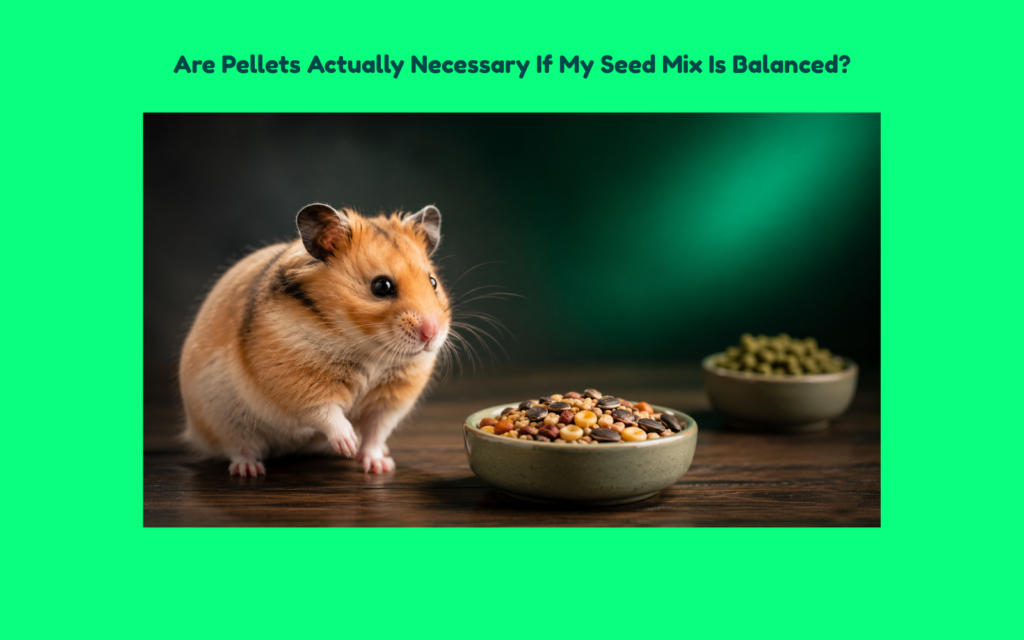
Are Pellets Actually Necessary If My Seed Mix Is Balanced?
You head to the store and pick out a beautiful, high-quality bag of food for your hamster. It is filled with a colorful variety of seeds, grains, and dried flowers. But then, as you pour it into the bowl, you notice those plain, brown pellets scattered throughout the mix. You might look at those and wonder if they are just filler, or if they are truly needed when the rest of the loose ingredients look so natural and complete.
Think of feeding a loose seed mix like serving a large, inviting buffet. If you left the entire table open for a guest, they would likely head straight for the desserts and the items they love most, leaving the heartier, plainer dishes behind. Your hamster handles their food bowl in the exact same way.
We are going to break down why pellets are added to loose mixes, how to track what your hamster is actually eating, and exactly how to check your bowl for ignored leftovers today.
Why are pellets commonly included alongside a seed mix to help maintain a consistent everyday meal?
Look closely at the leftovers. Are they scattered? Are they buried? Or are they sitting in a perfect pile, completely ignored? When you take the time to track this daily consumption of pellets, you stop guessing. You start to see a real pattern of what is being consumed versus what is just being pushed aside to get to the “better” parts of the mix. This is a much more accurate way to observe your hamster’s true daily habits than simply relying on how empty the bowl appears to be at a quick glance.
How do you track the daily consumption of pellets alongside your loose seeds?
The only way to truly understand what your hamster is consuming is to get hands-on with your feeding routine. It is very easy to simply dump a new scoop of food into the bowl when you see it getting low, but that often hides the reality of what is being left behind.
Instead of just topping off the bowl, use a measured amount. Every day, give your hamster a specific amount of food that you have weighed or measured. Check the bowl the next morning before you decide to add anything fresh. This gives you a clear window into their actual habits. Compare what went in with what stayed behind. If you poured in a specific amount and you come back to find only pellets, you have your answer.
What visual signs separate actively consumed pellets from ignored ingredients?
You do not need special tools to see what is happening; you just need to know where to look. When you start inspecting the bowl, the differences between actively consumed food and ignored food become very obvious.
Look inside the bowl. If the food is being consumed, the bowl will usually be quite empty. You might find a few stray husks or fragments, but the pellets will be gone just like the seeds. Now, check the hiding spots. This is where the real truth lives. If your hamster is actually eating the pellets, you will find a mix of seeds and pellets in their nest or storage areas. That is a sign of a successful, balanced consumption where every part of the meal is being utilized.
Notice what keeps appearing in the bowl day after day if it is being ignored. You will see a persistent layer of pellets forming. This layer remains even as you add new seeds on top. The hamster digs down, pushes the pellets to the sides, and eats the seeds. If you keep seeing that same layer of pellets, it is a sign that they are not actively consumed. They are merely obstacles in the way of the items the hamster actually wants. When you see this accumulation, you know that the “balanced” mix you are providing is being sorted by your hamster into “favorites” and “leftovers.”
What should you do if your hamster selectively eats the seeds and leaves the pellets behind?
If you find that your hamster is consistently leaving the pellets behind, it is time to make a small adjustment to your routine. The worst thing to do is to keep dumping fresh seeds on top of the pile, because that just encourages the behavior of sorting.
Pause before adding more food. This is the most important step in the Leftover Pellet Reset. Instead of refilling the bowl, take a moment to look at what is sitting there. If the bowl is full of pellets but empty of seeds, just leave it as it is for a short time. Observe the bowl over the next twenty-four hours.
Give the leftovers time. Sometimes, if the bowl is not immediately refilled with fresh, tempting seeds, the hamster will return to the previously ignored pieces and consume them. If you come back the next day and the bowl is finally empty, you know they are willing to eat the full mix when they have no other choice. If, however, the pellets remain untouched, you can then make a more informed decision about your next scoop size, ensuring you are not adding more food than your hamster is actually prepared to finish.
The Leftover Pellet Reset
- Identify the untouched pellets left in the bowl.
- Pause before adding more food to the bowl.
- Observe the bowl over the next day to see if the pieces disappear.
- Give the leftovers time and only add a smaller, measured scoop once the bowl is finally empty.
How do you check your current feeding bowl to verify your hamster’s pellet consumption today?
You can start this audit right now. You don’t need to change anything yet; you just need to gather the data. Walk over to the enclosure and take a good look at the main food bowl.
Look in the corners of the cage and inside any hideaways you can safely check. Compare what you find in those corners to what is sitting in the bowl. Are there stashes of seeds? Are there piles of forgotten pellets? If you see a large pile of seeds stored away but the pellets are nowhere to be found in the stash, that is a clear indicator of what your hamster prioritizes.
This simple audit helps you understand the reality of your hamster’s diet. It is not about judging the food you bought; it is about observing the reality of the bowl and adjusting your daily routine to prevent waste. By paying attention to these details, you become a better judge of how much your hamster actually needs to eat in a day, rather than how much you *think* they should be eating.
The Bowl and Stash Audit
- Target Issue Checking the bowl to see if pellets are being eaten or ignored.
- Visual Indicator Looking for large piles of untouched pellets sitting in the bowl or completely absent from the hiding spots.
- Required Change Reassessing the daily scoop amount to prevent wasting food.
- Action To Take Holding back fresh seeds until the current pellets are eaten, or adjusting the next measured scoop.
Pellets are ultimately included in these mixes as a practical tool to help provide a wider variety of ingredients in one piece, but what matters most is what your hamster actually puts in their mouth. Visual observation over time reveals the true patterns of their consumption, and checking their secret hiding spots often tells the real story of what they are choosing to store versus what they are ignoring. Regular bowl audits like the one above are the most effective way to ensure your hamster is eating what you provide and to minimize unnecessary food waste in their enclosure.
Perform this physical audit today, look closely at your food bowl, and adjust your feeding routine if you spot a pile of untouched pellets.
Veterinary & Husbandry Disclaimer
The observational techniques and feeding routines discussed in this article are provided for educational purposes only. This content does not constitute medical or nutritional advice and is not intended to replace a consultation with a qualified exotics veterinarian. Always seek professional veterinary guidance before making significant changes to your hamster’s diet, especially if you notice unexpected weight loss, illness, or sudden changes in behavior.