
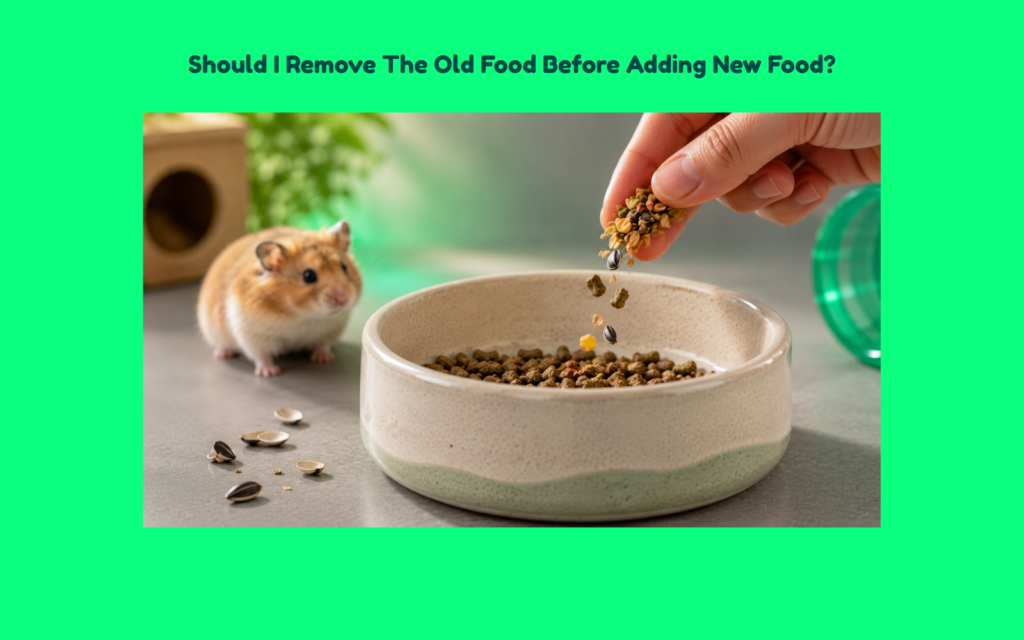
Should I Remove The Old Food Before Adding New Food?
It is a common daily cage-cleaning routine: an owner looks at the food bowl, sees that the tasty seeds are gone but plain pellets remain, and assumes the hamster is “finished.” They dump the old food in the trash and pour a fresh scoop. However, this well-meaning habit quietly reinforces the habit of eating seeds first and ignoring the rest.
We are going to break down why leaving those leftover pellets is actually a good thing, how to properly adjust your next top-up, and exactly how to check your bowl for safely unconsumed food today.
Think of it like a child eating the marshmallows out of a cereal box—if you keep handing them a fresh box every time the marshmallows run out, they will never eat the actual cereal.
Why does continuously removing unconsumed old food encourage selective eating?
Here is what owners commonly notice: you walk up to the enclosure for your evening routine, look down at the feeding dish, and see that every single high-value seed, pumpkin seed, and oat spray has completely vanished. Now, look at what remains in the bowl. You will almost always find a small pile of the plain, lower-preference pellets sitting exactly where you left them. The immediate, automatic assumption is that the hamster is simply finished eating. So, you remove the old food, physically dumping perfectly dry, structurally sound leftovers into the trash can just so you can refill the bowl with a brand-new scoop of mixed food.
Notice the pattern: watching the same routine play out day after day confirms that the hamster is simply waiting for the next refill. The pattern is often easy to spot once you stop replacing the bowl every time the seeds disappear. Many owners notice that the favorite seeds vanish quickly while the remaining pellets sit untouched for days. When the same leftovers keep appearing after every refill, it usually signals a deeper selective-eating habit rather than a problem with the food itself. If you provide a fresh mix every time the high-value seeds disappear, the animal quickly learns that finishing their everyday meal is entirely unnecessary. Why eat the plain pellets when a fresh batch of tasty seeds will magically appear tomorrow? A bowl that keeps getting entirely refreshed will always result in massive amounts of leftover food. In contrast, a bowl where the dry leftovers remain available forces the hamster to return and eat the rest of their provided meal. Constantly choosing to clear away perfectly fine, unconsumed old food prevents your pet from eating a complete meal.
1. Full Mix
2. Sorting
3. Leftovers Tossed
-
→
The Rule: Constantly clearing the bowl encourages selective eating.
-
→
The Reason: Treating a partially empty bowl as “finished” teaches the pet that waiting produces better food.
-
→
The Reality: Leaving the unconsumed old food helps make more of the food usable and encourages a complete meal.
How do you properly adjust your next daily portion when you have leftover food?
Before adding new food, you must establish a clear, physical top-up routine instead of a mindless dumping habit. When you approach the cage with your bag of fresh mix, pause and explicitly look down at the feeding area. Check what is already there. Do not simply grab the bowl, toss the contents, and pour a fresh scoop without a second thought. Instead, visually inspect the remaining items. You need to check for leftovers not just sitting directly inside the dish, but also scattered in the nearby bedding where they might have been pushed or temporarily hoarded.
Take a moment to physically measure what remains using your eyes and hands. If the bowl is still half full of lower-preference pellets, you do not need a full daily scoop. You only need to add a small top-up to bridge the gap between what is currently sitting in the cage and what constitutes a normal everyday meal. Top up instead of replacing the entire dish. Using a small measuring scale or a dedicated measuring scoop allows you to add precisely the small amount needed to replenish the high-value seeds without completely burying the leftover food. You also want to strictly avoid overflowing food dishes. An overflowing bowl completely masks how much food is actually being eaten, making it nearly impossible to tell if your hamster is sorting their food or eating a complete meal. By visually measuring the unconsumed old food and only topping up the difference, you prevent waste and ensure the bowl is manageable.
Incorrect: Blindly Clearing
Throwing away perfectly good pellets to pour an overflowing mound of new food.
Correct: The Top-Up
Using a measuring scale to add just enough mix to complete the everyday meal.
What visual signs distinguish safe remaining dry food from spoiled food that requires removal?
A crucial part of this routine is knowing exactly when leftover food is perfectly fine to stay and when it truly needs to be thrown away. You need to perform a vivid, side-by-side visual and tactile inspection. Look closely at the pellets to distinguish safe remaining dry food from spoiled food. Safe, dry leftovers are incredibly easy to identify once you know what you are looking at. Pick up a pellet. It should feel completely hard to the touch. It will remain structurally intact, refusing to crumble easily under light pressure. Check for moisture by running your fingers over the food and the immediate area; safe leftovers are always surrounded by completely dry bedding. If you are ever unsure, compare the leftovers to the bag. Safe, dry leftovers should look exactly like the food fresh out of the bag, just sitting in a different location.
Spoiled food, on the other hand, looks and feels vastly different. You are looking for obvious signs of moisture and mess. Watch out for swollen, mushy pellets sitting directly under a leaky water bottle drip. Look for high-value seeds that are physically clumped together by dampness or urine. Pay close attention to any dry food that is resting directly against a rotting piece of fresh vegetable, like a forgotten floret of broccoli. These visible, tactile differences are stark and immediately actionable. If the dry leftovers have been exposed to water bottle drips, urine, or rotting fresh vegetables, you must physically remove them immediately. If they are hard, dry, and look like they just came out of the bag, they stay.
Safe & Dry
Hard, intact, dry bedding
Spoiled / Wet
Mushy, clumped, soiled
How do you fix a selective sorting habit caused by repeatedly replacing a hamster’s old food?
Fixing a selective sorting habit requires a temporary shift in your daily routine and a bit of patience. If you notice only the high-value seeds are disappearing while the lower-preference pellets pile up, you must pause your normal top-ups. Hold off on adding a fresh scoop of mixed food. This is often the hardest part for owners, as it feels counterintuitive to walk away from a partially empty bowl. However, you must stop adding fresh food until the remaining items are consumed. Watch the bowl over the next day. You will likely see the hamster visit the dish, realize no new seeds have magically appeared, and eventually start eating the perfectly good pellets they previously ignored. It is incredibly common for owners to feel guilty during this process and give in too early by tossing in a handful of fresh seeds. Resist this urge. Your hamster is not starving; they are simply holding out for their favorites. Wait for the pellets to disappear before you reach for the bag again. Holding out simply encourages the pet to utilize their remaining food. Once you see that the leftover food has been mostly eaten, you can resume your consistent daily routine. You will find that maintaining this consistency over just a few days visibly reduces the amount of massive leftovers, firmly correcting the habit of constantly replacing a hamster’s old food.
The Selective Sorting Reset
-
1
Identify the dry, ignored pellets left in the bowl or bedding.
-
2
Temporarily withhold the next daily scoop of mixed food.
-
3
Wait until the remaining dry pellets have been mostly eaten.
-
4
Resume a consistent daily routine, adjusting the next top-up to avoid massive leftovers.
How do you check your current bowl to verify the integrity of the old food today?
It is time to put this into practice with a complete, hands-on, cage-side inspection routine. Walk over to your enclosure right now and look directly at your hamster’s food dish. You need to physically engage with the contents to verify the integrity of the old food today. Touch the remaining food with your fingers to feel for any hidden dampness or unexpected soft spots. You cannot always see moisture from above, so tactile confirmation is crucial. Next, look under the bowl. Lift it up entirely and check the surrounding bedding for moisture, ensuring a leaky water bottle or a hidden pee corner hasn’t compromised the area from below. Sift through the leftover pellets with your fingers to verify that no fresh food bits, like cucumber seeds or apple skins, have been buried underneath the dry mix and started to spoil. This highly tactile, visual process confirms the structural integrity of the food before you make the daily decision to either leave it in place or toss it in the trash. You are actively looking for the stark differences between safe, unconsumed old food and a ruined batch. If everything is hard, intact, and dry, you leave it right where it is. If you feel any mushiness or see any clumping, you dump it. By physically interacting with the bowl environment, you completely eliminate the guesswork of cage cleaning.
Quick-Reference Audit Checklist
Target issue: Checking the leftover food to see if it should stay or go.
Visual indicator: Physically touching the remaining pellets to check for moisture, wet bedding, or hidden fresh food.
Required change: Removing the food ONLY if moisture or mess is found.
Action to take: Leaving the dry food exactly where it is, and adjusting the next ration so the hamster finishes their everyday meal.
Finding leftover pellets in your hamster’s bowl at the end of the day is completely normal and expected. It is vital to remember that constantly throwing away perfectly dry food simply encourages selective eaters to hold out for the best pieces.
By shifting your routine and adjusting your daily top-ups, you prevent massive food waste and encourage a much more complete, satisfying everyday meal. Routine visual checks will always keep the enclosure safe and hygienic. Ultimately, simple, hands-on observation of the bowl is always better than constantly replacing the food out of habit.
Sources & References
- → National Center for Biotechnology Information (NCBI) – PMC10066078: Impact of exploration behavior and aptitude for pellet consumption.
- → National Center for Biotechnology Information (NCBI) – PMC8229078: Impact of Portion Control Tools on Portion Size Awareness and Choice.
- → The Hamster Forum: Community discussion on feeding amounts and frequency.
Disclaimer: The information provided in this guide is for educational and informational purposes only and is not intended to serve as a substitute for professional veterinary advice, diagnosis, or treatment. While we strive to provide highly accurate and practical husbandry guidance, every hamster is unique. Always consult with a qualified, exotic-savvy veterinarian regarding your pet’s specific health, diet, and medical needs. Never disregard professional veterinary advice or delay in seeking it because of something you have read on HamsterAtlas.