
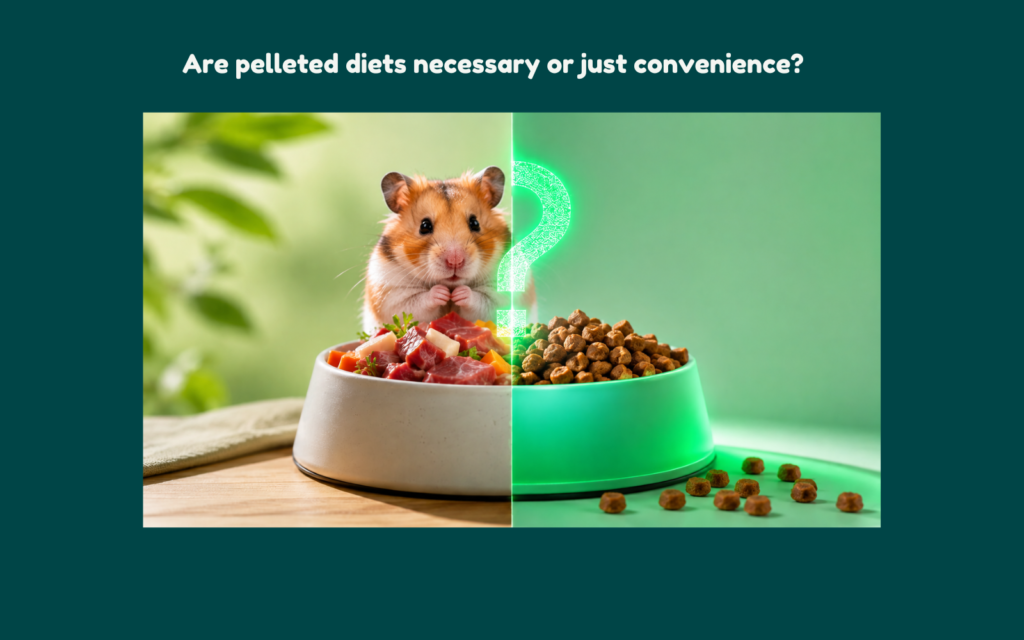
Are Pelleted Diets Necessary or Just Convenience?
While opening a bag of uniform blocks is undeniably easier for a busy owner, the true value of a pelleted diet lies in completely removing the risk of accidental malnutrition.
It is incredibly common to assume those plain, brown laboratory blocks are just a lazy, cheap way to feed a pet. When you stand in the pet aisle, the colorful, loose mixes full of seeds and dried veggies always look inherently better or more natural. But we are going to break down why these plain brown blocks are actually a biological necessity, how they stop picky eaters in their tracks, and how to safely switch your pet over to a stable diet.
Think of it this way: a high-quality pelleted diet is basically a daily multivitamin built directly into a protein bar. It absolutely lacks the visual excitement of a sprawling buffet. But it guarantees your pet gets exactly what their body needs to function, every single day, without fail.
Why are pelleted diets considered a nutritional necessity rather than just a convenience?
Single-format foods do save time, but their primary biological purpose is to completely eliminate selective feeding and lock in your pet’s baseline macronutrients.
You have to feed a diet that guarantees a balanced intake of proteins and fats with every single bite. This isn’t just about making feeding time faster for you; it is about protecting them from their own instincts.
Here is why that matters. Hamsters will always prioritize taste over health. They are hardwired to seek out the highest-calorie bits of food they can find. If allowed to pick apart their meals, they will actively ignore the fibrous, nutrient-dense ingredients that keep their organs functioning in favor of the tasty stuff.
If you just pour a simple bowl of mixed seeds, you are giving them the opportunity to accidentally starve themselves of essential proteins by only eating the fatty pieces. Pelleted diets remove that risk entirely by baking everything they need into one solid piece. Ultimately, nutritional completeness remains the strongest argument for pellets.
How do uniform laboratory blocks guarantee dietary stability compared to loose mixes?
The physical structure of a compressed block forces a hamster to consume a perfectly balanced meal every time they eat.
When you feed uniform laboratory blocks, you are providing steady, sustainable energy. Every bite delivers the exact same ratio of protein, fat, and fiber. This guaranteed, reliable nutrient delivery keeps their internal systems running smoothly without major spikes or crashes.
Compare that to the highly unpredictable, risky consumption patterns often seen when a hamster is allowed to pick and choose from a loose seed blend. They eat the high-fat sunflower seeds first, get a massive burst of energy, and then crash. This selective eating in loose foraging formats causes rapid weight fluctuations and nutritional crashing because they are essentially living on junk food.
What physical health requirements make the extruded food format necessary for hamsters?
A hamster’s teeth never stop growing, meaning their daily meals must double as a physical tool to safely wear down their incisors.
It is easy to forget that a hamster’s diet has a physical job to do, not just a nutritional one. There is a strict biological requirement for hard, uniform textures in their enclosure to provide consistent friction. This friction is what safely wears down a hamster’s continuously growing teeth.
The specific hardness of this manufactured format acts as a functional dental tool every time they take a bite. Because the pieces are dense and require real effort to chew, they naturally grind the teeth down. This constant mechanical friction proves the extruded food format is a biological necessity for their anatomy rather than merely a convenient feeding method for the owner.
How do you fix selective eating habits by introducing a pelleted base diet?
If your pet is currently exclusively eating the fatty pieces of a loose mix, you can safely pivot them to a nutritionally stable format without triggering a protest.
Let’s talk about the Dietary Repair Template. If you have a stubborn eater addicted to “junk food” seeds, you cannot just drop a bowl of plain blocks in front of them. That usually results in a stressful, stubborn hunger strike.
You have to guide them safely. You do this by gradually introducing the uniform pieces alongside the old food to force the hamster to slowly acclimate to the new texture and taste without shocking their system.
Start with a 75/25 ratio—mostly their old mix with just a few new blocks. Over 7 to 14 days, shift that to a 50/50 mix. Finally, move to a 25/75 phase-in, heavily favoring the pelleted base diet. This slow pivot repairs their eating habits gently but firmly.
How do you audit a label to verify the nutritional necessity of your pelleted hamster food today?
You can quickly verify if a block is actually providing high-quality baseline nutrition—rather than just acting as a cheap, convenient filler—by simply flipping the bag over and checking the nutritional breakdown right now.
Don’t just trust the front of the bag. You need to look at the actual ingredient list and nutrient breakdown on the back to ensure the pellet is actually doing its job.
The Pellet Quality Audit Checklist
-
Macronutrient Lock-inIdeal Indicator: Stable protein content (15-19%) with whole grains listed first.
Warning Sign: Excessive corn bran or vague “animal derivatives” dominating the top spots.
Action: Upgrade to a block that transparently lists high-quality protein sources. -
Micronutrient DeliveryIdeal Indicator: Fortified with natural mixed tocopherols.
Warning Sign: Reliance on synthetic dyes (Red 40, Yellow 5) to make the blocks look visually appealing to humans.
Action: Choose an earth-toned, naturally preserved laboratory block. -
Dental & Digestive FrictionIdeal Indicator: High-quality, fibrous ingredients clearly integrated into the block’s structure.
Warning Sign: Blocks that easily crumble into dust at the bottom of the bag.
Action: Select a structurally dense pelleted hamster food that requires actual chewing effort.
Use this quick label audit to evaluate your pantry and choose a highly vetted, well-balanced pelleted block.
Getting their foundation right from day one is a simple fix that drastically improves their everyday comfort and long-term health.
Sources & Veterinary Authorities
- RSPCA Hamster Care Guide — Strong welfare-based source supporting balanced feeding and gradual diet transitions.
- VCA Animal Hospitals – Owning a Pet Hamster — Trusted veterinary authority explaining proper hamster feeding practices and why balanced diets matter.
- UC Davis Veterinary Medicine – Hamster Care — Strong university veterinary source covering selective feeding, balanced nutrition, and pelleted/laboratory diets.