
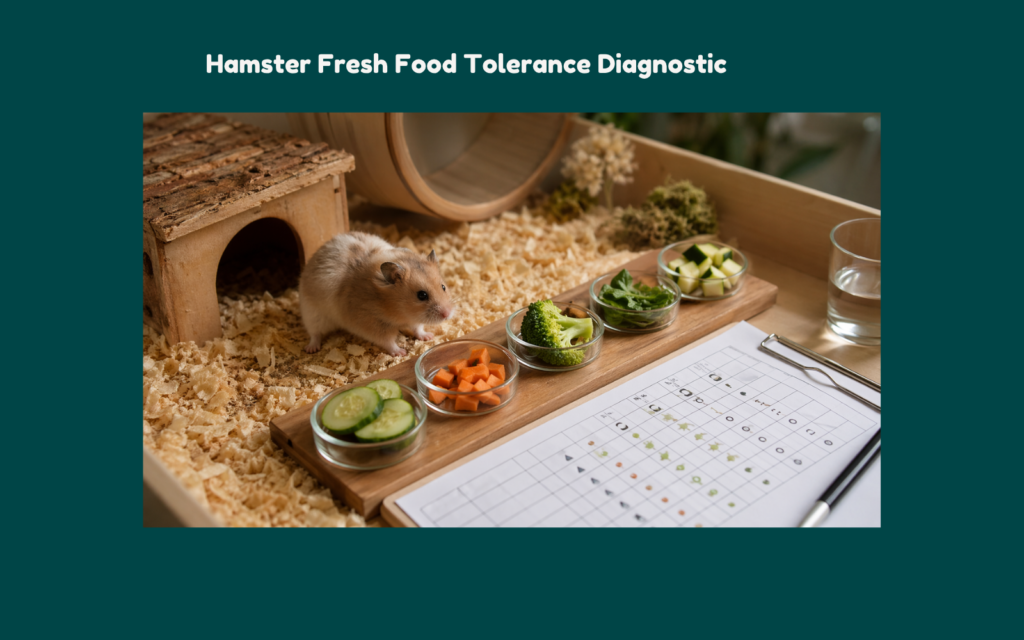
How to Use the Fresh Food Tolerance Assessment Tool to Prevent Digestive Upset
Standardized Clinical Assessment Protocol | Context: Hamster Clinical Nutrition
To effectively prevent digestive upset and severe gastrointestinal distress, owners must implement the fresh food tolerance assessment tool, a structured diagnostic methodology engineered to systematically identify, quantify, and eliminate precise dietary variables responsible for intestinal dysbiosis.
Technical Figure 1.0: Hydrostatic Overload in the Hindgut System
Why Is the Fresh Food Tolerance Assessment Tool Critical for Hamster Digestive Stability?
What Is the Fresh Food Tolerance Assessment Tool and How Does Its Protocol Work?
Diagnostic Roadmap Tracking
Phase 1: Baseline Stabilization
Execute a 7-day total fresh food fast to recalibrate gut pH and normalize microbial populations.
Phase 2: Variable Selection
Isolate a single independent variable (biochemical matrix or volumetric threshold).
Phase 3: Execution & Quantitative Tracking
Implement fractional inputs (1/4 tsp) while logging terminal fecal quality scores.
Phase 4: Binary Segmentation & Analysis
Segment data into “Optimal Digestion” vs “Poor Digestion” cycles.
Phase 5: Resolution & A/B Protocol
Finalize dietary boundaries using the A/B Test Protocol to restore long-term homeostasis.
How Do You Secure Control Variables?
The Confounding Variable Checklist
Diagnostic Execution Tracker
Phase 4 Analysis: Binary Segmentation
No data logged.
Frequently Asked Questions
Your questions about our science-backed templates, answered.
Is “Wet Tail” the same as food intolerance?
How long should I wait between testing new foods?
What should I do if my hamster has a Score 2 stool?
Protocol Deployment
Download the official Printable Quantitative Data Log to begin Phase 1 tonight.