
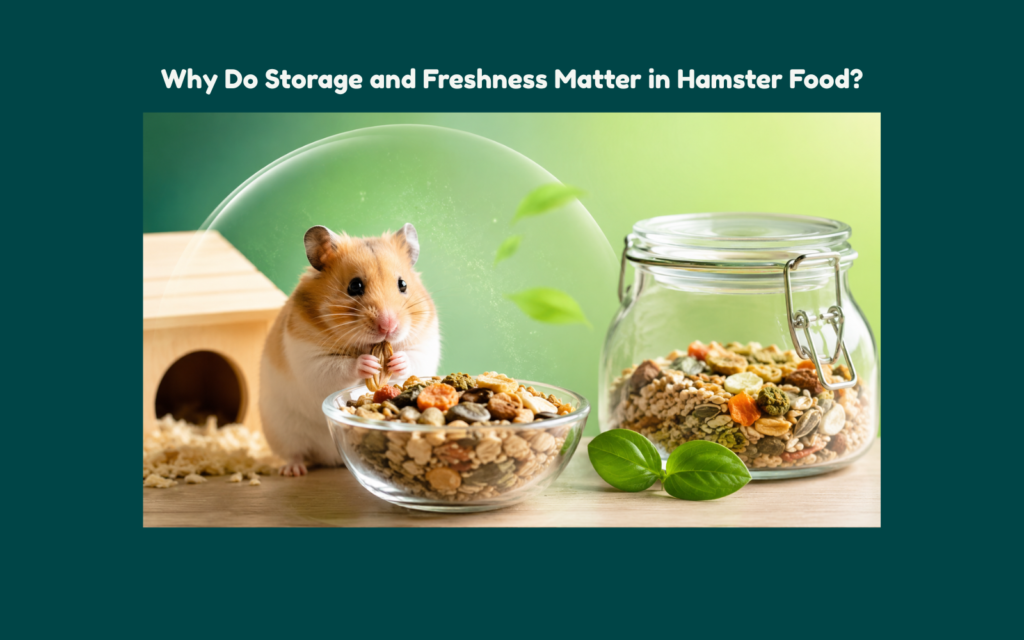
Why Do Storage and Freshness Matter in Hamster Food?
The nutritional value printed on a bag of hamster food is only accurate if the ingredients are properly preserved against environmental degradation in your home. You spend significant time selecting the perfect, high-quality seed mix. Yet, many unknowingly compromise that investment by leaving the food in its original, unsealed bag where humidity and pests can destroy it. Think of it like leaving a fresh salad out on the counter; the ingredients are healthy, but the exposure quickly renders them useless. This comprehensive guide explores the science of food preservation, covering how environmental factors degrade delicate vitamins, the best container setups to use, and how to safely handle compromised batches.
Why do storage and freshness in hamster food form the baseline for safe daily nutrition?
Even a highly nutritious diet loses essential vitamin content and can harbor unsafe molds if exposed to poor environmental conditions. Proper preservation is just as critical as the initial ingredient selection when providing a daily diet. Water-soluble vitamins and essential fatty acids naturally break down when exposed to oxygen and light, stripping the food of its baseline nutrition. If you feed properly preserved ingredients, you ensure your pet actively absorbs the required nutrients to support everyday wellness. Conversely, feeding oxidized, stale blocks leaves the animal quietly malnourished, a reality supported by the National Research Council (NRC) Nutrient Requirements of Laboratory Animals, which grounds the necessity of stable, bioavailable vitamins for long-term health.
Figure 1: Environmental factors such as oxygen and UV light actively degrade the delicate vitamins and healthy fats within the diet, resulting in lipid oxidation.
How do improper storage and freshness in hamster diets increase diet-related risks?
Failing to protect your pet’s food from the environment actively invites unwanted pests and breaks down the delicate healthy fats they rely on for energy. Maintaining an airtight, temperature-controlled environment provides critical nutritional stability. When you contrast this with leaving food in unsealed, original bags in warm or humid rooms, the difference is stark. Poor environments cause rapid lipid oxidation—leading to rancidity—and accelerate nutrient degradation. Standard veterinary and food-science literature explicitly details how this lipid oxidation specifically destroys the essential fatty acids vital in stored small-animal feeds.
What specific practices best maintain the freshness of hamster food?
Protecting the structural integrity of the mix requires moving away from the manufacturer’s packaging and utilizing dedicated, physical storage barriers. Transferring commercial mixes out of easily compromised packaging and into solid glass or high-quality acrylic protects against oxidation. This physical barrier prevents humidity from sparking mold growth and actively deters common household pests. Established clinical nutrition manuals demonstrate the efficacy of these UV-blocking, airtight containers in extending the shelf-life of dry pet foods, confirming that practical physical protection translates directly to dietary safety.
Figure 2: Transferring food from its high-risk original packaging to a protective, airtight container effectively preserves essential nutritional integrity.
How do you address compromised storage and freshness protocols for hamster food?
If you discover that your current supply has become stale, moldy, or infested, you must safely discard the batch and reset your pantry habits to prevent future contamination. Feeding an animal from a bag compromised by seed mites or mold poses a severe, immediate health risk, and such food cannot be salvaged. First, strictly discard the compromised batch entirely. Second, purchase a new, fresh bag and mandate a 48-to-72-hour deep-freeze of the unopened package to neutralize any hidden natural pests arriving from the warehouse. Specific entomological data regarding the thermal lethality thresholds of common grain mites, such as Tyrophagus putrescentiae, explains how this 48-to-72-hour deep freeze actively protects pantry investments. Finally, transition the pet to the fresh supply using a measured phase-in if changing varieties, and immediately transfer the thawed food into a sanitized, airtight container.
Figure 3: The safest protocol for managing compromised food involves entirely discarding the spoiled batch, deep-freezing the replacement, and securing it in airtight storage.
How do you audit your pantry to ensure optimal storage and freshness in hamster food today?
You can immediately secure the safety of your pet’s diet by actively inspecting your current food supply and storage environment today.
| Storage Factor | Ideal Condition | Warning Sign | Action to Take |
|---|---|---|---|
| Expiration & Odor | Earthy, natural grain scent | Dusty, sour, or rancid odors; passing the best-by date | Discard immediately and replace with a fresh batch |
| Container Seal | Solid glass or acrylic with an airtight gasket | Kept in the original ripped bag or a loosely lidded bin | Transfer immediately to an airtight container |
| Environment | Cool, dark, and dry (like a lower pantry shelf) | Condensation inside the bin or stored in direct sunlight | Move storage containers away from windows, radiators, and high-humidity rooms |
References & Source Material
- Baseline Nutrition & NRC Guidelines: National Research Council (NRC) Subcommittee on Laboratory Animal Nutrition. (1995). Nutrient Requirements of Laboratory Animals: Fourth Revised Edition. Washington, DC: The National Academies Press.
- Lipid Oxidation & Nutrient Degradation: Hu, M., & Jacobsen, C. (Eds.). (2016). Oxidative Stability and Shelf Life of Foods Containing Oils and Fats. AOCS Press / Elsevier.
- Efficacy of Airtight Storage: Hand, M. S., Thatcher, C. D., Remillard, R. L., Roudebush, P., & Novotny, B. J. (2010). Small Animal Clinical Nutrition (5th ed.). Topeka, KS: Mark Morris Institute.
- Thermal Lethality Thresholds (Grain Mites): Eaton, M., & Kells, S. A. (2011). Freeze Mortality Characteristics of the Mold Mite Tyrophagus putrescentiae, a Significant Pest of Stored Products. Journal of Economic Entomology, 104(4), 1432-1438.
Evaluating your pet’s food carefully is a practical, proactive way to support their lifelong health and daily well-being.