
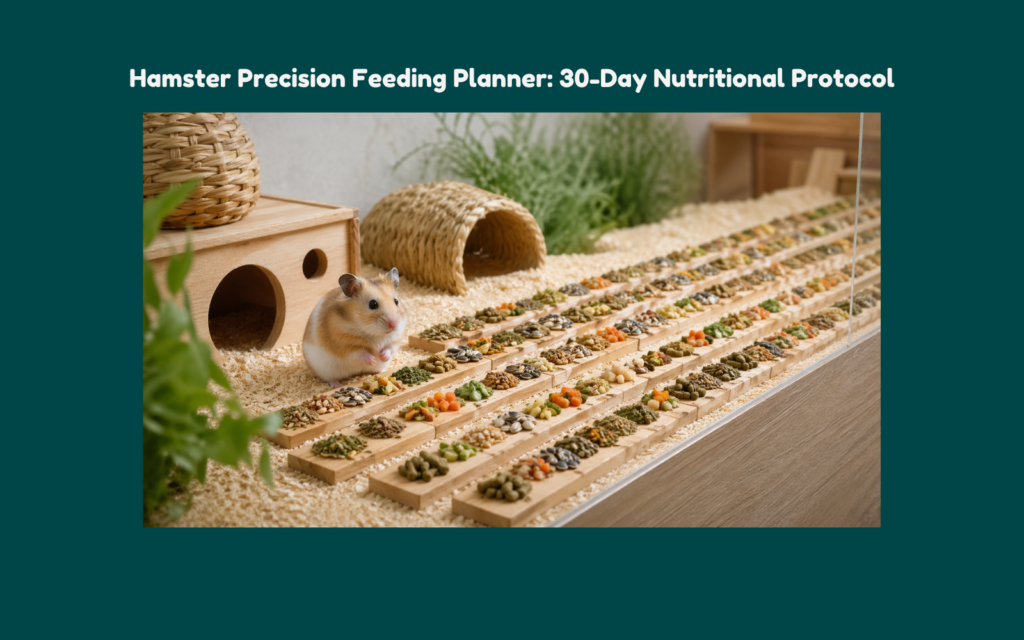
How to Build a Precision Hamster Feeding Routine to Stop Selective Eating
To effectively prevent selective eating and ensure a balanced diet, owners must implement a structured hamster feeding routine that replaces mindless bowl-filling with empirical, data-driven portion control.
Watching a hamster pick out only the tasty, high-fat seeds while leaving the nutritionally fortified pellets behind is a common frustration for owners. However, endless bowl-filling guarantees malnutrition and severe obesity. An unregulated food bowl is effectively an “unregulated buffet of desserts and salads,” where a rodent will always gorge on the high-fat desserts until they reach metabolic bankruptcy.
This guide provides a step-by-step roadmap to building a precision hamster feeding routine, covering exact portion controls, daily tracking, and how to read your hamster’s subterranean hoard to make necessary dietary adjustments.
By adopting a systematic feeding routine, caretakers can effectively eliminate selective eating behavior and secure their pet’s long-term health.
Understand why a structured hamster feeding routine is essential for long-term health
A structured hamster feeding routine is essential for long-term health because it prevents the animal from exclusively consuming high-fat seeds and ignoring vital nutrients essential for digestion and immune function.
Data Visualization: This model illustrates how selective feeding causes dangerous metabolic fluctuations, whereas precision routines maintain an ideal state of caloric homeostasis.
Rule: A domestic hamster diet requires a stringently balanced intake: 18-20% crude protein for growing individuals (scaling down to 12-15% for seniors), 5-7% fats, and 10-15% dietary fiber.
Reason: Mindless bowl-filling is the primary enabler of selective feeding; in an environment of absolute abundance, small omnivores preferentially gorge on high-calorie elements and ignore fortified pellets, triggering a macronutrient imbalance.
Example: The visual evidence of a selectively eaten diet presents as a food dish completely devoid of fatty seeds, leaving behind a stagnant, untouched layer of compressed alfalfa pellets and fibrous grains.
Evidence from established veterinary models on high-fat diets indicates that when hamsters are allowed to indulge in highly palatable, fat-rich foods for as little as 12 weeks, they can experience a tripling of whole-body fat mass. This data proves that constant daily bowl-filling actively triggers severe obesity and long-term metabolic dysfunction.
Define the core phases of a successful hamster feeding routine
A successful hamster feeding routine follows a clear, 30-day roadmap designed to seamlessly transition you from passive food provisioning to an organized, predictable schedule.
- Mission setup (Days 1–7): Calculate volumetric requirements, procure a high-quality homogenous pelleted block to eliminate selective eating, and clear out old hoards.
- Habit anchoring (Days 8–14): Lock in a reliable evening trigger to automate the feeding schedule and stabilize the animal’s food-anticipatory circadian responses.
- Consumption tracking (Days 15–21): Deploy a digital scale to log daily input, hoard volumes, and bi-weekly weight fluctuations.
- System debrief and adjustment (Days 22–30): Evaluate the burrow hoard and adjust macronutrient inputs based on the gathered data.
Established veterinary behavioral protocols suggest that a phased 30-day transition is vital to stabilize food-anticipatory circadian responses. This controlled shift prevents the stress and anxiety typically associated with abrupt dietary restriction and frantic cache hoarding behaviors.
Establish simple portion rules before starting your hamster feeding routine
To ensure your new schedule works, you must establish strict volumetric boundaries before starting your hamster feeding routine to prevent accidental overfeeding.
The Feeding Control Checklist
-
Mandate measuring the base mix with a dedicated tablespoon: Set the strict baseline at 1.5 to 2 tablespoons (approx. 11-14 grams) for Golden Syrian hamsters, and a strict maximum of 1 tablespoon for dwarf species.
-
Prohibit pouring directly from the bag: The mix must be manually stirred first to prevent heavy fortified blocks from sinking to the bottom, ensuring the hamster receives an equal macronutrient ratio.
-
Establish the strict 2-3 day refill schedule: Withhold further provisions until the existing supply is at least 80% depleted from both the surface bowl and the subterranean hoard.
Exotic animal husbandry guidelines emphasize that due to differences in basal metabolic rates, a Syrian requires 11-14g per cycle, while a Roborovski (weighing merely 20-25g) requires significantly smaller volumes to avoid caloric surplus.
Choose an evening trigger to effortlessly automate your hamster feeding routine
You can effortlessly automate your hamster feeding routine by choosing an existing evening trigger to serve as a reliable daily reminder.
Variable A (Post-dinner cleanup): A sequence-based trigger (e.g., executing the routine immediately after loading the dishwasher).
Variable B (Refrigerator visual cue): An environment-based trigger (e.g., placing the hamster’s prepped vegetables next to your own evening beverage).
Rule: Anchor the new feeding task to an established evening habit to ensure absolute consistency.
Observational behavioral ecology data confirms that hamsters exhibit intense crepuscular activity; because up to 80% of their foraging happens after dark, an evening trigger aligns perfectly with their natural metabolic awakening and high-energy states.
Track daily food intake to monitor the success of your hamster feeding routine
To monitor the success of your hamster feeding routine, you must track daily food input, hoard statuses, and bi-weekly weight changes using a dedicated precision tracking matrix.
The Precision Tracking Matrix
| Day | Base Mix Fed | Fresh Veg/Protein | Hoard Status | Bi-weekly Weight |
|---|---|---|---|---|
| Monday | 1.5 Tbsp | 1 Tbsp Broccoli | Minimal | 145g |
| Tuesday | None | 2 Mealworms | Moderate | N/A |
| Wednesday | 1.5 Tbsp | 1 Tbsp Cucumber | Moderate | N/A |
Active Cycle Monitoring Hub
Select a logged day node to check fulfillment data
Analyze the burrow hoard to safely adjust your hamster feeding routine
Explanatory Note: The hoarding instinct is biologically decoupled from satiation. When calories are over-supplied, the loop stalls at “Selective Eating,” as shown above.
You can safely adjust your hamster feeding routine by analyzing the burrow hoard during routine cleanings to identify exactly which ingredients are being ignored and prevent spoilage.
If: Spot-cleaning the main burrow.
Do: Audit specific uneaten ingredients and evaluate the total caloric volume.
Result: Identify overfeeding based on a cache containing more than 3 to 4 days’ worth of caloric requirements or a complete absence of high-fat seeds with a towering surplus of extruded blocks.
Laboratory studies on rodent behavior demonstrate that cache hoarding is a deeply instinctual drive. A hamster will continue to store food indefinitely if allowed; therefore, a massive hoard of rejected nutritional pellets is irrefutable evidence of overfeeding and requires immediate dietary refinement. Failure to address this can lead to metabolic dysregulation or gastrointestinal stasis from poor fiber intake.
Fix common dietary problems by refining your hamster feeding routine
You can fix common dietary problems by refining your hamster feeding routine based on your tracking log notes, utilizing specific adjustments to restore balanced nutrition.
Explanation: As a hamster enters its senior stage (>18 months), renal efficiency decreases. Lowering crude protein levels reduces osmotic stress and the metabolic load on aging kidneys.
| Identified Obstacle & Indicator | Specific Reduction / Adjustment Strategy |
|---|---|
| Diet-Induced Obesity (Body mass exceeds species maximum). | Reduce total base mix volume by 20%, eliminate high-fat seed treats, and transition to exclusively pelleted blocks. |
| Protein Overload / Renal Aging (>18 months old). | Reduce crude protein intake from 18-20% down to 12-15% to ease renal load; introduce easily digestible proteins sparingly. |
| Failure to Thrive / Weight Loss (>15% loss, anorexia). | Implement a soft, aqueous convalescent paste fed twice daily in 1 Tbsp portions to maintain caloric density without requiring intense chewing. |
Veterinary gerontology protocols highlight that high-protein diets (22-24%) become excessively taxing in geriatric hamsters (>18 months), necessitating a reduction to 12-15% to mitigate the effects of renal aging.
Resolve common questions about maintaining a balanced hamster feeding routine (FAQ)
When exactly should the base seed mix be refilled if the bowl is empty, but the hamster is not losing weight? ↓
Direct Answer: Only when the underground cache is 80-90% depleted.
Rule: An empty surface bowl only means successful pouch transport; refilling an empty bowl with a full subterranean hoard facilitates selective eating.
Is scatter feeding a viable alternative to using a standardized food bowl? ↓
Direct Answer: Yes, dispersing the dry mix across the substrate forces natural ethological foraging behavior.
Rule: Scatter feeding drastically slows consumption and provides vital enrichment, but hoard tracking becomes even more critical to ensure food isn’t just lost in the bedding.
How frequently should fresh foods and high-value proteins be integrated? ↓
Direct Answer: Strictly limit safe vegetables to a 1-tablespoon portion daily; fruits to pea-sized amounts 1-3 times weekly.
Rule: Uneaten fresh foods must be purged within 12-24 hours to prevent dangerous bacterial proliferation and fungal spoilage in the burrow.
Husbandry guidelines mandate an 80-90% hoard depletion threshold and a strict 12-24 hour window for fresh food removal.
Finalize your hamster feeding routine and start tracking tonight
You can finalize your hamster feeding routine and start tracking tonight by defining your core mission, locking in your evening trigger, and preparing your physical log.
- Step away from mindless bowl-filling to restore nutritional balance.
- Solidify your evening trigger to ensure feeding consistency.
- Prepare your physical log to track daily intake and weight trends.
The transition from passive feeding to a precision nutritional framework is the single most effective intervention a caretaker can make to ensure the metabolic longevity of a captive hamster.
Disclaimer: This guide is provided for educational and informational purposes only and does not constitute professional veterinary advice, diagnosis, or treatment. Always seek the advice of your veterinarian or other qualified health provider with any questions you may have regarding a medical condition or dietary changes for your pet. Never disregard professional advice or delay in seeking it because of something you have read in this protocol.