
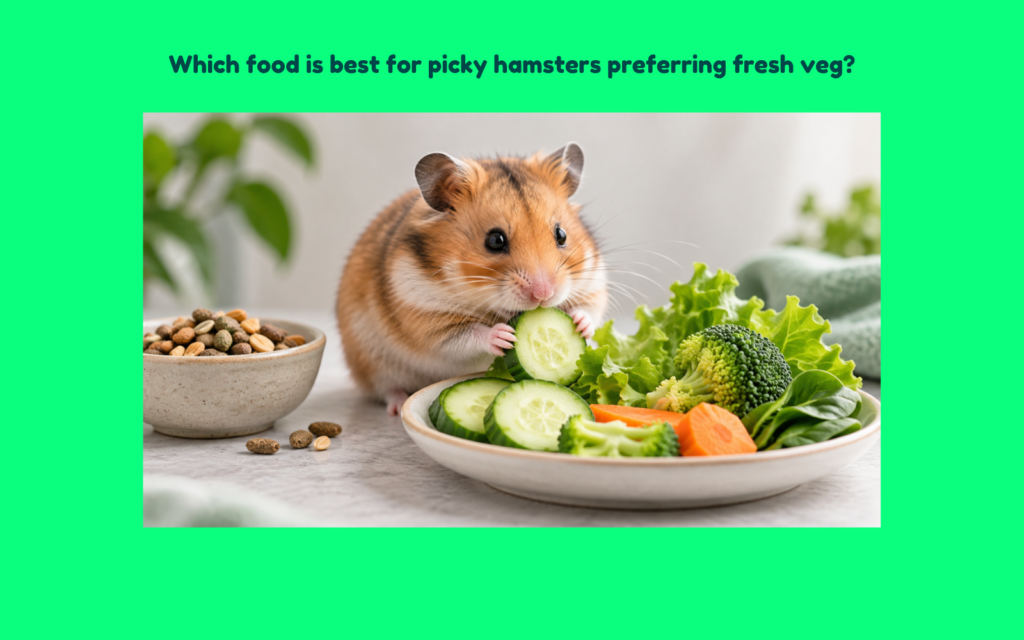
Which Food Is Best for Picky Hamsters Preferring Fresh Veg? A Dietary Evaluation
A hamster that strongly prefers fresh vegetables may be showing reduced acceptance of its commercial food or a pattern of selective feeding, but the observed behavior should be defined before assigning a cause. Choosing an appropriate baseline diet requires comparing commercial diet formats, product-specific formulations, whole-diet adequacy, and actual consumption rather than assuming one universally best food.
The decision should consider what commercial food is currently offered, which fresh vegetables are available, relative acceptance, the amount actually consumed, pouching and caching, repeated food-selection patterns, commercial diet format, opportunity for component selection, product-specific ingredient composition, guaranteed analysis, whole-diet adequacy, species-specific evidence, and the role of fresh vegetables within the total feeding pattern.
- Fresh-vegetable preference does not automatically prove that the commercial food is deficient.
- Preference does not automatically prove selective feeding.
- Selective feeding is not the same as whole-food refusal.
- High-moisture food preference is not automatically caused by moisture.
- A uniform food is not automatically nutritionally superior.
- A heterogeneous mix is not automatically nutritionally inferior.
- One product does not automatically “fix” picky eating.
- A food being readily eaten does not prove dietary adequacy.
- Fresh vegetables should not automatically replace the commercial baseline.
- Actual consumption matters more than what is merely offered.
Avoid naming a universal winner because: product choice should follow behavioral, format, formulation, and intake evaluation.
Avoid diagnosing selective feeding from preference alone because: preference, refusal, component selection, and actual intake are distinct observations.
The evaluation should follow this sequence:
Observed behavior → actual intake → format relevance → product formulation → nutritional fit → practical management
How Can Observed Food Preference Be Distinguished From Overall Dietary Adequacy?
Start with the observable feeding pattern. Relevant observations can include fresh vegetables being approached quickly, eaten first, commercial food being consumed later or only partly, particular components being selected from a mixed diet, pellets or blocks being carried away, food being cached, or food disappearing without confirmed consumption.
No single observation should be converted directly into nutritional deficiency, dislike of all commercial food, selective feeding, illness, or dietary adequacy.
Keep four questions separate:
- What does the hamster prefer?
- What does the hamster actually consume?
- What nutrients does the total consumed diet provide?
- Is the feeding pattern evidence-supported as appropriate?
Preference is behavioral. Adequacy is nutritional. They may interact, but they are not interchangeable.
Avoid using acceptance as a nutritional score because: readily consumed food still requires a separate suitability evaluation.
Avoid using refusal as proof that a product is inappropriate because: refusal may have behavioral, contextual, sensory, or other explanations.
Avoid treating “picky” as a diagnosis because: it is an owner-facing description, not a causal explanation.
Food offered → observed response → actual intake → repeated pattern → nutritional evaluation
Do not use fresh preferred → commercial diet inadequate or commercial refused → medical problem.
What Factors Are Associated With the Preference for Fresh Vegetables Over Commercial Diets?
Fresh and commercial foods can differ in moisture, texture, firmness, aroma, temperature, size, shape, freshness, familiarity, presentation, location, recent exposure, alternative food availability, handling, and previous feeding pattern. These are potential explanatory variables, not automatic causes.
Use association language such as associated with, may influence, may alter acceptance, or may change food selection unless stronger causal evidence exists.
For every proposed factor, ask whether it actually differs between the foods, whether hamster-specific evidence links it to food selection, whether the evidence is causal or associative, whether it explains the current observation, and whether it has a practical feeding implication.
Avoid explaining the behavior with one variable prematurely because: multiple sensory and contextual factors can influence acceptance.
Observable characteristic → evidence-supported association → applicability → feeding implication
Do Moisture Content and Texture Relate to Food Selection?
Where relevant, compare the physical characteristics of fresh vegetables, pellets, blocks, extruded foods, and heterogeneous mixes. Variables can include water content, hardness, chew resistance, crispness, softness, surface texture, and piece size.
Do not infer higher moisture = more palatable or soft food = preferred without supporting evidence. Preference for fresh vegetables also does not establish dehydration, dental discomfort, difficulty chewing, or a metabolic need for water.
Physical difference → observed selection → evidence-supported interpretation
Avoid using moisture as a nutritional-quality proxy because: water content and dietary adequacy are separate questions.
Avoid using texture preference to diagnose oral disease because: behavioral preference alone cannot establish a medical cause.
Does Food Presentation or Handling Context Relate to Relative Acceptance of Commercial and Fresh Foods?
Presentation variables can include bowl feeding, scatter feeding, hand feeding, food location, timing, simultaneous versus separate offering, familiarity, repeated exposure, food handling, storage condition, and freshness at offering.
Do not assume that hand feeding creates preference, bowl feeding reduces interest, scatter feeding solves refusal, or separate feeding prevents selection without direct evidence.
Presentation context → observed acceptance pattern → evidence relevance → practical implication
If the goal is to understand what influences acceptance, avoid changing multiple variables at once.
Avoid interpreting a response to presentation as proof of formulation preference because: food context and food composition are different variables.
How Do Commercial Diet Formats Relate to Component Selection?
Commercial diets can have broadly uniform or heterogeneous physical formats. Uniform formats may include blocks, pellets, or nutritionally formulated pieces with broadly consistent physical composition. Heterogeneous formats may contain seeds, grains, pellets, dried ingredients, and other visibly distinct components.
Do not equate uniform = complete or heterogeneous = unbalanced. Format is only one layer of evaluation.
The behavioral sequence is:
Physical format → opportunity for selection → observed consumption → potential dietary implication
First ask how much opportunity the format provides for component-level selection. Then separately ask whether the hamster actually consumes components unequally.
Avoid choosing the baseline diet from format alone because: product formulation and nutrient profile remain separate evidence questions.
| Commercial Diet Format | Interaction With Component Selection | Evidence-Supported Relevance |
|---|---|---|
| Uniform block/pellet format | May reduce opportunity to choose visibly different ingredients within the product. | Does not guarantee acceptance, complete consumption, or nutritional superiority. |
| Heterogeneous seed/grain mix | Provides visibly distinct components that may allow component-level selection. | Opportunity for selection does not prove selective feeding or nutritional imbalance. |
| Uniform format with low acceptance | Limited component-selection opportunity, but pieces may still be refused, partly consumed, or cached. | Format alone cannot solve reduced acceptance. |
| Heterogeneous format with broad consumption | Multiple components are available and consumed. | Visible variety does not automatically imply problematic selective intake. |
| Heterogeneous format with repeated unequal consumption | Some components are repeatedly eaten while others remain. | Actual intake and nutritional relevance must be evaluated before concluding imbalance. |
How Do Uniform Diet Formats Relate to Opportunities for Component Selection?
The narrow question is whether uniform structure reduces the ability to select among visibly different components. It does not automatically answer whether the food is nutritionally better.
A hamster can still refuse pieces, consume less than offered, cache food, or preferentially choose other foods in the total feeding environment.
Avoid confusing reduced component-selection opportunity with guaranteed nutrient intake because: the hamster must still consume an appropriate amount of the diet.
Are Heterogeneous Mixes Associated With Unequal Component Consumption?
Look for repeated patterns such as specific seeds consistently eaten, pellets repeatedly left, grains repeatedly selected, certain ingredients cached, or certain ingredients consistently remaining.
Do not diagnose selective feeding from one leftover, one feeding, food moved elsewhere, or an empty bowl without checking caches.
Separate:
opportunity for selection
observed unequal consumption
demonstrated nutritional consequence
Avoid assuming heterogeneous diets inevitably produce selective feeding because: opportunity for component choice is not the same as demonstrated repeated selection.
How Should Candidate Commercial Foods Be Evaluated Using Product-Specific Criteria?
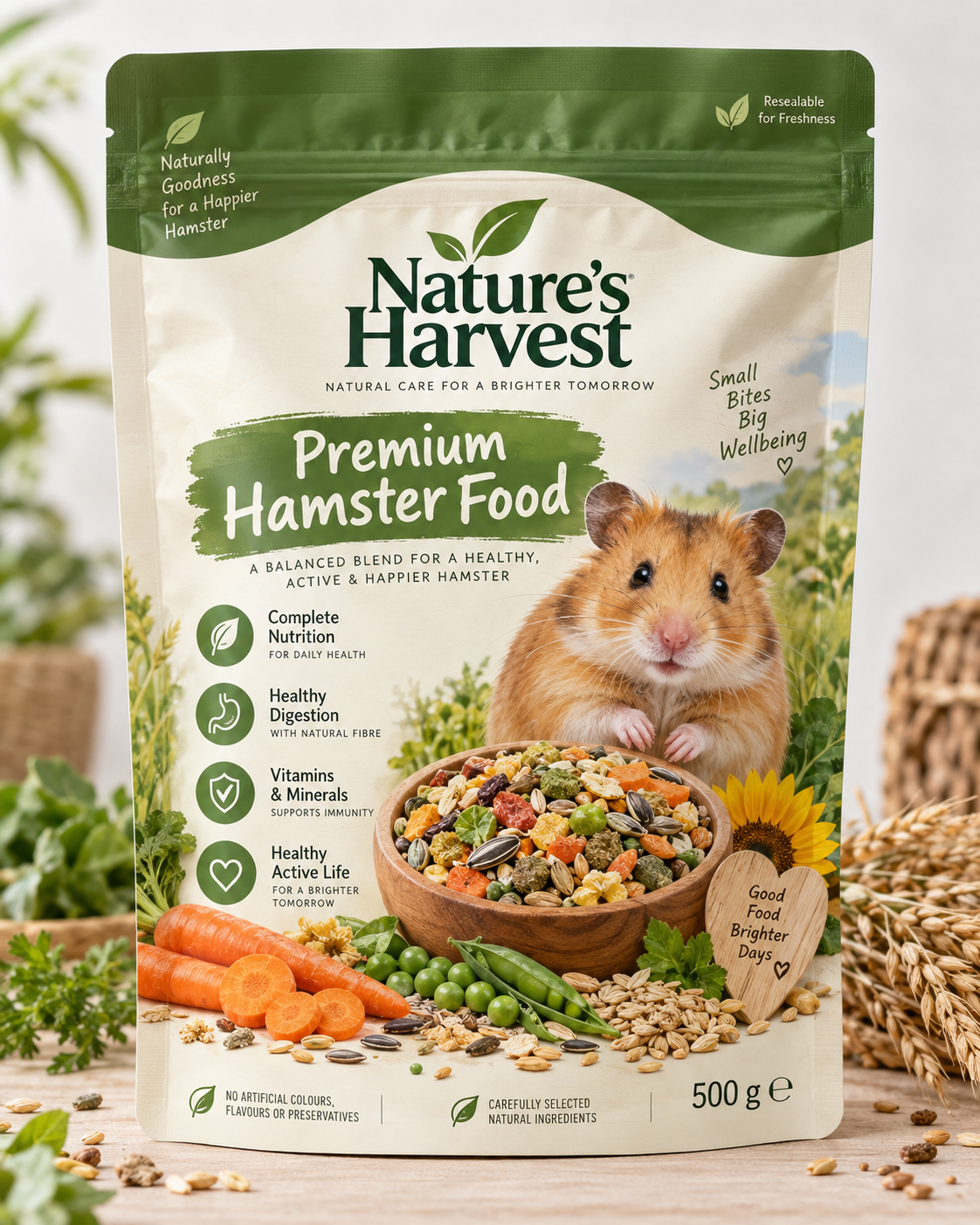
Candidate foods should be evaluated only after the observed feeding pattern has been defined, relevant format characteristics have been identified, and the current product formulation has been verified.
For every candidate product, establish:
- exact current product and manufacturer
- intended species
- physical format
- current ingredient list
- guaranteed analysis
- relevant nutrient values
- feeding directions
- manufacturer adequacy claims where present
- independent hamster-specific evidence where available
- practical acceptance and selection considerations
Do not rank a product from pellet status, seed content, first ingredient, brand reputation, marketing claims, owner reviews, or price alone.
Product identity → formulation → nutrient data → format → observed acceptance context → evidence-supported suitability
Avoid assuming a product is suitable because it is commonly recommended because: popularity is not nutritional evidence.
Avoid assuming a product is unsuitable because it contains seeds because: ingredient presence alone does not establish total dietary adequacy.
| Candidate Food | Diet Format | Reported Nutrient/Formulation Characteristics | Acceptance/Selection Consideration | Suitability Relevance |
|---|---|---|---|---|
| Candidate A | Verify current format. | Use current first-party ingredient and guaranteed-analysis data. | Evaluate against the observed acceptance pattern. | Do not infer suitability from format alone. |
| Candidate B | Verify current format. | Use current first-party ingredient and guaranteed-analysis data. | Evaluate opportunity for refusal or component selection. | Compare with hamster-specific nutritional evidence. |
| Candidate C | Verify current format. | Keep missing formulation data explicitly unknown. | Do not predict acceptance without evidence. | Preserve uncertainty where evidence is incomplete. |
| Strong acceptance but uncertain nutritional fit | Any format | Evaluate complete formulation independently. | High acceptance may improve practical intake. | Palatability does not establish adequacy. |
| Appropriate formulation but poor observed acceptance | Any format | Nutritional profile may be suitable on paper. | Actual intake may limit practical utility. | Suitability requires both formulation evidence and adequate consumption. |
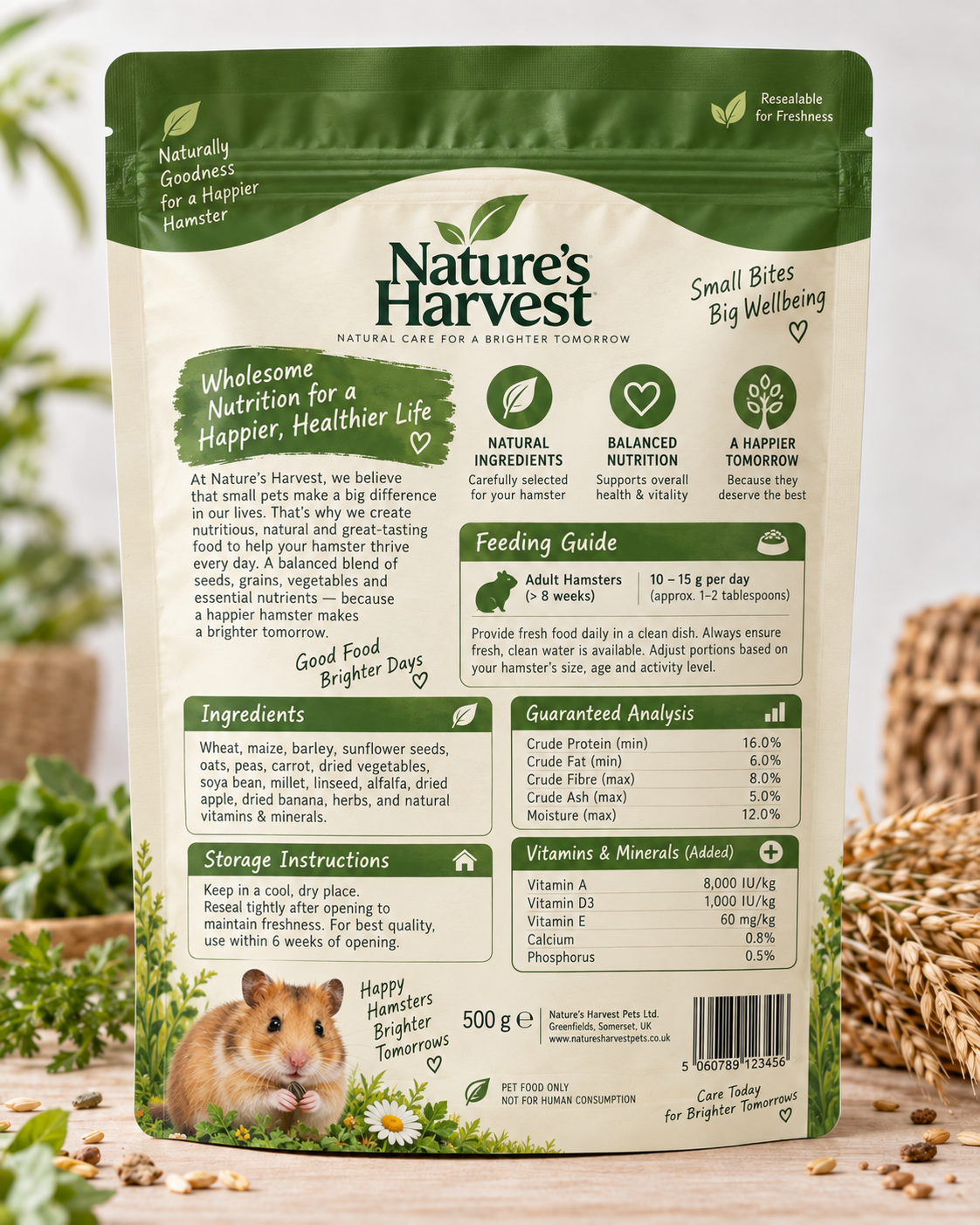
How Do Candidate Foods Compare Using Reported Formulation and Nutrient Information?
Compare equivalent product information where available. Relevant variables can include crude protein, crude fat, crude fiber, moisture, other guaranteed nutrients where relevant, major ingredients, fortification, energy information where reliable, feeding directions, and intended life stage where stated.
Guaranteed-analysis minimums and maximums are not exact analytical composition. Do not invent carbohydrate content, sugar content, amino-acid adequacy, metabolizable energy, digestibility, or exact micronutrient intake unless supported.
Label value → declaration type → hamster evidence → interpretation
Avoid declaring the highest-protein product “best” because: a single nutrient cannot establish overall suitability.
Do Product-Specific Characteristics Change Suitability Beyond Format Alone?
Format comparison cannot answer exact formulation, nutrient profile, ingredient composition, fortification, piece characteristics, feeding instructions, acceptance, actual intake, product-specific selection opportunity, life-stage positioning, or independent evidence.
A uniform product can still be poorly suited nutritionally. A heterogeneous product can still require a full nutritional evaluation. Two pellet products or two seed mixes can differ substantially.
Format establishes behavioral structure, while product formulation establishes nutritional specifics.
Avoid using format as a proxy for product quality because: products within the same format can have materially different formulations.
How Suitable Are Commercial Diet Options for Hamsters With Strong Fresh-Vegetable Preference?
This is the selection stage. Synthesize the observed feeding pattern, actual commercial-food consumption, vegetable consumption, format characteristics, component-selection opportunity, repeated component-selection behavior, current product formulation, nutrient profile, species-specific evidence, practical acceptance, management burden, and remaining uncertainty.
Use this sequence:
Observed behavior → format relevance → product-specific formulation → nutritional fit → actual consumption → practical management → conclusion
Evidence may support one candidate, several suitable candidates, continued use of the current food, a uniform format under defined conditions, a workable heterogeneous format where consumption is adequate, or no confident preference among products.
Reduced commercial-food intake can also warrant broader evaluation rather than another product switch.
Avoid claiming a new product will solve the behavior because: product selection and behavioral outcome are separate evidence questions.
Avoid selecting solely from observed palatability because: high acceptance does not establish nutritional adequacy.
Candidate product → format → formulation → nutrient evidence → observed acceptance → actual intake → management burden → suitability
How Do Candidate Foods Compare Using Combined Format and Product-Level Evidence?
For each candidate, ask what format it uses, how that format affects opportunity for component selection, what its current formulation and nutrient profile are, whether hamster-specific evidence supports that profile, how well the hamster actually consumes it, whether vegetable preference materially reduces baseline intake, and what management burden the product creates.
Do not allow a “better” format to override poorer formulation evidence, or a stronger formulation on paper to override insufficient actual consumption without discussing the trade-off.
Format evidence + product evidence + consumption evidence → practical suitability
Avoid using any one evidence layer as the entire verdict because: practical diet suitability depends on both formulation and actual intake.
Which Feeding-Management Conditions Affect the Practical Suitability of the Baseline Diet?
Relevant management conditions include commercial food actually consumed, fresh vegetables offered and consumed, vegetable availability relative to commercial food, feeding presentation, caching, component selection, product refusal, portioning where supported, total feeding schedule where supported, other supplementary foods, and species-specific considerations.
Do not automatically remove fresh vegetables, withhold them until pellets are eaten, free-feed unlimited commercial food, restrict commercial food to force preference, mix several commercial foods, add protein supplements, add vitamins or minerals, or hand-feed commercial food unless evidence supports the intervention.
Avoid using hunger as a behavioral correction strategy without evidence because: reduced intake and forced food-choice strategies can have welfare and nutritional implications.
When a hamster consistently prefers fresh vegetables over its baseline commercial food, the next step is to evaluate evidence-supported ways to encourage pellet consumption in picky eaters without relying on hunger or forced food restriction.
Avoid assuming vegetable preference must be eliminated because: the goal is an appropriate total diet, not equal acceptance of every food.
How Should You Establish a Feeding and Observation Routine for the Selected Diet?
Only implement a routine after selecting an evidence-supported baseline commercial diet. Potential monitoring variables include exact commercial diet, amount offered where supported, apparent amount consumed, leftovers, component-specific leftovers, fresh vegetables offered and consumed, pouching, caching, baseline-diet displacement, repeated acceptance pattern, body weight or condition where evidence supports monitoring, broader behavior, and evidence-supported concerning changes.
Do not invent universal daily grams, tablespoon amounts, pellet counts, commercial-to-vegetable percentages, feeding frequencies, transition schedules, weight thresholds, or minimum-consumption percentages.
Selected diet → consistent offering → observe → account for caching → distinguish offered from consumed → assess repeated pattern → reassess suitability
Avoid changing commercial product, fresh vegetable type, and feeding presentation simultaneously where practical because: multiple simultaneous variables make the response harder to interpret.
Avoid assuming food disappearance equals consumption because: hamsters may pouch and cache food.
- Confirm the exact current commercial product being fed.
- Verify its current ingredient list and guaranteed analysis.
- Confirm that the selected baseline diet is supported by appropriate nutritional evidence.
- Record commercial food offered.
- Record fresh vegetables offered where supplementation remains appropriate.
- Observe relative acceptance without labeling the hamster from one feeding event.
- Distinguish food approached from food actually eaten.
- Account for pouching and caching.
- Inspect commercial-food leftovers.
- For heterogeneous foods, note repeatedly selected and repeatedly uneaten components.
- For uniform foods, note refusal, partial consumption, or caching.
- Distinguish the offered diet from the actually consumed diet.
- Monitor whether fresh vegetables appear to displace baseline commercial-food intake.
- Do not assume displacement from one observation.
- Do not automatically remove fresh vegetables because they are preferred.
- Do not automatically add another commercial food because the current one is less preferred.
- Do not automatically add supplements to compensate for presumed selective eating.
- Keep species-specific evidence visible.
- Monitor body weight or condition only according to evidence-supported guidance.
- Reassess the feeding plan if persistent low baseline intake or another evidence-supported concern emerges.
How Should Evidence-Supported Portioning Practices Be Applied for the Baseline Diet and Any Conditional Vegetable Supplementation?
Specific quantities or frequencies should only be used where evidence supports them. Where available, identify the baseline diet amount, measurement basis, vegetable identity, vegetable amount, vegetable frequency, species applicability, and source context.
Do not convert a manufacturer package feeding direction into a universal hamster requirement without evaluating context.
Do not invent commercial-to-vegetable ratios, “80/20” rules, teaspoons, tablespoons, pellet counts, cube sizes, or daily vegetable quotas.
If evidence provides only qualitative guidance, state that limitation rather than manufacturing precision.
Evidence-supported amount → implementation → observed intake
Avoid reducing baseline commercial food merely because fresh vegetables are preferred because: preference does not establish that displacement is nutritionally appropriate.
How Should Consumption Be Monitored to Distinguish the Offered Diet From the Actually Consumed Diet?
Offered diet means all food placed into the hamster’s feeding environment. Actually consumed diet means food that is reasonably established as eaten rather than merely offered, transported, or cached.
- amount offered where measurable
- amount visibly eaten
- remaining food
- individual components remaining where applicable
- food transported
- food cached
- vegetable offered
- visibly consumed
- remaining pieces
- transported pieces
- cached pieces
- vegetable-first consumption
- commercial food consumed later
- repeated commercial refusal
- repeated component selection
- primary-diet displacement
- changes after presentation adjustments
Do not infer empty bowl = complete consumption, missing vegetable = consumed, or commercial food left = nutritionally unsuitable without accounting for storage and repeated observations.
Offered → observed → cached/transported → actually consumed estimate → nutritional interpretation
Avoid calculating nutrient intake from offered food when actual consumption is uncertain because: the nutrient profile of the bowl may differ from the hamster’s actual consumed diet.
- Define the observable food-preference pattern.
- Separate preference from nutritional adequacy.
- Evaluate moisture, texture, presentation, and context without assuming a single cause.
- Distinguish uniform from heterogeneous commercial formats.
- Separate opportunity for component selection from observed selective intake.
- Evaluate named candidate foods using current product-specific formulation and nutrient evidence.
- Do not choose a product from format alone.
- Integrate product suitability with actual consumption.
- Preserve species-specific evidence boundaries.
- Retain fresh vegetables only within an evidence-supported total feeding plan.
- Distinguish offered food from the actually consumed diet.
- Monitor repeated patterns rather than one feeding event.
Do not conclude universally that pellets are best for picky hamsters, seed mixes are unsuitable, uniform blocks cure selective feeding, fresh vegetables cause commercial-food refusal, fresh vegetables should be removed, one brand is universally best, a preferred food is nutritionally superior, a less-preferred food is nutritionally inappropriate, fresh vegetables can replace the commercial baseline, or all reduced commercial-food intake is behavioral unless the completed evidence review supports the exact conclusion.
Avoid forcing a universal “best food” because: suitability depends on product formulation, format, species, observed feeding behavior, actual intake, and management context.