
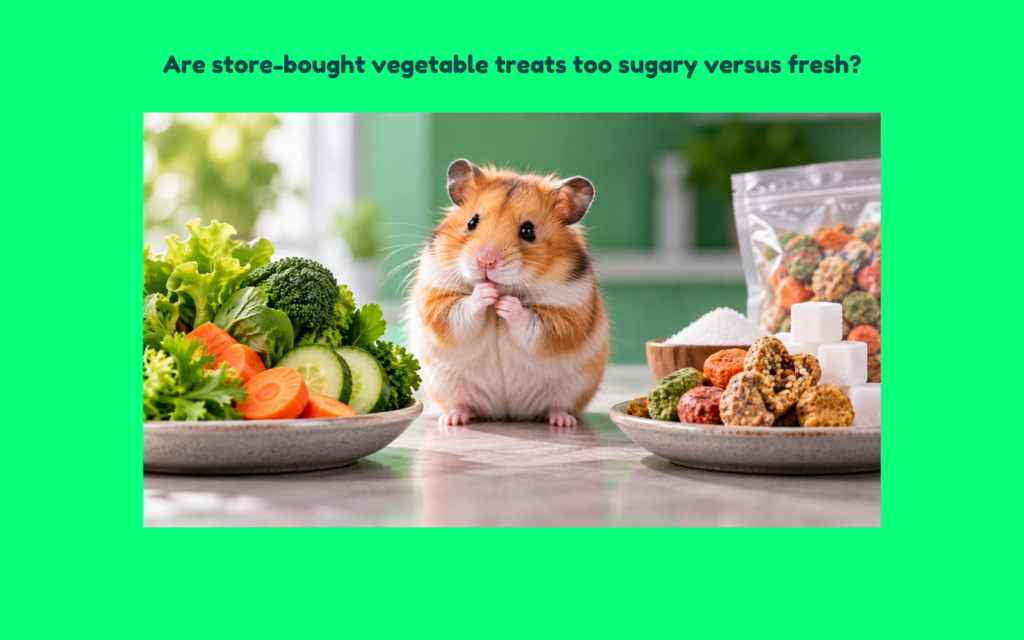
Are Store-Bought Vegetable Treats Too Sugary Versus Fresh? A Dietary Evaluation
Store-bought vegetable treats can differ from fresh vegetables in moisture, processing, ingredient composition, and serving size. Whether a commercial product results in meaningfully greater sugar intake depends on the vegetable or formulation being compared, inherent sugars, any added sweeteners, moisture-adjusted concentration, the amount actually fed, and the hamster-specific evidence used to interpret that intake.
A valid comparison therefore needs to establish the exact commercial product, the exact fresh comparison vegetable, whether the comparison is like-for-like, whether the commercial item is single-ingredient or multi-ingredient, its inherent sugars, any added sweeteners, moisture, as-fed sugar concentration, dry-matter sugar concentration where calculable, serving amount, estimated intake, hamster species where relevant, and overall treat-feeding context.
- Dehydration can increase nutrient concentration per unit weight by removing water.
- Greater sugar concentration per 100 g does not automatically mean greater sugar intake per feeding.
- Fresh vegetables contain naturally occurring sugars.
- The presence of a sweetener does not reveal total sugar exposure without quantitative data.
- Absence of an added sweetener does not mean a product contains zero sugar.
- An ingredient list alone does not establish exact sugar concentration.
- Sugar concentration and sugar intake are different variables.
- A multi-ingredient baked or extruded treat is not simply the dried equivalent of one vegetable.
- A strict hamster sugar threshold should not be invented without direct evidence.
- Syrian, dwarf, and other hamster populations should not automatically receive the same metabolic interpretation.
Avoid treating concentration as intake because: the amount consumed determines exposure as well as nutrient concentration.
Avoid treating dehydration as sugar addition because: removing water can increase sugar concentration by weight without adding sugar molecules.
Avoid treating a commercial category as one formulation because: baked, extruded, formulated, dehydrated, and freeze-dried products can differ substantially.
The comparison should follow this sequence:
Exact item → valid comparison basis → sugar concentration → serving exposure → hamster-specific evidence → practical suitability
How Do the Physical and Formulation Characteristics of Commercial Versus Fresh Vegetables Differ?
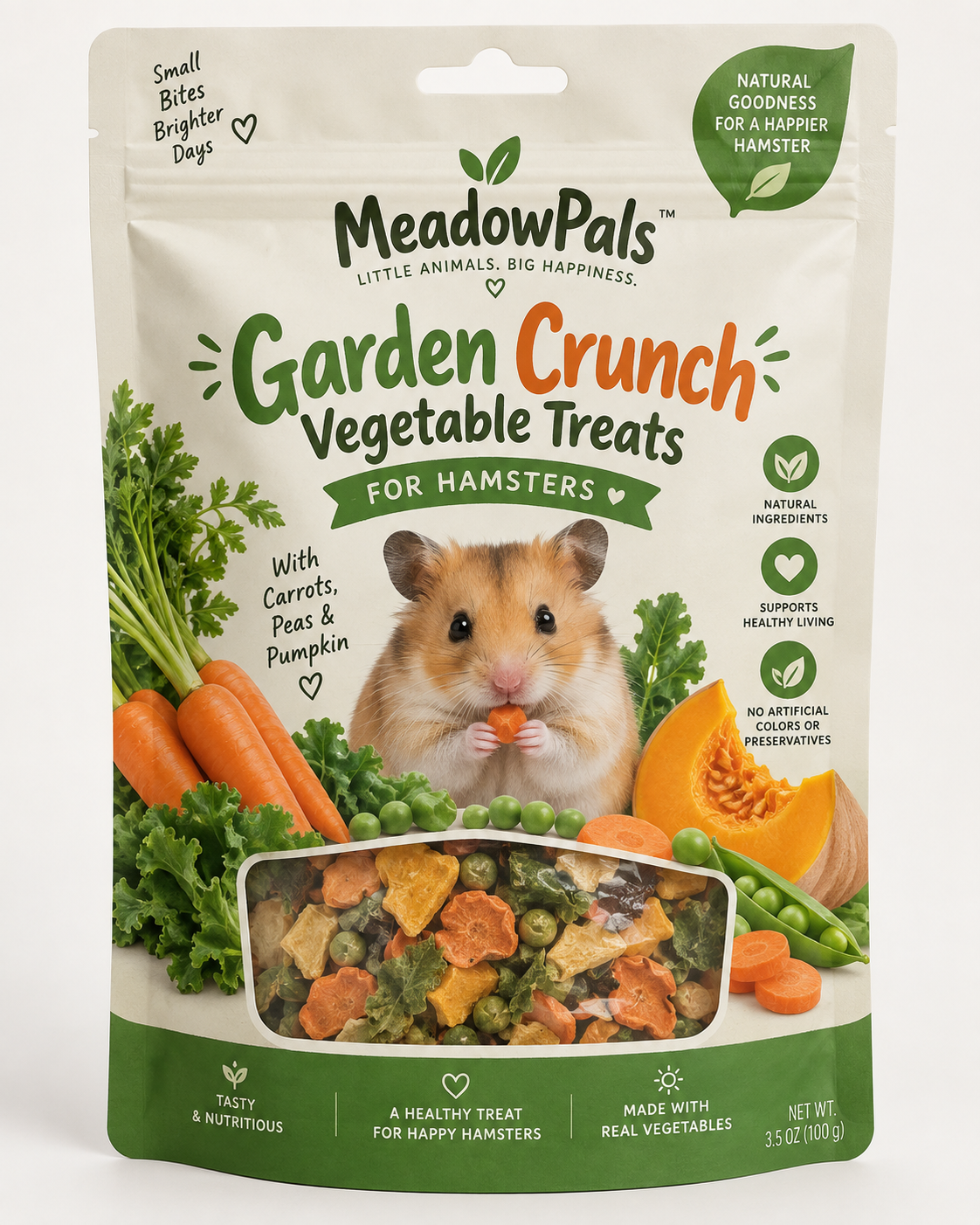
Start by classifying the exact foods being compared. Commercial “vegetable treats” can include dehydrated pieces, freeze-dried pieces, baked products, extruded treats, formulated biscuits, compressed treats, or multi-ingredient vegetable snacks. Fresh comparisons should use the same vegetable where possible, or the closest explicitly justified comparison when an exact match is unavailable.
For each commercial product, establish:
- exact product name
- vegetable source or sources
- processing method where disclosed
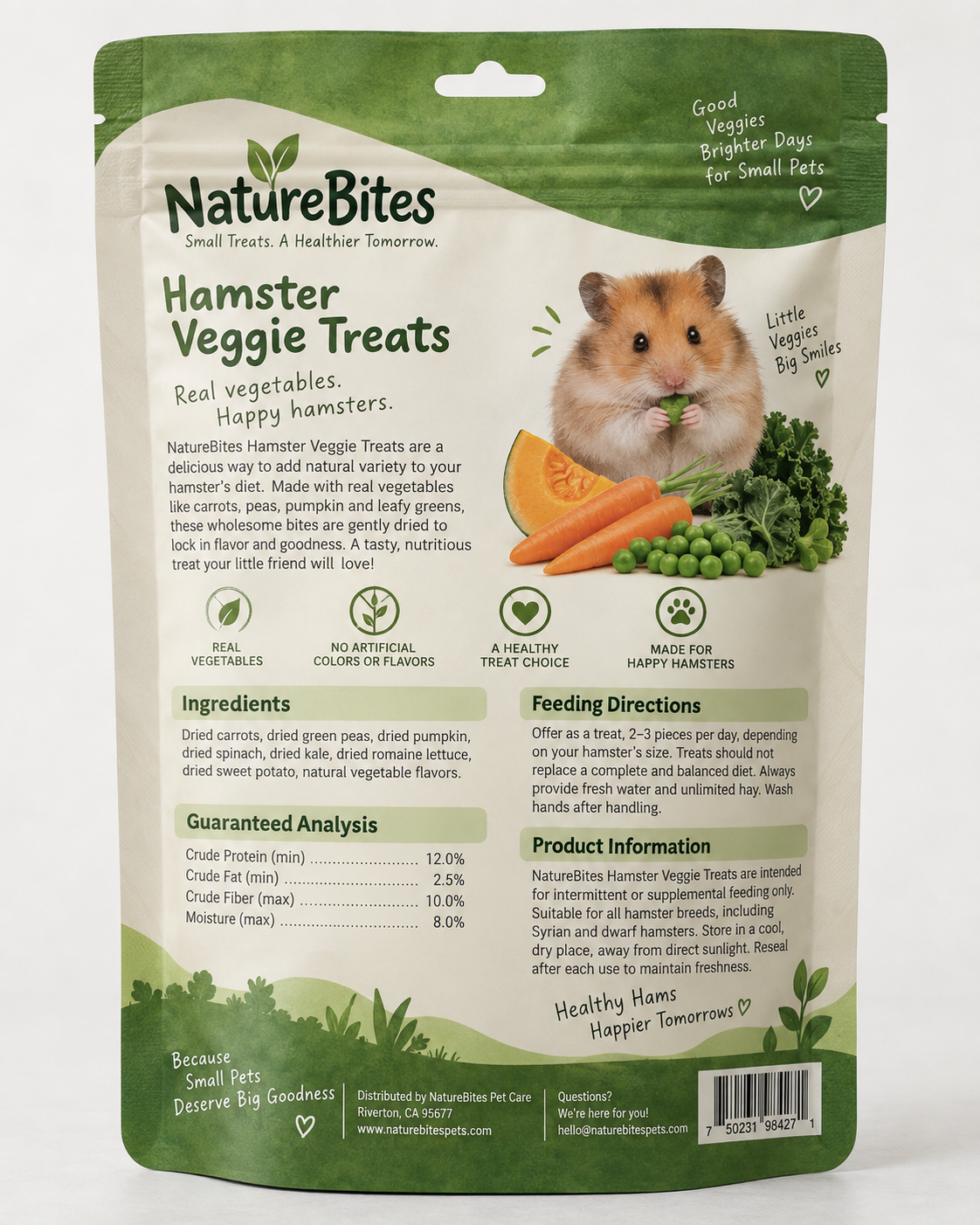
- ingredient list
- added sweeteners where present
- other non-vegetable ingredients
- moisture where available
- total sugar where available
- serving information where available
For each fresh vegetable, establish:
- exact vegetable identity
- raw versus cooked state
- edible portion used in composition data
- moisture
- total sugar
- serving or comparison basis
Do not use the label “vegetable treat” as evidence that a product is predominantly vegetable, and do not assume that a product contains only the vegetable pictured on the package.
Keep these categories separate:
Single-ingredient commercial vegetable
Multi-ingredient commercial vegetable formulation
Fresh vegetable
Avoid comparing a formulated biscuit directly with raw carrot as if dehydration were the only difference because: grains, binders, oils, sweeteners, or other ingredients can alter the nutrient profile.
Avoid treating processing method as a nutritional verdict because: processing identifies a physical or formulation difference but does not independently establish suitability.
Product identity → product type → processing method → ingredient composition → moisture → sugar data → valid comparison type
Do not begin with commercial = sugary / fresh = low sugar.
How Do the Sugar Content Profiles of Processed and Fresh Vegetable Options Compare?
This is the main quantitative comparison. Before comparing values, establish the exact commercial product, exact fresh vegetable, whether the comparison is like-for-like, whether the commercial product is single- or multi-ingredient, the source of each sugar and moisture value, the measurement basis, and whether each value is measured, declared, estimated, or unavailable.
Do not combine incompatible data. A commercial value reported per 100 g should not be compared directly with a fresh-vegetable value reported per serving and presented as equivalent.
| Comparison Item | Product Type | As-Fed / Dry-Matter Evidence | Added Sweeteners | Serving Basis | Interpretation |
|---|---|---|---|---|---|
| Fresh vegetable | Raw fresh produce | Populate only from reliable composition data. | None unless prepared with additional ingredients. | State exact basis used. | Establish baseline for the matched vegetable. |
| Single-ingredient dehydrated vegetable | Commercial processed vegetable | Compare as-fed and dry-matter values where valid data permit. | Verify current ingredient list. | State exact basis used. | Separate moisture concentration from compositional change. |
| Multi-ingredient commercial vegetable treat | Formulated commercial product | Use product-specific nutrition data only. | Identify verified sweeteners where present. | Use verified serving basis where available. | Do not treat as the direct equivalent of one fresh vegetable. |
| Product with no quantitative sugar declaration | Commercial treat | Leave sugar value unknown unless supported by another reliable source. | Ingredient list may identify a sweetener but not exact total sugar. | Do not invent. | Qualitative ingredient evidence cannot substitute for quantitative sugar data. |
| Product with incompatible comparison data | Any format | Do not force numerical comparison. | Record only verified information. | State limitation. | Preserve uncertainty rather than manufacturing equivalence. |
The matrix should be used as:
Product identity → measurement basis → sugar profile → serving basis → interpretation
How Does Sugar Concentration Compare on As-Fed and Dry-Matter Bases to Separate Moisture Effects From Compositional Differences?
As-fed basis describes the food in the state in which it is offered, including its water content. It is useful for serving-level calculations and for comparisons when serving mass is known.
Dry-matter basis removes water mathematically to compare nutrient concentration independent of moisture. Where reliable moisture data exist:
Any derived result should be labeled as a calculated estimate. Do not calculate when moisture data are unavailable, sugar data use an incompatible basis, product composition is insufficiently defined, or values come from mismatched formulations.
The dry-matter comparison should answer:
Is the apparent concentration difference primarily explained by water removal, or does the composition also differ?
It should not answer:
Which treat is automatically better?
A dehydrated product can have more sugar per 100 g because water has been removed while being offered in a much smaller mass. That concentration difference alone does not establish greater or lower sugar intake per feeding.
Avoid saying dehydration creates sugar because: water removal changes concentration, not necessarily the total sugar contained in the original material.
Avoid comparing only dry-matter concentration when the reader’s actual question concerns feeding exposure because: serving amount remains necessary to estimate intake.
How Can Inherent Vegetable Sugars Be Distinguished From Added Sweeteners on Commercial Ingredient Lists?
Keep three categories separate:
inherent sugars
added sweeteners
total measured sugar
A vegetable can naturally contain sugars without added sweeteners. A commercial product may contain no added sweetener, one added sweetener, multiple sweetening ingredients, or other ingredients that naturally contribute sugars.
Potential sweetener terms can include sugar, sucrose, molasses, honey, glucose, corn syrup, or other syrups where they are actually listed. For each commercial product, ask:
- Does the current ingredient list identify an added sweetener?
- If yes, which one?
- Is its quantity disclosed?
- Is total sugar disclosed?
- Can the contribution of that sweetener be quantified?
Ingredient-list evidence can establish presence of a sweetener, while nutrition data are needed to establish amount of sugar.
Avoid calling inherent vegetable sugars “added sugar” because: they are analytically and formulation-wise different categories.
Avoid using sweetener presence alone as a safety verdict because: dose and total dietary exposure remain unresolved.
How Relevant Is Sugar Content to Hamster Dietary Suitability?
“Too sugary” should not be treated as a known hamster threshold unless hamster-specific evidence actually defines one. Evaluate carbohydrate metabolism, sugar intake, dietary sugar restriction, treat feeding, obesity or metabolic disease where directly relevant, species-specific susceptibility, and total dietary context without converting one evidence category into another.
Keep these categories distinct:
- documented nutrient requirement
- experimental exposure level
- clinical risk factor
- husbandry recommendation
- internet feeding rule
The correct sequence is:
Measured or estimated sugar exposure → hamster-specific evidence → applicability → dietary interpretation
Because dehydration can concentrate naturally occurring sugars by weight, the suitability of dried carrots for diabetic hamsters should be evaluated separately using serving exposure and hamster-specific evidence.
not:
contains sugar → unsafe
Avoid using human sugar guidelines because: they are not hamster dietary thresholds.
Avoid importing guidelines from rabbits, guinea pigs, rats, or mice without explicit justification because: cross-species dietary rules require evidence of applicability.
For each evidence source, identify hamster species, population or strain, age or life stage, study purpose, diet composition, sugar type, dose or concentration if reported, exposure duration, outcome measured, and relevance to companion-hamster treat feeding.
How Can Sugar Concentration Be Distinguished From Estimated Sugar Intake Based on Amount Consumed?
Sugar concentration = sugar per defined quantity of food
Estimated sugar intake = sugar concentration × amount actually consumed
A food can have a higher sugar concentration but be eaten in a much smaller mass, or a lower concentration but be eaten in a larger mass. Therefore, evaluate:
Concentration → amount offered → amount consumed → estimated sugar intake
Where serving quantity is known and quantitative sugar data are reliable, estimated sugar intake can be calculated. Where actual consumption is unknown, offered sugar should not be labeled as consumed sugar.
Account for uneaten pieces, pouching, caching, partial consumption, and repeated feeding. Do not invent consumption percentages or assume a manufacturer serving size equals hamster consumption.
Avoid saying the higher-concentration product produces greater sugar exposure without considering serving amount because: total intake depends on both variables.
Avoid using “per 100 g” differences alone to dictate treat choice because: hamsters are not necessarily consuming equal 100 g quantities of each product.
Does Hamster-Specific Nutritional Evidence Define a Sugar-Intake Threshold?
Search specifically for a direct hamster sugar threshold rather than assuming one exists. The evidence may show a defined threshold, experimental doses without a companion-animal threshold, qualitative veterinary limitation, taxon-specific findings, or insufficient evidence for a numeric limit.
If no direct threshold exists, state that clearly. Do not manufacture grams of sugar per day, percentage of calories from sugar, body-weight-based cutoffs, weekly sugar maxima, “safe” sugar percentages, or glycemic cutoffs from unrelated research.
Do not convert an experimental disease model into a routine pet-hamster feeding limit without appropriate evidence.
Avoid presenting an experimental sugar exposure as an established safe upper limit because: experimental dose and husbandry recommendation are different evidence categories.
Does Evidence Support Species-Specific Differences Relevant to Sugar Evaluation?
Keep species distinctions explicit. Potential populations may include Syrian or golden hamsters, Campbell’s dwarf hamsters, Winter White or Djungarian hamsters, Roborovski hamsters, Chinese hamsters, and hybrid dwarf populations.
Only discuss differences supported by appropriate evidence. For every species-specific claim, identify the taxon studied, population or strain where relevant, outcome, dietary exposure, and limits of extrapolation.
Keep:
species-specific evidence → species-specific conclusion
Do not upgrade:
one dwarf model → all dwarf hamsters
Avoid using the label “dwarf hamster” as one metabolic category because: distinct taxa may not share identical evidence.
How Suitable Are Commercial Versus Fresh Vegetable Treats?
The final treat comparison should synthesize exact product formulation, fresh comparison vegetable, sugar concentration, measurement basis, moisture, added sweeteners, serving amount, estimated intake where supportable, processing, species-specific evidence, primary-diet context, feeding frequency where supported, and management practicality.
Use this decision sequence:
Product or vegetable identity → sugar profile → serving exposure → hamster evidence → feeding context → practical suitability
Possible evidence-derived outcomes include:
- the fresh vegetable is more appropriate in the defined comparison
- the commercial vegetable treat is appropriate under defined conditions
- either format may be suitable depending on product and serving
- a particular commercial formulation raises an evidence-supported concern
- a direct comparison cannot be made from available data
- neither format requires rejection solely because it contains sugar
Do not force a category-wide winner.
Avoid making the selection from processing status alone because: product-specific formulation and actual intake matter.
Avoid selecting from sugar concentration alone because: total dietary exposure and other formulation characteristics remain relevant.
Exact item → formulation → sugar basis → added sweeteners → likely serving exposure → hamster-specific relevance → management burden → conclusion
What Are the Feeding Trade-Offs of Commercial Vegetable Treat Formats Compared With Fresh Vegetables?
Commercial vegetable treats may include dehydrated, freeze-dried, baked, extruded, formulated, compressed, or other verified formats. Do not collapse every commercial option into “dried vegetables.”
Potential commercial-treat trade-offs include shelf stability, lower or different moisture, concentrated nutrient density by weight, added ingredients, possible sweeteners, manufacturer-defined piece or serving formats, formulation complexity, storage convenience, and portion visibility.
Potential fresh-vegetable trade-offs include high moisture, minimal formulation complexity when raw and single-ingredient, naturally occurring sugar, perishability, variable piece size, caching and leftover retrieval, and composition differences between vegetable types.
Do not assume commercial = concentrated sugar for every product, fresh = low sugar for every vegetable, or single ingredient = nutritionally superior without broader evidence.
Format → formulation → sugar exposure → husbandry trade-off → suitability
Avoid scope contraction to dehydrated treats only because: the central entity explicitly includes multiple commercial vegetable-treat formats.
Which Feeding-Management Conditions Affect the Practical Suitability of Either Format?
Evaluate the exact vegetable or commercial formulation, hamster species where relevant, primary diet, sugar concentration, serving amount where supported, added sweeteners, acceptance, caching, leftover management, moisture, portion consistency, feeding frequency where supported, and other treat intake.
Do not automatically recommend fresh vegetables every day, commercial treats only weekly, avoiding all products with sweeteners, fixed treat percentages, vegetable rotation, baseline-food reduction to compensate for treats, or sugar-free treats as automatically superior unless evidence supports those instructions.
Avoid increasing treat frequency because a hamster readily accepts the food because: palatability does not establish dietary need.
How Should You Establish a Feeding and Observation Routine for Vegetable Treats?
Only implement a treat routine after the selected item is shown to be suitable. Treats remain supplementary to the primary diet.
Potential monitoring variables include exact treat, product format, ingredient list, vegetable identity, added-sweetener status, portion where evidence supports one, presentation, acceptance, apparent consumption, pouching, caching, leftovers, primary-diet consumption, and evidence-supported concerning changes.
Do not invent universal grams, piece sizes, teaspoons, percentage of total diet, daily or weekly schedules, sugar quotas, or weight thresholds without appropriate evidence.
Use this implementation sequence:
Verify suitability → determine evidence-supported portion where available → offer → observe → account for caching → monitor baseline intake → reassess
Avoid using a commercial package serving as a hamster-specific serving automatically because: manufacturer serving information may not represent the evidence-supported amount for the hamster being evaluated.
Avoid assuming fresh-treat disappearance equals consumption because: pouching and caching may alter observation.
- Identify the exact commercial product or fresh vegetable being offered.
- Verify that the selected treat is independently suitable for the hamster.
- Confirm whether the commercial item is single-ingredient or multi-ingredient.
- Review the current commercial ingredient list.
- Identify added sweeteners where present.
- Do not infer total sugar from sweetener presence alone.
- Use quantitative sugar data only when the measurement basis is known.
- Distinguish as-fed concentration from dry-matter concentration.
- Compare like-for-like vegetables where possible.
- Treat multi-ingredient commercial products as product-specific formulations.
- Do not equate sugar concentration with sugar intake.
- Use evidence-supported portion guidance where available.
- Do not invent a serving when quantitative guidance is absent.
- Record which treat format is offered.
- Observe acceptance and apparent consumption.
- Account for pouching and caching where relevant.
- Monitor whether treat feeding changes consumption of the primary diet.
- Manage fresh leftovers according to evidence-supported husbandry guidance.
- Do not automatically increase treats because the hamster prefers them.
- Keep species-specific evidence visible where relevant.
- Reassess treat use if evidence-supported concerning changes appear.
How Should Evidence-Supported Portioning and Feeding Practices Be Applied for the Selected Treat Format?
Only provide a quantitative portion or feeding frequency when appropriate evidence supports one. Where supported, specify exact treat identity, portion basis, mass or defined unit, frequency, whether the recommendation applies to commercial or fresh format, hamster species if relevant, and source context.
Do not automatically convert a nutrition-data serving size into a hamster feeding recommendation.
Do not use vague advice such as “a tiny amount,” “a small piece,” “occasionally,” or “in moderation” as if those phrases were quantitative instructions. If the evidence supports only qualitative restraint, state that no more precise amount is established.
Do not prescribe equal masses of fresh and dehydrated vegetables simply for convenience or equal piece counts across differently sized commercial treats.
Avoid treating equal visible portions as equal sugar exposure because: moisture, density, formulation, and piece mass can differ.
How Should Acceptance, Consumption, and Evidence-Supported Concerning Changes Be Monitored?
- approached
- selected
- refused
- repeatedly preferred where relevant
- visibly eaten
- partially eaten
- transported
- missing but not confirmed consumed
- pouched
- moved
- stored
- recovered later
- primary food still consumed
- other treats offered
- repeated treat selection
- leftovers
Include only hamster-specific, appropriately sourced observations. Potential areas, where supported, may include broader reduction in food intake, body-weight or body-condition changes, changes in normal feeding behavior, or other veterinary warning signs.
Do not diagnose diabetes, obesity, glucose intolerance, gastrointestinal disease, dental disease, or nutrient deficiency from treat preference or consumption alone.
Do not imply sugar-containing treat + later symptom = sugar caused symptom.
Observation → pattern → evidence-supported interpretation → appropriate response
Avoid creating a medical checklist from intuition because: clinical escalation criteria require veterinary evidence.
- Identify the exact commercial treat and fresh comparison.
- Distinguish single-ingredient from multi-ingredient commercial formulations.
- Separate processing effects from formulation differences.
- Compare sugar on clearly defined bases.
- Use dry-matter comparison only to separate moisture effects where valid.
- Distinguish inherent sugars from added sweeteners.
- Do not infer total sugar from an ingredient list alone.
- Distinguish sugar concentration from actual estimated intake.
- Determine whether hamster-specific evidence establishes a meaningful sugar threshold.
- Keep species-specific findings separate.
- Compare commercial and fresh formats conditionally rather than declaring a universal winner.
- Use evidence-supported portions and monitoring practices where available.
Do not conclude universally that commercial vegetable treats are too sugary, fresh vegetables are always lower in sugar, dehydrated vegetables contain added sugar, drying makes vegetables unsafe, added sweeteners automatically make a product unsuitable, fresh vegetables contain no sugar, all dwarf hamsters require stricter sugar limits, one sugar percentage determines treat suitability, a universal hamster sugar threshold exists, commercial treats should never be used, or fresh vegetables should always replace commercial treats unless the completed evidence review supports the exact conclusion.
Avoid forcing a category-wide verdict because: commercial vegetable treats are heterogeneous formulations and fresh vegetables differ substantially from one another.