
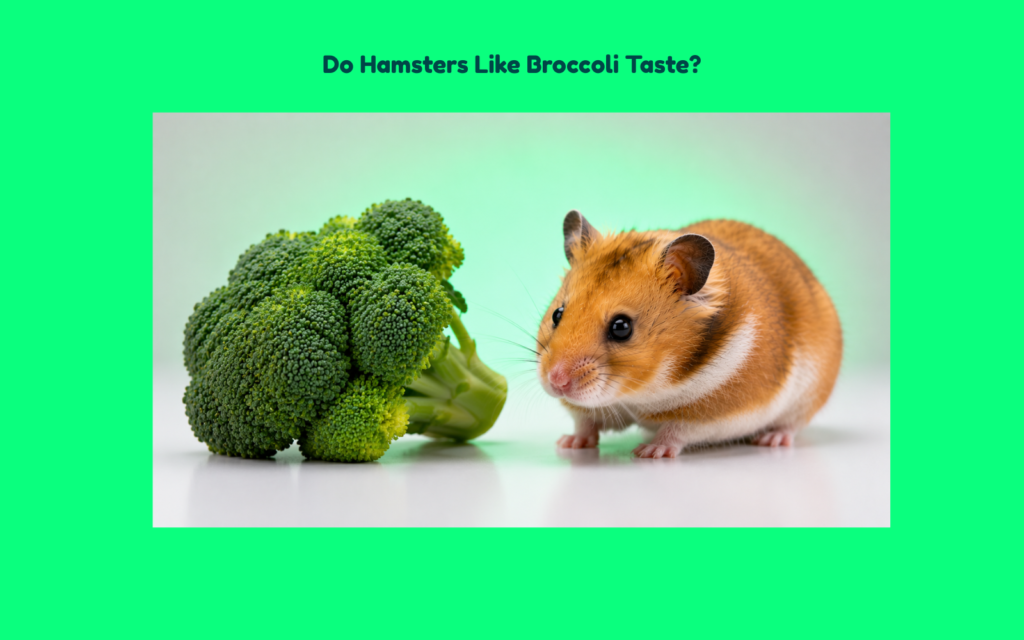
Do Hamsters Like Broccoli Taste?
Hamster owners often place fresh broccoli into the enclosure and wonder if their hamster “likes the taste.” While owners use the word “taste,” the practical reality in the living room involves looking strictly at the sequence of missing pieces. Navigating this comes down to checking whether the fresh broccoli pieces remain visibly present or no longer remain visibly present in the bowl. We are going to break down why owners commonly notice some broccoli pieces no longer remain visibly present before others, how to check the sequence in which broccoli pieces no longer remain visibly present when providing broccoli side-by-side with other vegetables, what a physically modified broccoli piece looks like, what to look for when broccoli remains untouched, and how to check your hamster enclosure for shriveling or discoloration today.
Why do owners commonly notice some broccoli pieces no longer remain visibly present before others?
Here is what hamster owners commonly notice when they look at the fresh vegetable structures in the bowl. Presenting a distinct physical structure like broccoli alongside other fresh vegetable components allows owners to notice a sequence of missing pieces. Owners commonly notice that the broccoli piece may no longer remain visibly present during the same check as other vegetable structures.
SEQUENCE OF MISSING PIECES
Diagram Explanation: This timeline maps the physical presence of a broccoli piece from initial placement (START) through subsequent observation intervals (CHECK 1 & 2), showing how structural presence diminishes over time.
Treating the absence of broccoli as an unobservable “taste” replaces observation with assumption. When you look at the bowl, you see different physical shapes. You might look at a dense, branched broccoli floret sitting next to a flat, circular carrot coin or a smooth, thin spinach leaf. You are simply noticing an observable sequence in which different physical structures leave the original presentation area.
Look at the fresh vegetable structures during multiple bowl observations. You might check the bowl and see that the thin leafy shapes no longer remain visibly present, while the dense, thick broccoli stalks remain visibly present. Look closely at the varying sizes of the broccoli pieces. A large broccoli stem displays a very different physical shape compared to a tiny, detached broccoli floret. During repeated checks, owners commonly notice that tiny, loose pieces no longer remain visibly present, while the massive, solid pieces remain exactly where they were placed.
When you look directly at the presentation area, compare the broccoli with other vegetables side-by-side. You see a clear physical contrast. You see the textured, dome-like top of the broccoli and the smooth, wet surface of a cucumber. You might check the bowl in the morning and see that the cucumber no longer remains visibly present. You might check the bowl in the evening and notice the broccoli piece remains visibly present. You simply notice a sequence where several fresh vegetable structures no longer remain visibly present before others.
How do you check the sequence in which broccoli pieces no longer remain visibly present when providing broccoli side-by-side with other vegetables?
Look at the broccoli pieces side-by-side with other distinct fresh vegetable components. Dropping broccoli randomly into the bedding hides the fresh vegetable structures and prevents you from noticing what remains. Instead, a side-by-side presentation clearly shows the sequence of missing broccoli pieces and other missing vegetable pieces.
SIDE-BY-SIDE LAYOUT
Diagram Explanation: This visual map displays three distinct vegetable shapes (Broccoli, Celery, Zucchini) arranged side-by-side to facilitate clear, comparative monitoring of which specific structures leave the bowl.
Place a distinct broccoli piece side-by-side with a piece of celery and a piece of zucchini in the presentation area. Look at the presentation layout. You see the three distinct fresh vegetable structures resting next to each other on the flat surface. Check the presentation area later. Notice when you look at the bowl later that the zucchini piece no longer remains visibly present, but the broccoli piece remains visibly present.
Perform repeated bowl checks to see the exact sequence of missing pieces. You might check the presentation area and see that the zucchini piece no longer remains visibly present. Check the presentation area again after a few hours. You might notice that the celery piece no longer remains visibly present, leaving only the broccoli piece sitting in the bowl. Compare the broccoli pieces with neighboring vegetable pieces during every single check. You might see a soft, leafy green sitting next to the rigid broccoli stalk.
Look at the sequence of missing pieces across multiple checks. You might check the bowl and see the soft vegetable piece no longer remains visibly present. Check the bowl again, and you might see the flat vegetable piece no longer remains visibly present. Check the bowl a final time, and you might see the solid broccoli stalk no longer remains visibly present. You are strictly looking at what remains visibly present and what no longer remains visibly present during repeated checks.
What visual signs distinguish a physically modified broccoli component from an untouched fresh broccoli piece?
Look closely at the edges of the broccoli florets sitting in the presentation area. When you look at the piece later in the bowl, you see immediate visual differences. A physically modified broccoli component displays clear modified edges. You might look at the textured top of the broccoli floret and see jagged, uneven sections. Look closely at the stalk. Notice the missing chunks. You might see small, semi-circular indentations cut directly into the thick, fibrous stem.
PHYSICAL MODIFICATION
Diagram Explanation: This comparative view highlights the geometric contrast between an intact floret (left) and the irregular, jagged shape resulting from physical interaction (right).
Compare an intact piece with a physically modified broccoli component. Look at an untouched fresh broccoli piece. An untouched broccoli piece remains exactly where it was placed. Look at the physical structure. It remains completely unchanged. Look at the outer edges of the untouched piece. You see perfectly intact florets and cleanly cut edges along the stalk with no missing chunks.
Perform side-by-side visual comparisons. Place an untouched broccoli piece directly next to a physically modified broccoli component. On the physically modified piece, you see modified edges and broken sections. You see a visibly smaller physical shape than the piece you originally placed in the bowl. On the untouched broccoli piece, you see the exact shape you originally created with the knife.
Owners commonly see tiny green crumbs resting around a physically modified broccoli stalk. Look at these missing chunks scattered on the presentation surface. When you look at the bowl later, comparing the missing chunks and modified edges to the cleanly cut, intact pieces allows you to clearly see the physically modified broccoli components resting in the presentation area.
What should you do if you notice repeated checks where broccoli components remain visibly present in the hamster enclosure?
Look at the untouched broccoli pieces that consistently remain visibly present during repeated bowl observations. If you look at the bowl and notice that the exact same broccoli stalk remains visibly present across multiple checks, look closely at alternative vegetable structures.
Place a different fresh vegetable component into the presentation area next to the untouched broccoli pieces. You might introduce a soft leafy green or a thin bell pepper slice. Compare the physical differences you see. Look at the physical shape of the dense broccoli stem compared to the physical shape of the thin leaf. Compare the rigid, fibrous exterior of the broccoli to the smooth, flexible surface of the alternative vegetable. Check the presentation area later. Notice if the thin leafy piece no longer remains visibly present while the solid broccoli stalk remains visibly present.
Look beyond the presentation area. Look at the enclosure corners and caches. You might look at the presentation surface and see no broccoli pieces. However, if you look directly at the bedding in the corner, you might see the untouched broccoli pieces resting exactly as they were cut. Compare what you see sitting in the bowl with what you see sitting in the caches. You are simply looking at the untouched broccoli pieces and comparing their physical shapes to alternative vegetable structures sitting in the enclosure.
How do you check your hamster enclosure today to see the visible condition of previously provided broccoli pieces?
Walk over to your hamster enclosure right now. Perform a full enclosure walkthrough to see the exact visual condition of any previously provided fresh broccoli pieces. Look closely at the top layer of bedding. Check the presentation surface where you originally placed the fresh vegetable structures. Look directly at the physical components resting on the bedding.
ENCLOSURE INSPECTION MAP
Diagram Explanation: This spatial map identifies the two critical monitoring zones: the primary presentation point (Bowl) and the secondary hoarding destination (Cache) for checking structural changes.
Check for visible wilting, visible shriveling, or visible discoloration. When you look at previously provided broccoli pieces, you might see visible wilting, visible shriveling, or visible discoloration. Look at the tiny green florets on a previously provided piece. You might see visible wilting, where the textured top appears flattened and less rigid. Look at the thick broccoli stem. You might see visible shriveling, where the outer edges curl inward and the physical shape appears significantly smaller.
Check the primary caches. Look at the previously provided broccoli pieces hidden in the corners. You might see visible discoloration, where the bright green florets and pale green stalk appear dark, brown, or significantly altered in color when compared to a fresh piece.
Compare a fresh broccoli piece to a previously provided broccoli piece side-by-side. Look at the crisp, bright, cleanly cut edges of the fresh broccoli piece. Look at the visible wilting, visible shriveling, and visible discoloration on the previously provided piece sitting in the cache. Notice the physical condition of the broccoli. If you see visible wilting, visible shriveling, or visible discoloration on the previously provided broccoli pieces, you are simply noticing the visible physical condition of the components sitting in the enclosure. Perform this visual check on your hamster enclosure today.
References
Disclaimer
Disclaimer: The information provided is for observational purposes only and does not constitute veterinary medical advice. Always consult with a qualified veterinarian regarding your hamster’s health and dietary needs.