
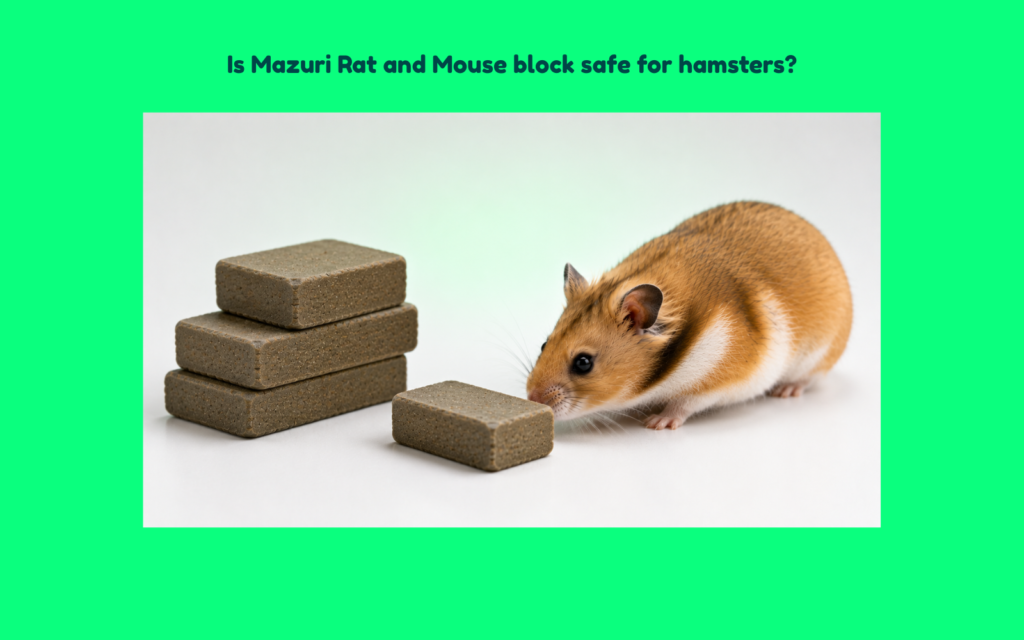
Is Mazuri Rat And Mouse Block Safe For Hamsters?
It is an incredibly common experience. Owners see people recommending Mazuri Rat and Mouse blocks online and immediately worry about invisible health factors like “protein overload” or if rat food is biologically safe for hamsters. You might sit on your couch, holding one of these large, rectangular blocks in your hand, placing it right next to a familiar scoop of your regular seed mix. The visual contrast is immediate. You look at the tiny, scattered seeds, and then you look at this dense, perfectly uniform shape. Naturally, you begin wondering what will actually happen to this massive item after placing it inside the enclosure.
While toxicological safety is a medical question reserved for veterinary professionals, answering whether this massive block fits into your specific enclosure comes down to what you can see. In the living room, practical use relies on one visible test: owners commonly look to see whether the large block breaks into smaller pieces and dust over time, or if the dense rectangles simply remain completely intact in the dark corners.
We are going to break down why owners introduce these large blocks, how to check the bedding after placing them in the cage, how to visually distinguish between an intact block and an altered block, and how to check your hamster’s stash today.
Why do owners commonly introduce large blocks to the bowl?
Here is what owners commonly observe when they hold a Mazuri block in their hand. Look at the physical shape of the item. It is a large, dense, standardized rectangle. It retains a highly uniform structure. There are no loose parts, no husks, and no varied textures. It is one solid piece.
Compare the tiny seeds with the dense block. A standard seed mix is made of very small, varied items that easily blend together in the bowl. When you look at the seeds, they form a flat, even layer inside the dish. Placing the Mazuri block into the dish introduces a completely different physical presentation. It sits as a singular, highly visible shape resting on top of the smaller grains. It stands out completely. You do not have to sift through the dish to find it; the block changes the entire visual appearance of the feeding area just by sitting there.
Chart Explanation: This diagram illustrates the stark visual contrast between a standard seed mix and a dense Mazuri block. While small seeds spread evenly and blend into the environment, the standardized block remains a distinct, highly visible object resting on the surface.
Because the block is so distinct, it is incredibly easy to locate compared with loose seeds. If a small brown seed is moved into a pile of brown bedding, it blends in perfectly. If a large, uniform rectangle is moved, its distinct shape remains obvious. Treating the block solely as an invisible supplement masks the simple reality that it is a dense, solid object that you can easily locate by looking in the cage. When you place it in the enclosure, you are introducing a massive physical item. Checking if it fits into your routine requires looking for this specific rectangular shape among the bedding and the regular seed mix later.
How do you verify what happens to the large blocks after they leave the bowl?
Following this large object requires simple daily checks across multiple locations. Look at the block in the bowl on Day 1. Notice the exact size and rectangular profile resting inside the ceramic dish. Take note of its sharp corners and perfectly flat sides.
On Day 2, check whether the specific shape remains visibly present in the bowl. If the shape is still sitting in the dish, nothing has changed. If the block is visibly absent from its original location, note the change and continue inspecting other visible areas of the enclosure. You must visually scan the different sections of the habitat.
Look at the corners the next day. Visually inspect the surface of the substrate along the glass or plastic walls. Check the entrances to the buried tunnels. Often, large items are left right at the opening of a tube, completely visible on the surface. Next, check the areas near the main hides. Look closely at the bedding right outside the wooden or ceramic houses.
Simply dropping blocks into the cage without checking the bedding can leave you with large rectangular chunks filling up multiple areas of the enclosure. Conversely, physically looking at the corners and hoards allows you to locate the block and see exactly what it looks like now. You might see the rectangular shape sitting perfectly undisturbed on a platform, or you might spot it resting on a pile of paper bedding in the far left corner. By checking these multiple enclosure locations over consecutive days, you can visually verify where the block travels after it leaves the ceramic dish.
Chart Explanation: This map highlights the primary inspection zones within a standard enclosure. Tracking the block requires daily visual sweeps moving from the food bowl to the corners, tunnel entrances, and the main hide to document the object’s physical location.
What visual signs separate an intact block from an altered block?
When you locate the object in the bedding, look closely at the edges of the item. What you see on the surface tells you what is happening. You must look closely at the physical contours.
A completely intact Mazuri block is smooth and perfectly rectangular. It retains its full original manufactured size and shape. There are no marks, no missing sections, and no surface alterations. The corners remain completely sharp. The edges are perfectly flat. When you hold an intact block up to the light, the silhouette is unbroken and uniform.
Compare an intact block with a visibly altered block. Notice the visible marks on the surface of the altered unit. The edges appear rough, and the overall rectangular shape is visibly reduced. You might see that one of the sharp corners is now rounded off or completely missing. You might notice heavy scraping along the flat sides. The entire item might look like a smaller, jagged version of its original self, with missing corners and uneven textures completely replacing the once-smooth surface.
Chart Explanation: This comparison demonstrates what to look for during a visual audit. An intact block retains sharp, manufactured edges, whereas an altered block will show visible signs of physical reduction, rough contours, and the accumulation of surrounding block dust.
Alongside the reduced shape, you will notice the distinct presence of crumbly block dust resting on the bedding directly beneath the piece. You might see small, grainy crumbs scattered across the wood shavings. Finding this block dust, these scattered crumbs, and the altered edges allows you to clearly see that the large shape is being broken into smaller pieces and dust, without having to guess how it happened. The visual evidence is right there on the substrate: a rough-edged block sitting in a small pile of its own dust.
What should you do if you see repeated intact blocks in the cage?
If you check the enclosure and locate these large, dense rectangles resting on the substrate, check their visible location and quantity. Look at what is left in the corners. You may find fully intact blocks sitting visibly on the surface or grouped together inside a hide.
Compare the quantity of intact blocks across repeated checks. Finding one intact block during a check is a common observation. However, locating the same intact rectangles across several days shows that the blocks remain visibly present in the enclosure. You must conduct repeated corner checks to confirm this. Look inside the main hides over the span of three or four days. If you observe the exact same sharp-edged shapes sitting in the exact same corners during every single inspection, the visual record is clear.
Review your routine by referencing what you see. You can reassess this situation using a simple visual review:
- Visually locate areas in the corners or hoards where the large, intact blocks repeatedly appear.
- Review how often you add a new block to the bowl.
- Compare the frequency of block addition alongside the visible quantity of intact blocks across your repeated checks.
- Reviewing how often blocks are added becomes especially important when they are used alongside a separate seed mix because both items contribute to the total amount of food visibly present inside the enclosure.
- Compare the locations over several days by observing the same shapes in the same places to verify if the blocks are moving.
- Continue looking at the visible shape and location of the blocks in the bedding while reviewing your current addition schedule.
How do you check your enclosure today to see the block’s condition?
You do not need to wait for a full bedding change to look for the blocks. You can perform a quick visual check on your active enclosure right now by walking through the specific areas of the cage.
Walk over to the enclosure, lean in close, and kneel down so you are at eye level with the surface. Begin with a thorough bowl inspection. Look inside the dish to see if the block is still resting on top of the seeds. Next, perform a bedding inspection. Look closely at the top layer of bedding. Conduct a corner inspection by checking the primary corners where the substrate meets the glass or plastic. Move your focus to perform a tunnel entrance inspection to see if a massive block is sitting at an opening. Finally, conduct a hide and hoard inspection. Gently lift the roof off the main multi-chamber house to look directly at the stash.
Visual Audit Checklist
-
Target inspection zone: Checking the top layer of bedding, the bowl, the tunnel entrances, and the primary caches.
-
Visual indicator: Locating completely intact blocks with sharp corners versus finding crumbly block dust, missing corners, and altered edges.
-
What to look for: Checking whether completely intact blocks appear in larger amounts across repeated daily checks.
-
Action to take: If you notice differing quantities of completely intact blocks piling up across your checks, continue reviewing the current addition schedule.
Perform this visual check on your enclosure today, and locate the blocks to physically see what remains in the corners.
Conclusion
Keeping track of a dense, standardized item like a Mazuri block relies entirely on looking at its visible shape and location within the enclosure. By identifying the distinct rectangular shape, checking the bedding over time, and noting the visible differences between completely intact units and altered, rough edges, you can clearly see what happens to the item. The process requires repeated checks over several days to confirm the visible changes. Keep your focus entirely on what is visibly present in the bowl, the bedding, and the corners. This ensures you can keep track of where these large pieces end up by simply looking at what is happening inside the cage, relying strictly on the visible condition of the items you place inside.
References & Further Reading
Disclaimer
The information provided in this article is for educational and observational tracking purposes only. It is not intended as a substitute for professional veterinary advice, diagnosis, or treatment. Always seek the advice of a qualified veterinarian with any questions you may have regarding your pet’s health, diet, or specific medical conditions.