
Higgins Sunburst vs. Harry Hamster: Which Is Better?
It is an incredibly common experience for hamster owners. You stand in the pet store aisle or sit on your living room couch holding a bag of Higgins Sunburst in one hand and a bag of Harry Hamster in the other. You look at the colorful packaging. You read the labels on the back, hoping to find a clear answer to which one is the ultimate choice for your enclosure. The immediate assumption is that one must be inherently superior based on the claims printed on the plastic or the ingredients listed on the back.
However, the back of the bag cannot answer this question. The practical reality in your living room is entirely different. The “better” mix for your specific cage is simply the one that is no longer visible after a few days. It is the one that does not leave growing piles of untouched pieces sitting in the dark corners.
When you open both bags and look inside, you see completely different physical shapes. Comparing these two mixes comes down to watching how these different physical shapes are moved around the cage and left behind in the bedding. We are going to break down why these two mixes leave different kinds of leftovers, how to track the specific pieces after they leave the bowl, how to clearly see what is actually being left behind, and how to check your hamster’s stash today to decide which mix leaves fewer untouched pieces behind.
Why does deciding which mix is “better” come down to looking at the leftovers?
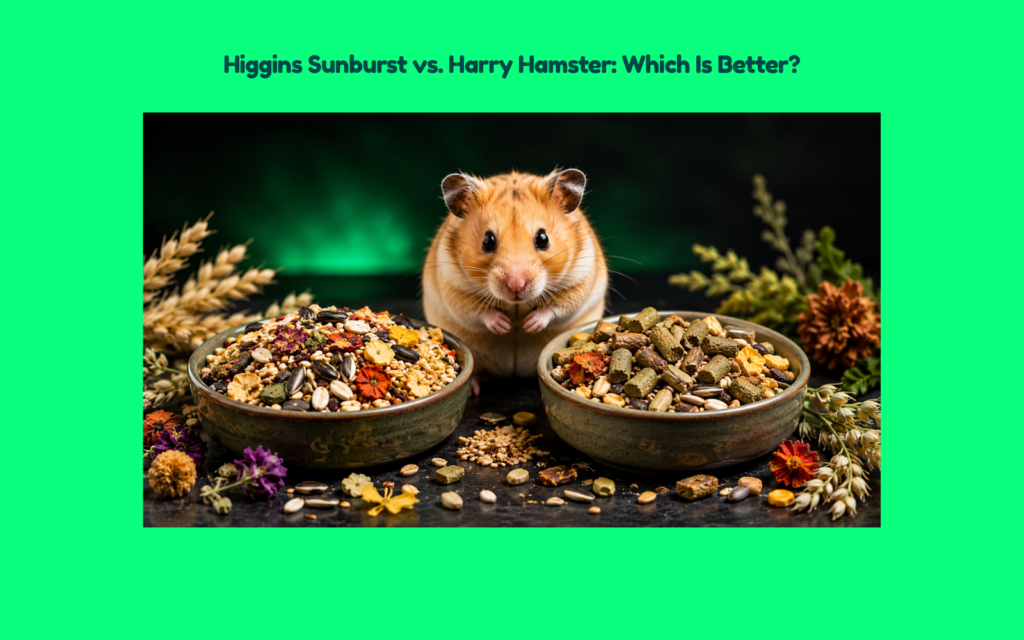
Here is what owners commonly observe when they open these two specific bags and pour out a scoop. The physical differences are immediately obvious. If you pour a scoop of Higgins Sunburst into the bowl, you see a highly varied, loose mixture. You are looking at hundreds of tiny, round millet seeds, small oval grains, flat pumpkin seeds, and distinct, bright pieces of dried fruit. The pieces are small, colorful, and loose.
Now, look at a scoop of Harry Hamster. It looks completely different. When you pour it into the bowl, you see much larger, bulky chunks. You see long, thick, solid pellets. You see whole peanuts still inside their heavy shells. You see large, hard, standardized pieces that take up a huge amount of physical space in the bowl.
Because these two mixes are built from completely different physical shapes, they naturally leave completely different types of visible leftovers piling up on the bedding. If you put small seeds into the cage, you have to look for tiny husks. If you put massive chunks into the cage, you have to look for large, untouched pellets.
Visualizing the Physical Differences
Figure 1: A visual representation of the physical contrast between the tiny, loose seeds of Higgins Sunburst and the large, heavy pellets of Harry Hamster as they appear in the bowl.
You cannot decide which mix leaves fewer untouched pieces by simply looking at the bowl right after you fill it. You have to look at what remains behind days later. If you pour Higgins Sunburst into the bowl and later find growing mounds of untouched dried fruit piling up in the corners, that mix is leaving a large amount of leftovers. If you pour Harry Hamster into the bowl and find all the large, chunky pellets shoved into the tunnel entrances completely untouched, that mix is piling up instead of disappearing.
Compare the loose seeds with the large chunks. The “better” mix is determined strictly by looking at the corners and the hoards to see which one leaves the fewest untouched pieces behind. It is entirely about looking at the leftovers.
How do you track the different pieces of food after they leave the bowl?
Tracking the food requires more than just glancing at an empty ceramic dish. An empty bowl only tells you that the pieces were moved, not what actually happened to them. To really track the food, you have to look closely at exactly what you pour into the bowl and then follow those specific pieces into the bedding.
The Daily Tracking Routine
Figure 2: The physical tracking progression. Observation moves from the initial bowl offering (Day 1), to the bedding surface (Day 2), and finally into the corners and hoards (Day 3+) to locate untouched pieces.
Look at the scoop in the bowl on Day 1. Take a mental snapshot of what you are offering. Are you offering the tiny, bright pieces of Higgins Sunburst, or the large, heavy pellets of Harry Hamster? Notice the specific shapes.
Watch where the specific pieces go. On Day 2, check the surface of the bedding right next to the bowl. Often, you will see specific pieces pushed directly over the edge. Look closely at the top layer of the substrate. Do you see the large chunky Harry Hamster pellets sitting on the wood shavings? Do you see the tiny Higgins dried fruit pieces resting on the paper bedding?
On Day 3, you must expand your search. Check the corners the next day. The food rarely stays in the open. Get down to eye level with the enclosure and look at the primary corners where the bedding meets the glass. Often, untouched pieces are pushed into these tight spaces.
Next, look at the tunnel entrances. You will frequently find a collection of pieces gathered just inside the opening of a buried tube. Finally, gently push the bedding aside near the main sleeping hides to look directly at the hoards.
You have to follow the shapes. If you poured Higgins into the bowl, you must actively scan the corners for those tiny, specific seeds. If you poured Harry Hamster, you must look for the large, heavy pellets. Guessing by simply staring at an empty bowl completely hides what is buried in the cage. A strict daily routine of checking the corners and hoards allows you to see exactly what actually disappeared and what was left behind.
What visual signs separate the untouched pieces from empty shells?
When you check the corners and the hoards, you will find piles of debris. To know what is actually happening, you must conduct a careful visual comparison between an empty shell and an untouched piece of food.
Look closely at the shapes. If you are using Higgins Sunburst, you have to distinguish between untouched seeds and discarded husks. An untouched seed is completely solid. It rests heavily on the bedding. An empty seed husk looks completely different. It is a thin, split, hollow shell. It looks like a tiny piece of transparent paper.
Untouched Solid Seed
Heavy, whole shape resting entirely intact on the bedding.
Empty Seed Husk
Thin, transparent, and split open like a piece of paper.
Figure 3: A structural comparison used during cage audits to visually differentiate between a solid, untouched piece of food (leftovers) and a split, transparent empty casing.
Notice the untouched pieces in the Higgins mix. You might find whole, solid pieces of dried fruit or intact, small, colored pellets resting in the stash. These are untouched leftovers. Compare what is left behind with the thin, papery husks that show the seed was actually opened.
If you are using Harry Hamster, the leftovers look entirely different. You are not looking for tiny, thin seed husks. You are looking at the large, chunky pellets. A completely untouched Harry Hamster pellet is solid, long, and heavily textured. It maintains its exact shape from the bowl.
Compare an untouched chunky pellet with the chewed fragments you might find in the bedding. Sometimes, you will see a large pellet that has been gnawed down, leaving a pile of powdery, chewed dust sitting on the substrate. The dust shows the chunk was broken down. However, if you find five completely whole, solid, heavy pellets shoved into the corner, you are looking at clear, untouched leftovers.
By knowing exactly what the specific pieces of Higgins Sunburst and Harry Hamster look like when they are completely whole, you can clearly see exactly which pieces are piling up in the cage.
What should you do if you see growing piles of specific pieces left on the bedding?
If you look closely at the enclosure and see specific pieces piling up untouched on the substrate, you need to look at your daily routine. Finding one untouched piece of dried fruit or a single large pellet buried in the corner is completely normal.
However, if you see a growing mound of untouched pieces, you are observing a clear pattern of accumulation. Look for growing piles of untouched pieces. Check the dark areas just inside the tunnels. Gently lift the roof off the main multi-chamber hide and look at the stash. If you see massive Harry Hamster chunks piled up, or a huge layer of Higgins dried fruit covering the corner, the leftovers are building up rapidly.
When you see a growing pile, look at what is left in the bowl. Review your daily scoop. If you are consistently finding growing piles of untouched pieces in the stash, you are adding new food to the bowl much faster than the old pieces are disappearing.
Persistent piles of untouched pieces create uncertainty because it becomes increasingly difficult to separate newly added food from items that have remained in the enclosure for several days.
Adjust what you put in the bowl. Reduce the size of your daily scoop tomorrow. Do not keep adding a huge mound of new pieces to the bowl if you already have a growing pile of them resting untouched in the back corner of the cage. Check the corners again after a few days to see if the visible leftovers in the bedding decrease.
How do you check your enclosure today to decide which mix leaves fewer untouched pieces behind?
You do not have to wait until you completely change the bedding to decide which mix leaves fewer leftovers. You can perform a visual check on your active enclosure right now to make your final decision.
Walk over to the enclosure, lean in close, and kneel down so you are at eye level with the surface of the substrate. Look closely at the top layer of bedding first. Are there any untouched pieces of dried fruit or solid chunky pellets resting clearly on the surface?
Check the primary corners where the bedding meets the glass. Often, pieces are pushed right against the walls. Look closely at the tunnel entrances and the main sleeping zones. Finally, gently move the top layer of bedding aside with your fingers to look directly at the food caches.
Use this quick-reference audit checklist to verify what you see:
The Enclosure Surface Audit
Perform this visual audit on your enclosure today, and determine which mix leaves fewer untouched pieces behind by physically looking at what remains in the corners.
Conclusion
Deciding between Higgins Sunburst and Harry Hamster does not require reading the back of the bag. It requires looking directly at the bedding. The answer is found by comparing what remains behind in the corners and the hoards. By observing the distinct shapes of the loose seeds, dried pieces, and chunky pellets, you can easily track where they go after they leave the bowl. Keep your focus purely on what you see in the cage. Watch the top layer of bedding, check the corners for untouched pieces, and monitor the stash over time. Repeated observations over several days ensure you can accurately track the specific pieces of each mix. Consistently looking at the surface and the hoard ensures you can decide which mix leaves fewer untouched pieces behind in your enclosure.
Product References:
Disclaimer: The information provided in this article is based entirely on observational tracking and is intended for general informational purposes only. It does not constitute medical, veterinary, or nutritional advice. Always consult with a qualified exotic veterinarian regarding your hamster’s specific health and dietary needs.