
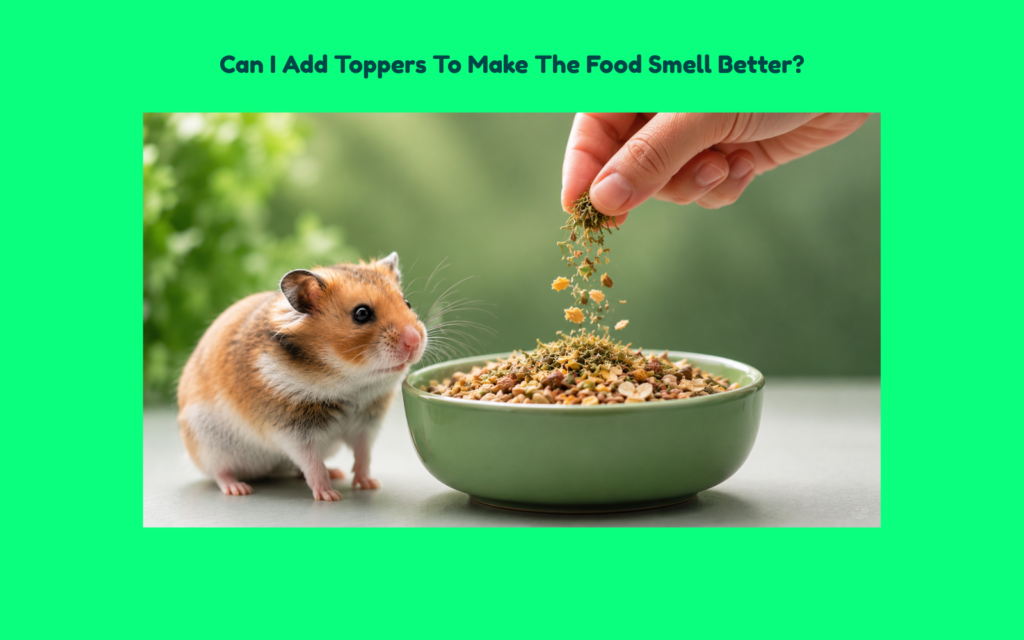
Can I Add Toppers To Make The Food Smell Better?
It is an incredibly common experience for hamster owners. You stand in your living room, holding the daily scoop of standard seed mix, and look at the plain, uniform brown seeds filling the bowl. Then, you open a container of dried rose petals, a bag of fragrant green herbs, or a small jar of freeze-dried insects. You take a pinch of these colorful extras and sprinkle them directly over the regular food. Instantly, the bowl looks entirely different. The uniform browns are broken up by bright pinks, yellows, and dark, textured shapes. The dusty smell of standard grains is suddenly replaced by a sharp floral scent or a pungent earthy odor.
When owners make this change, the immediate assumption is often that adding these colorful “toppers” will instantly fix a perceived lack of interest in the main bowl. However, guessing if the hamster is a “picky eater” requires making assumptions about things you cannot see. We must focus strictly on what is physically sitting in front of us. The practical reality is that adding herbs, flowers, or freeze-dried pieces simply changes how the bowl smells and adds more extra pieces of food to the daily scoop.
We are going to break down why owners add extra pieces to the bowl, how to track them once they are mixed in, how to tell the difference between the regular seeds and the extra items, and how to check your hamster’s cage today.
Diagram Explanation
Visualizing the physical transformation of a standard seed bowl when bright, textured toppers are introduced.
Why do owners commonly add extra pieces to the daily feeding routine?
Here is what owners commonly observe when they prepare a standard bowl of hamster food. The regular commercial seed mix usually has a very consistent, uniform appearance. You see small, round millet seeds, oval-shaped pellets, tan grains, and brown peanuts. When you lean in and smell the plain mix, it usually has a dry, dusty, or mildly grainy scent. The physical pieces all look very similar, and they easily blend together into a single, uniform pile.
Now, compare that plain bowl with a bowl containing extra pieces. When you open a bag of supplemental toppers, you are immediately hit with a completely different smell and appearance. Dried calendula and hibiscus flowers have a sharp, fragrant floral smell. Dried herbs like dandelion or plantain emit a strong, heavy, earthy scent. Freeze-dried insects carry a distinct, pungent odor. When you sprinkle these items over the seeds, you are completely altering how the bowl smells.
Beyond the smell, the bowl physically changes after these additions. Look at the pieces inside the bowl. You are no longer looking at just brown seeds. You see bright yellow petals resting on top of the grains. You see dark, solid blocks of freeze-dried insects mixed into the pellets. You see leafy green fragments settling into the gaps between the seeds.
Owners commonly add these extras because they can physically see and smell this massive transformation. The plain pile of seeds becomes a highly textured, colorful, and heavily scented mixture. However, treating a topper merely as a weightless “flavor sprinkle” often masks the simple reality that it introduces extra physical pieces of food that must be accounted for in the daily scoop. You are adding more pieces to the bowl, and those extra pieces will eventually end up somewhere inside the enclosure.
How do you track the extra pieces after you add them to the regular seed mix?
When you pour a scoop of regular seeds into the cage, you watch what disappears. When you start adding extras like herbs and flowers, you must track those specific items too. Treating toppers as zero-impact additions quickly leads to hidden piles of leftover food. To prevent this, you have to establish a clear tracking routine using a digital gram scale.
Weigh the combined scoop on a digital scale before you put anything into the cage. Do not weigh the seeds and then casually toss a pinch of herbs on top. Pour the primary mix onto the scale, sprinkle your flower petals and freeze-dried pieces over it, and then record the total combined weight. You must know exactly how many extra pieces you are placing into the enclosure.
Diagram Explanation
Demonstrating the necessary tracking routine: weighing the primary seed mix combined with the extra pieces on a digital scale before feeding.
On Day 1, you place the combined scoop into the cage and watch where the extra pieces go. Usually, the hamster empties the bowl and carries the entire mixture deep into the bedding. At this stage, everything is hidden from view.
On Day 2, look at the top layer of the bedding. Are the bright yellow petals sitting discarded on the surface? Check the area immediately surrounding the bowl. Often, you will see the leafy green herbs pushed aside and left resting on the substrate. Notice which pieces remain visible and which ones have completely disappeared.
On Day 3, expand your observations. Check the primary corners of the enclosure. Look closely around the hide entrances and the areas where the hamster frequently travels. Compare the regular seeds you see resting on the bedding with the extra pieces you sprinkled in.
If you do not weigh the combined scoop and actively track where the extras end up, you will lose sight of what is actually happening. You might keep sprinkling a heavy pinch of dried flowers every single day, completely unaware that the previous pinches are simply being dumped in the back corner of the cage. Finding extra pieces in a hidden stash does not automatically prove they were consumed, because food transported away from the bowl may remain intact inside the enclosure for extended periods. Tracking the combined scoop every single day allows you to see exactly which pieces are taken and which ones are left behind.
What visual signs distinguish the leftover extra pieces from the regular seeds?
To successfully track where the added items end up, you have to conduct a careful visual comparison. Because the enclosure is filled with paper, wood shavings, and standard food pieces, you need to know exactly what to look for when inspecting the bedding.
Look closely at the shapes and colors of the regular seed mix. The standard seeds, grains, and pellets are typically smooth, hard, and oval or round. Their colors range from light tan to dark brown. Because of their neutral colors, these regular seeds often blend in very closely with the surrounding paper or wood bedding. If a brown seed is dropped in the corner, it can be difficult to spot without a very close inspection.
Now, compare the regular seeds with the added extra pieces. The visual differences are immediately obvious. Notice the bright flower petals. Dried rose petals and marigolds hold their vibrant pink, red, and yellow colors. When a bright pink petal is dropped on top of brown wood shavings, it stands out clearly. It does not blend in.
Diagram Explanation
Highlighting the distinct differences in shape, texture, and color between the smooth, neutral regular seeds and the bright, jagged extra pieces.
Next, look closely at the textures. Dried herbs do not look like hard seeds. They are leafy, crumbly, and jagged. Freeze-dried proteins have a highly distinct shape. A solid, dark block of freeze-dried chicken or the ribbed, elongated shape of a dried mealworm looks absolutely nothing like a smooth, round grain of millet.
Describe what you physically see when you pick up these pieces from the bedding. The regular seeds feel dense and hard. The flower petals feel thin and brittle. The herbs feel like dry, crumbling leaves. By mapping the visual signs of the familiar, neutral-colored seeds against the bright colors, leafy textures, and distinct shapes of the newly added toppers, owners can clearly see exactly which pieces are being left behind on the substrate.
What should you do if you observe a growing pile of untouched herbs and flowers on the bedding?
If you look closely at the enclosure and see the bright flower petals or leafy herbs just piling up on the substrate, you need to review your daily routine. Finding an occasional dropped petal or a single piece of dried herb resting near the bowl is completely normal. However, if you see a growing mound of bright yellow flowers or dark freeze-dried insects clustering in the back corner, you are observing a clear pattern.
Compare an occasional leftover piece with a repeated, growing pile. Check the main corners of the enclosure. Check the dark areas just inside the tunnel entrances. Gently push the top layer of bedding aside near the main sleeping hides. If these areas are filling up with untouched, brightly colored extra pieces, the additions are piling up too fast.
Review how much you sprinkle into the bowl. If you see persistent piles of untouched herbs, you are adding new extras much faster than the old ones are being removed. Adjust your daily scoop by significantly reducing the amount of extras you mix in. Do not keep adding more colorful toppers to the scale if you already have a growing pile of them resting untouched on the bedding.
How do you check your enclosure today to see where the extra pieces went?
You do not have to wait until you completely change the bedding to see where the added herbs and flowers went. You can perform a visual check on your active enclosure right now. Walk over to the enclosure, lean in close, and kneel down so you are at eye level with the surface of the substrate.
Look closely at the top layer of bedding first. Are there any bright pink or yellow petals resting clearly on the surface? Check the primary corners of the cage where the bedding meets the glass or plastic. Next, check the hide entrances. Often, extra pieces are carried to the door of the hide and then dropped just outside the entrance. Look closely at the substrate inside the buried tunnels. Finally, gently move the top layer of bedding aside with your fingers to look directly at the food caches.
The Enclosure Surface Audit
Diagram Explanation
An enclosure surface audit map showing the common areas where untouched extra pieces tend to accumulate, such as enclosure corners and hide entrances.
Perform this visual audit on your enclosure today. Look closely at the corners and the hoards, and stop sprinkling extra items into the bowl if you consistently spot growing piles of untouched herbs and flowers inside the cage.
Conclusion
Adding extra pieces like dried herbs, flowers, and freeze-dried insects physically changes the appearance and smell of the daily scoop. By observing the distinct colors, leafy textures, and unique shapes of these additions, you can easily track where they go after they leave the bowl. Keep your focus purely on what you see in the cage. Watch the top layer of bedding, check the corners for bright petals, and monitor the stash over time. Repeated observations over several days ensure you can track the extra pieces accurately. Consistently looking at the surface and the hoard ensures you can use these additions without accidentally building a massive, undocumented pile of untouched herbs in the enclosure.
Citations & References
Disclaimer: The information provided on HamsterAtlas is for educational and observational purposes only. It does not constitute professional veterinary advice, diagnosis, or treatment. Always consult with a qualified exotic veterinarian regarding the health, specific diet, and medical care of your hamster.