
Can I Use Sprays (Millet/Flax) For Foraging?
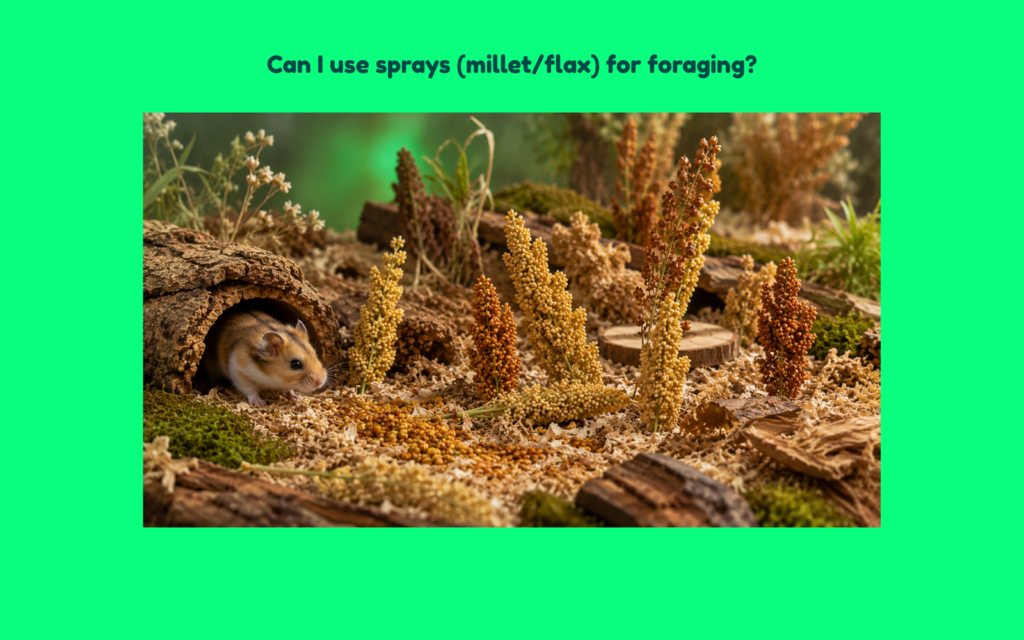
It is an incredibly common experience. Owners see beautiful pictures of enclosures filled with tall, standing stalks of millet, flax, and oat, and they immediately want to replicate that look. When owners ask if they can use these sprays for foraging, the answer is yes. Many owners successfully use sprays to present food exactly as it grows on the stem, making the hamster actively pull the seeds free. With this approach, owners often expand a foraging protocol by introducing natural food sources that require active extraction and collection.
However, the immediate assumption is often that these standing stalks are just background additions designed to give the enclosure a certain appearance. Treating sprays as background items completely misses what they actually are. Sprays are dense clusters of real food attached to a stick. Pushing multiple stalks into the bedding adds a large number of attached seeds to the overall routine.
We are going to break down why owners use seed sprays for foraging, how to track the food as it leaves the stalk, how to tell when a spray is truly empty, and how to check your standing stalks today.
Why do owners commonly add seed sprays to their feeding routine?
Here is what owners commonly observe when they look at pictures of elaborate enclosures online. The cages are filled with tall, standing stalks of millet, flax, and oat. It is incredibly easy to look at these setups and assume these standing stalks are just visual additions meant to make the cage look nice. However, when you hold a fresh millet or flax spray in your bare hand, you immediately notice what the item actually contains.
Look closely at the top of the stalk. You will see dozens, sometimes hundreds, of heavy, individual seeds tightly packed together. The dense seed clusters occupy a large amount of space. Owners use sprays for foraging by pressing three or four of these heavy stalks upright into the bedding. By doing this, they change how the food is presented in the cage.
Instead of collecting loose ingredients from a smooth ceramic bowl, the hamster must actively reach up and pull the heavy seeds off the stem. Using a spray for foraging simply means you are making the hamster detach the seeds directly from the branch. Compare a standard scoop of loose seeds resting in a dish with three large millet sprays pressed into the corners of the cage. The sprays contain the exact same type of real food you would find in a bowl, just attached to a standing stalk.
The Reality of Seed Sprays
When you push five standing stalks deep into the bedding, you are adding a large number of attached seeds to the enclosure. Treating sprays strictly as a visual background often masks the reality that these heavy, dense clusters contribute a large amount of seeds to the total daily feeding routine. When you see a spray used for foraging, you must see it for what it is: an upright stick covered in hundreds of unconsumed seeds that will eventually end up in the bedding.
How do you track the food when seeds are attached to a spray stalk?
When you pour seeds into a bowl, tracking what disappears is simple. When the seeds are attached to a tall spray stalk, tracking requires a different daily observation. You have to establish a clear day-one baseline. Note the large number of seeds on the brand-new stalk the exact day you push it into the bedding. Look closely at how thick the clusters are and how far down the stem they reach.
Watch the stalk over the next few days. Check the stalk each morning when you walk into the room. On day two, you might notice small gaps appearing along the lower branches. By day five, compare the current shape of the stalk with what you saw on day one. You will start comparing the remaining heavy clusters at the top with the partially stripped branches at the bottom.
Notice what disappears from the stem. The missing seeds do not simply vanish into thin air. You must actively check the bedding to see where the detached seeds are going. Look at the bedding directly beneath the overhanging stalk. You will often see seeds that were pulled loose and dropped onto the surface during the foraging process. Next, check the nearby hiding areas and tunnels. You will often find the detached spray seeds piled inside the hoard.
Treating sprays as “free additions” quickly leads to an undocumented surplus of seeds hiding in the cage.
To accurately track when a spray needs to be replaced, you must conduct a clear visual comparison between a fresh stalk and a completely processed stem.
Intact Spray
View a fresh spray from multiple angles. Look closely at the branches. Notice the solid, unbroken clusters of heavy seeds clinging tightly to the central stem. The intact spray looks thick, heavy, and completely covers the underlying wood. You cannot see the bare stick through the dense layers of seeds.
Fully Stripped Stalk
Now, compare that intact spray with a fully stripped stalk. A fully processed stalk looks entirely different. The thick clusters are completely gone. You are left looking at bare, thin branches that look brittle and empty. There are clear missing clusters along the entire length of the stem, exposing the main wooden stick from top to bottom.
Look at the bedding surface immediately below the bare branches. You will see a localized accumulation of split, empty chaff. This split chaff is the thin, hollow outer shell left behind after the solid seed is removed. Seeing a completely bare wooden stick surrounded by empty chaff on the bedding is the exact visual sign that the item has been completely detached from the main structure. This visual difference helps you check exactly when the stalk is completely finished and ready to be removed.
What should you do if you observe a persistent accumulation of detached spray seeds across the bedding?
If you look closely at the enclosure and see whole, unconsumed flax or millet seeds piling up across the surface, you need to review your current routine. Look for persistent piles of untouched millet accumulating in specific areas. Finding one or two dropped seeds under a stalk is completely normal when using sprays for foraging. However, if you see a growing mound of heavy, intact seeds spilling out of the main hides or covering the corner of the cage, the unconsumed food is piling up too fast.
Compare an occasional dropped seed with a persistent accumulation that grows larger every single week. Check the corners of the enclosure. Check the entrances to the buried tunnels. Gently lift the roof of the main multi-chamber hide and look closely at the stash locations.
If these areas are overflowing with whole seeds that perfectly match the standing stalks, you are adding new sprays much faster than the old ones are being consumed. Review how often you add new sprays to the bedding. Adjust your replacement schedule by waiting until the existing stalks are completely bare, and the existing piles of detached seeds are noticeably reduced, before you push another fresh stalk into the enclosure.
How do you check your enclosure today to assess the condition of existing seed sprays?
You do not have to wait until cleaning day to check your standing stalks. You can perform a visual check on your active enclosure right now to see exactly how the foraging sprays are being used. Walk over to the enclosure, lean in close, and kneel down so you are at eye level with the surface.
Look closely at the standing stalks. Are they thick and heavy, or are they thin and bare? Check the bedding directly below the stalks for empty, split chaff. Next, check the primary corners and the entrances to the main hiding spots. Gently move the top layer of bedding aside to look at the hoards and verify if whole seeds are accumulating.
Use this quick-reference audit checklist to evaluate your standing sprays today:
- Target inspection zone: Checking the standing stalks and the primary caches inside the hides.
- Visual indicator: Locating completely bare stems sticking out of the bedding, or finding dense patches of untouched spray seeds piling up in the hoard.
- Observable requirement: Confirming whether intact spray seeds are actively accumulating and multiplying across repeated daily observations.
- Action to take: Removing the fully stripped bare stalks from the cage immediately, and waiting to add new ones if you consistently spot growing piles of untouched spray seeds.
Conclusion
Sprays are a fantastic way to present food, but they are not just visual background items; they are dense clusters of seeds attached to a stem. Using them for foraging means adding a large amount of dense seed clusters directly to your daily routine. By observing the stalks as they go from thick, heavy clusters to bare, thin branches, you can follow exactly how fast the food is being removed. Keep your focus purely on what you see in the cage. Watch the standing stalks, check the bedding directly below them, and monitor the detached seeds over time. Consistently looking at the surface and the hoard ensures you can use sprays for foraging without accidentally overwhelming the enclosure with untouched food.
Sources
- Roselark Pet Products: Hamster Sprays – Why They Are Essential
- MDPI: Agriculture – 2077-0472/12/10/1634
- ScienceDirect: Pest Monitoring in Agricultural and Biological Sciences