
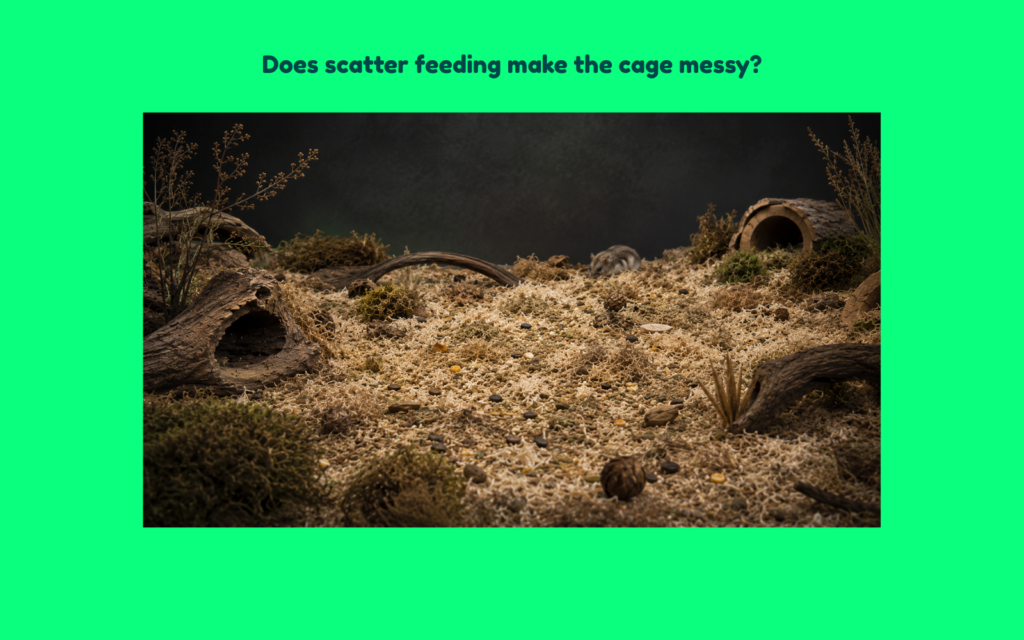
Does Scatter Feeding Make The Cage Messy?
It is a remarkably common experience for hamster owners. You decide to switch your daily routine from using a traditional feeding bowl to sprinkling the seed mix directly across the bedding. You scatter the food, close the enclosure, and walk away. A few days later, you look inside the cage and see what appears to be a massive mess. Empty shells, fragmented pieces, and discarded husks are spread everywhere. The immediate worry is that the cage is becoming excessively dirty, or that the scattered food is simply being wasted and lost in the substrate.
When you encounter this visual shock, it is easy to assume the scatter feeding routine is failing. However, staring at a layer of scattered pieces and guessing whether it is a mess or just normal leftovers often leads to confusion. Distinguishing between a dirty cage and a successful routine comes down to understanding what you are actually looking at on the surface of the bedding.
We are going to break down why owners notice more pieces on the surface, how to accurately track your daily scoop, how to tell the exact difference between whole seeds and empty shells, and how to check your bedding today.
Why does a scatter feeding routine commonly result in a wider distribution of foraging debris?
Here is what owners commonly observe when they switch from a traditional feeding bowl to a scatter feeding routine. When you use a bowl, every single seed is centralized in one specific location. As the seeds are processed, all the discarded husks, empty peanut shells, and split seed coats pile up neatly inside or directly next to that single ceramic dish. The waste is contained, making the rest of the enclosure look pristine.
Diagram 1.0: Visualizing how removing a centralized bowl naturally distributes identical empty shells across the bedding surface.
When you toss the daily seed mix across the enclosure, you completely change this visual dynamic. By intentionally distributing the seeds, you are ensuring that the discarded husks will also be spread out over a wide area. Look at the surface of the bedding. The scattered debris you see is simply the result of the seeds being opened exactly where they were found, rather than being carried back to a centralized container.
Owners often make their judgment about the mess after seeing the enclosure only once. That can be incredibly misleading. Look at the surface of the bedding on Day 1. The scattered seeds are fresh, the area looks clean, and very few shells are immediately visible. Now compare that with Day 3 or Day 4. The bedding often appears much busier because empty husks have accumulated across a much wider area of the surface.
Notice exactly where these shells collect over time. Some remain close to the original feeding locations on the open surface. Others become mixed into pathways, tunnels, and frequently traveled sections of the enclosure. The cage may look dramatically messier as the days pass, even though the actual amount of waste being produced has not changed at all.
Compare a bowl routine with a scatter routine over the exact same period. The bowl creates a heavily concentrated pile of shells in one corner. Scatter feeding creates dozens of smaller shell clusters spread evenly across the enclosure. The visual appearance changes significantly, looking like a widespread mess, even though the exact same types of leftovers are being produced.
How do you track what disappears from the bedding each day?
When the food is no longer contained in a single bowl, visual guessing completely fails. If you simply stare at the top layer of the bedding, you cannot accurately tell what has been moved, what is hidden, and what is simply an empty shell. To effectively track what is disappearing from the surface, you have to follow the same routine each day.
Digital Scale
Establishes the exact baseline weight before scattering.
Walk over to your supplies and weigh the daily scoop on a digital gram scale before you sprinkle anything into the cage. You must know the exact starting weight. Once the pre-weighed ration is distributed, your job is to check the same areas each day, paying close attention to the primary corners and the surface the following morning. This allows you to monitor exactly what disappears from the surface over a 24-hour period.
However, a single day rarely tells the full story. You must weigh the daily scoop on your digital scale and repeat the exact same routine for several consecutive days. Day 1 provides a basic starting point. Day 2 provides your first direct comparison. By Day 4 or Day 5, a clear visual pattern begins to emerge on the surface of the bedding.
Look at the bedding surface before adding the next scoop. Notice whether the solid, whole seeds from previous days are still visible on top of the substrate. Compare today’s surface directly with yesterday’s observations. If intact seeds continue appearing in the exact same locations day after day, the pattern of unconsumed food becomes much easier to identify.
Keeping a simple notebook beside the enclosure helps many owners track this process. Record the exact weight of each daily scoop and write a short, practical observation about what you saw on the surface the next morning. These repeated, written observations create a much clearer picture of what is actually moving than visual guessing alone.
What visual signs distinguish unconsumed seeds from discarded husks and normal bedding debris?
Because the pieces are spread out, you have to look closely to distinguish between a messy pile of trash and a pile of wasted food. You have to conduct a careful visual comparison to tell the difference between whole, uneaten ingredients and the empty shells left behind.
Whole Seeds
Look closely at the pieces resting on the surface. Whole seeds look noticeably different. They are solid, heavy, and completely intact. When a whole pumpkin seed, sunflower seed, or compressed pellet sits on the bedding, it rests clearly on top of the substrate. It remains completely whole and solid.
Discarded Husks
Compare the intact seeds with the discarded husks. Discarded husks look entirely different. Notice the split, hollow shells scattered across the area. They are extremely lightweight and often look like fragmented, broken pieces of thin paper. Because they look thin and hollow, these empty husks easily blend into the normal paper or wood bedding, looking like natural enclosure dust rather than wasted food.
Diagram 2.0: A visual comparison highlighting the physical difference between heavy, intact ingredients and lightweight, hollow shell waste.
Look closely around the enclosure, as empty husks rarely remain evenly distributed. Check the corners first. Lightweight shells often collect exactly where the bedding naturally settles against the glass or plastic walls. Next, inspect the entrances of hides, cork logs, and tunnels. These high-traffic areas frequently develop highly visible clusters of fragmented shells.
Compare those localized locations with the center of the enclosure. Whole, unconsumed seeds are often much easier to spot in open areas because their heavy weight keeps them sitting clearly on top of the substrate. Empty husks, meanwhile, blend into the surrounding bedding much more easily and may require a closer inspection to verify. The more familiar you become with the physical appearance of split, lightweight shells, the easier it becomes to separate normal leftover trash from actual unconsumed food.
What should you do if you observe a persistent accumulation of intact seeds across the bedding surface?
If you look closely at the surface and realize that you are seeing solid, intact seeds piling up rather than just empty husks, you need to execute a practical surface assessment. Keep the routine entirely focused on what you see and how much you are scooping.
Review your pre-weighed daily scoop. If heavy, whole seeds are actively accumulating across the surface, the daily ration is simply exceeding what is being removed from the top layer. Look for persistent piles of whole seeds in specific areas of the enclosure. If you confirm that these are solid ingredients and not hollow shells, you need to slightly adjust the amount you scatter tomorrow.
Finding a few intact seeds on the surface is not unusual. The important observation is consistency. Look at the exact same area over multiple days. Does the pile of whole seeds remain the same size? Does it slowly grow larger as the week progresses? Are new, heavy seeds being added to the surface before the old seeds ever disappear?
Compare today’s pile of intact seeds with the pile you observed several days ago. If the accumulation continues to increase steadily despite your daily feeding routine, the enclosure is providing clear visual evidence that the daily scatter amount needs reassessment.
The goal here is not to remove every single visible seed from the surface. You should never completely stop feeding based on scattered leftovers. The goal is simply to identify whether a persistent surplus of whole ingredients is forming on the bedding surface, and to adjust your gram scale measurements accordingly to prevent the piles from growing larger.
How do you audit your enclosure’s surface today to assess the distribution of foraging debris?
If you are staring at a scattered mess right now, you need to verify exactly what that mess is made of. Walk over to the enclosure, open the lid, and kneel down so you are close to the surface.
Look closely at the top layer of bedding. Gently push the top layer of substrate aside with your fingers and look at the pieces. Are you looking at heavy, intact seeds, or are you looking at thin, split, hollow husks? Check the primary corners and the entrances to the main hiding zones.
Use this quick-reference audit checklist to evaluate your enclosure:
Surface Audit Checklist
- Target inspection zone: Checking the top layer of the surface and the primary corner caches.
- Visual indicator: Locating dense patches of split, hollow shells versus solid, untouched seeds resting on the bedding.
- Observable requirement: Confirming whether intact, whole seeds are actively accumulating and growing into larger piles across repeated daily observations.
- Action to take: Executing a localized spot-clean to remove the heavy clusters of empty shells, and reducing the daily weighed scoop slightly if a surplus of intact seeds is visually confirmed.
Consistent visual checks are the only way to manage a scatter feeding routine effectively. Perform this visual audit on your bedding surface today, and adjust your daily scoop if you consistently spot growing piles of whole, untouched seeds.
References
- University of Washington Office of Animal Welfare. “Rodent Cage Sanitation Frequency.” https://sites.uw.edu/oawrss/iacuc/policies/rodent-cage-sanitation-frequency/
- United States Environmental Protection Agency (EPA). “National Overview: Facts and Figures on Materials, Wastes and Recycling.” https://www.epa.gov/facts-and-figures-about-materials-waste-and-recycling/national-overview-facts-and-figures-materials
- National Center for Biotechnology Information (NCBI). “Environment, Housing, and Management.” Guide for the Care and Use of Laboratory Animals. https://www.ncbi.nlm.nih.gov/books/NBK9979/
Disclaimer: The information provided on HamsterAtlas is for educational and informational purposes only. It is not intended to substitute for professional veterinary advice, diagnosis, or treatment. Always seek the advice of your veterinarian with any questions you may have regarding a medical condition, dietary changes, or the overall health of your pet.