
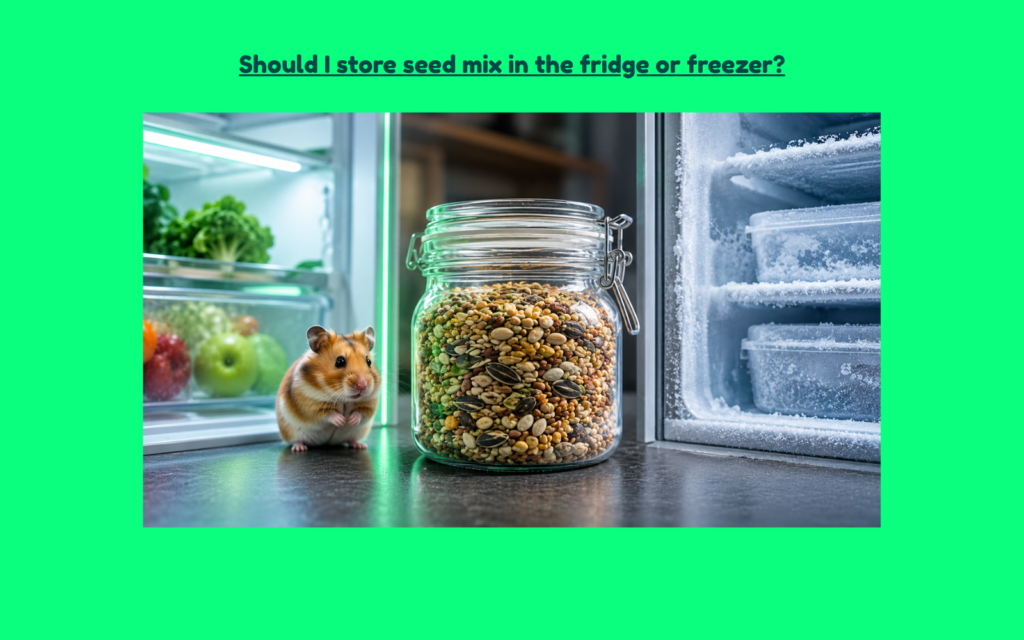
Should I Store Seed Mix In The Fridge Or Freezer?
You just brought home a new food bag of seed mix. You want to keep it fresh and prevent bugs from hatching, and you are currently standing in your kitchen deciding whether to put it in the fridge next to the vegetables or in the deep freeze. Cold storage is a great idea to protect your pet’s food. However, picking the wrong appliance can quietly ruin the entire bag with hidden moisture.
We are going to break down why the freezer is the safer choice, how to freeze your food without causing dampness, and the exact steps to check your current container for hidden water drops today.
Think of it this way:
A dry seed mix is exactly like a dry sponge. If you put it in a damp, constantly opening fridge, it will soak up moisture from the air and eventually grow mold. We want to avoid that completely.
Why is a freezer preferred over a refrigerator to protect your seed mix?
When you want to keep bugs out of your food, you need an environment that prevents dormant bug activity without ruining the seeds. One of the main reasons owners freeze a newly purchased seed mix is to reduce the risk of hidden pest activity developing inside the food over time. If storage conditions fail or contamination occurs before the food reaches your home, the first warning sign is often the appearance of tiny black bugs moving through the mix during a routine container inspection. This is exactly why owners choose to store seed mix in the fridge or freezer, but the results between the two are very different.
Many owners assume that because the fridge keeps human vegetables fresh and crisp, it is the perfect spot to protect pet food. Here is what usually happens when a new bag is brought home from the pet store: you look at the pantry shelf, worry about pests, and immediately decide to toss the bag into the fridge next to the carrots. But a dry seed mix is not a fresh vegetable. Look at the choice this way: your goal is to find a stable, dry, cold environment.
A freezer produces a different, more reliable result. Exposing a new bag of food to sub-zero freezer temperatures prevents dormant bug activity and keeps high-fat seeds fresh for a long time. The fridge simply cannot compete. Standard refrigerator temperatures are often insufficient to reliably arrest dormant pest activity compared with proper freeze-treatments, and they introduce hidden moisture to the dry mix.
The Storage Reality
- The Rule: Choose the deep freeze for new bags, never the fridge.
- The Reason: Freezer temperatures prevent dormant bug activity, while standard fridge temperatures are less reliable and introduce hidden moisture to your food.
- The Example: Placing a sealed, brand new bag in the freezer for a few days protects the food from spoiling. Avoiding the high-moisture environment of a standard refrigerator saves that same bag from ruin.
How do you freeze a seed mix without causing dampness and mold?
Freezing the food works incredibly well, but you have to follow a very specific kitchen routine to avoid creating water drops on the seeds. When you bring the food home straight from your shopping trip, look at the bag and visually check that the factory seal is still fully intact. Place this fully sealed commercial bag directly into the back of your freezer.
Leave it there for 48 to 72 hours. The patience required during this waiting period is crucial. The next step is the most important part of the entire process. Take the bag out of the freezer and place it on your kitchen counter. Do not open it yet.
As you watch the bag sit on the counter, you will actually see water droplets form on the outside of the plastic as the cold surface meets the warm room air. You must let the sealed bag come completely to room temperature. Wait until those external water droplets have entirely evaporated and the outside of the bag feels warm to the touch before you break the seal.
If you open a cold bag immediately, warm room air rushes inside. That warm air hits the cold seeds and creates water drops directly on the food, ruining it with hidden dampness. Wait for it to warm up on the counter.
One continuous freeze-and-thaw cycle prevents condensation on your daily mix.
The Success Method
Doing one continuous, unbroken freeze-and-thaw cycle before opening the bag and moving the food into a dry, room temperature container for daily use.
The Daily Fetch Trap
Repeatedly moving your everyday feeding container between cold storage and room temperature to grab a scoop often creates water droplets inside the mix, which can eventually ruin the food.
Always keep your daily, everyday feeding container at room temperature.
What makes a refrigerator a bad place to store a dry seed mix?
Picture the inside of a busy, real-world kitchen fridge. The door is constantly swinging open as family members grab drinks, pull out ingredients, and use the appliance throughout the day. Every time that door opens, a wave of warm kitchen air rushes in.
These actions cause massive temperature shifts and create visible moisture, especially around the produce drawers where condensation naturally gathers. Because of this, fridges are highly active, damp environments. Contrast this chaotic, damp environment directly with a closed, quiet deep freezer designed for long-term storage. A freezer is a less frequently disturbed storage environment, keeping conditions completely stable.
Physical Traits Comparison
What should you do if you notice dampness in your seed mix container?
If you realize you made a mistake—perhaps you stored your food in the fridge or you opened a cold bag too soon—you need to take immediate action. The most critical thing to understand is that damp food cannot be saved, dried out in the oven, or salvaged.
When owners see dampness, they often try partial fixes, such as simply scooping out the wet-looking clumps or wiping down the inside of the lid. This is not enough. Dampness spreads invisibly through the dry mix. Keeping the seemingly “dry” seeds from a damp container will still ruin the food, as the unseen moisture remains.
The Damp Food Cleaning Steps
Step 1: Isolate the damp food container immediately so you do not accidentally feed it to your pet.
Step 2: Physically discard the ruined mix into the trash. Do not try to save the dry-looking pieces or scoop around the clumps.
Step 3: Completely wash and thoroughly dry the empty storage container. Ensure zero water drops remain on the plastic or glass before moving forward.
Step 4: Restock the container with a newly processed, strictly dry standard daily mix.
How do you check your current food container for hidden dampness today?
You can easily do a physical pantry audit right now. Grab your primary airtight container and take it over to a kitchen window or hold it under bright natural light. You are looking for any visual signs that moisture has found its way inside.
Hold it up and look closely at the walls of the plastic or glass for a faint fog, and check the top corners for tiny water beads. Next, dig your hand in and scoop a handful of food from the very bottom of the container. Compare that bottom-layer food directly with the top-layer food. You are looking to see if any seeds are stuck together in clumps that do not easily fall apart.
Quick-Reference Audit Checklist
- Target issue: Checking for seed mix dampness and excess condensation.
- Visual indicator: Locating water beads on the inside of the container, fog on the glass, or identifying seeds sticking together in clumps.
- Required change: Stopping the use of the damp food immediately to avoid mold.
- Action to take: Discarding the damp mix, completely drying the container, and starting fresh.
To wrap this up, remember that the freezer is highly useful when used correctly for an initial freeze to protect a new bag of food. However, placing that food in the fridge introduces unnecessary dampness to a dry seed mix.
Your standard daily mix and food containers always belong on a pantry shelf at room temperature. Regular container inspections help catch dampness problems early, and taking just a few seconds to perform a visual container check can prevent an entire bag of food from being ruined.
Please perform this physical pantry audit today, visually check the inside of your container for water drops or fog, and throw away the mix if any dampness is found before dispensing tomorrow’s meal.