
Are Grains Like Barley And Quinoa Good For Hamsters?
Seeing grains like barley and quinoa on your ingredient label is actually a good sign—it means your pet’s food is using solid foundation grains as a base instead of relying on cheap, sugary fillers.
You are sitting on the couch, staring at a bag of hamster food, looking at a long ingredient list and wondering if those grains belong there or if they are just filler. It is a common reality: some grains are base ingredients for a stable diet, while other ingredients (like molasses or dried fruit) are just flashy, sugary distractions.
We are going to break down exactly what those grains are doing in your hamster’s mix, how to identify them on the label, and why they are much better than empty, sugary bits.
Think of your hamster’s diet like building a solid, long-lasting campfire. You need thick, slow-burning logs to keep it going for hours. Those are your foundation grains. You do not just want a bunch of quick-burning kindling that sparks up for a second and then dies. Those are the sugary fillers.
Why are grains like barley and quinoa used as base ingredients in a regular food mix?
These grains act as the stable foundation of a regular food mix, providing a solid base you can actually identify instead of relying on heavily processed bits.
Finding familiar, simple grains on an ingredient label is a relief for many owners. When you read an ingredient list, seeing words you recognize—like barley or quinoa—is a sign of a cleaner, less complicated bag. Avoiding overly long, unpronounceable lists is one of the easiest ways to bypass hidden fillers. Simple is usually better, and if you can recognize these staple ingredients, you are already halfway to verifying a quality mix.
Rule: You must verify that your everyday mix relies on whole staple grains rather than sugary binders or fruit pieces.
Reason: Grains like barley and quinoa are solid, whole ingredients that form a reliable base for your pet’s everyday diet.
Example: Choosing a mix based on these staple grains provides a much more reliable foundation compared to mixes that are mostly colorful, sugary filler bits. Here is why that matters: checking the ingredient label is the best way to verify quality.
How do you identify the distinct roles barley and quinoa play in the mix?
It helps to know what you are looking at; while both are solid grains, they each physically look different and are easy to spot on an ingredient label.
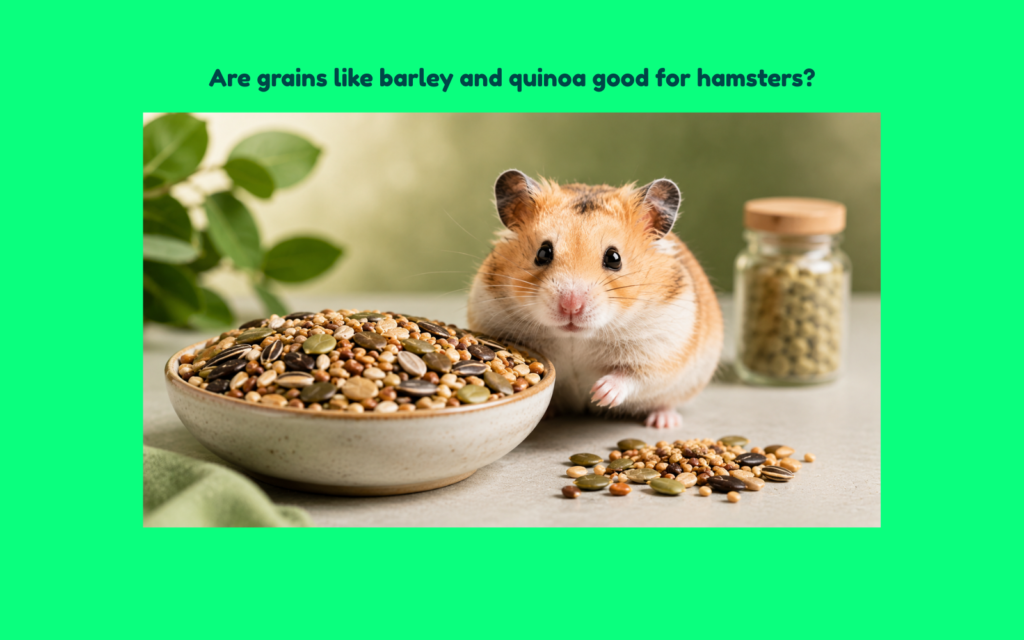
Opening a bag and physically seeing a visual “mix” of grains is a reassuring sign of ingredient diversity. They look different and provide a variety of physical textures in the bowl. Seeing more than one type of staple grain suggests the mix is well-rounded and uses common, everyday ingredients that are easy for any owner to visually identify. Seeing visual variety is a great starting point for any grain-based mix.
Barley is a larger, sturdy, reliable grain. It anchors the everyday mix visually. Quinoa, on the other hand, appears as small, round seeds that provide a distinct physical contrast to the typical base. Seeing both of these distinct physical formats listed on a label is a reliable indicator that the manufacturer is using a mix of foundation grains rather than just one single ingredient.
How do you use the ingredient label to distinguish staple grains from sugary fillers?
If you want to verify if your bag is truly a solid everyday mix, you just need to flip the bag over and read what is actually inside.
You are probably confused about why your mix looks so colorful but isn’t providing the steady energy you keep reading about. The solution is simple. First, ignore the pictures on the front and go straight to the guaranteed analysis panel.
Second, look at the first few ingredients. If you see staple grains like barley, quinoa, or other whole-grain formats, you have a solid foundation. However, before relying on any grain-based mix, it is worth checking for signs of storage contamination such as grain weevils that could affect ingredient quality.
But here’s the catch: if you see sugar, molasses, or fruit in the first three slots, you are looking at a flashy mix, not a regular food mix.
Can you perform a pantry audit to verify the presence of grains like barley and quinoa?
You can actively verify if you are prepared by physically inspecting your primary seed mix label and your current additive inventory today.
The Ingredient Simplicity Check: The verification target is the readability of the ingredient list. The label indicator is finding simple, recognizable grain names at the start of the list. The action: if you see a wall of chemical names or strange additives, pause and ask yourself if there is a simpler, more recognizable option available. Simple, readable lists are your best friend during a physical pantry audit.
Pantry Ingredient Audit Checklist
The Foundation Grain Check
- Verification Target: The back ingredient list of your primary food bag.
- Label Indicator: Locating grains like barley or quinoa in the mix.
- Action: Keep in mind that finding these as staple ingredients is a helpful audit tip for judging formula quality, but it is a personal observation tool rather than a rigid law for every mix.
The Filler Audit
- Verification Target: Avoiding empty, sugary fillers.
- Physical Label Indicator: Finding sugar, dried fruit pieces, or honey/molasses listed before the main grains.
- Action: If your mix relies on these sugary fillers as a primary ingredient, treat the bag as an unreliable everyday mix and verify a grain-based primary bag for the future.
Perform this physical pantry audit today to check your ingredient list, and verify your bag’s base quality before you reach for the next bowl refill.
Grains like barley and quinoa are common, reliable staple ingredients that provide a stable foundation. Reading the actual ingredient label is always more helpful than looking at the marketing on the front of the bag. Make grain identification a regular verification habit, as it is one of the best ways to verify the ingredient label and ensure the physical pantry audit results in better, healthier decisions for your pet every single week.