
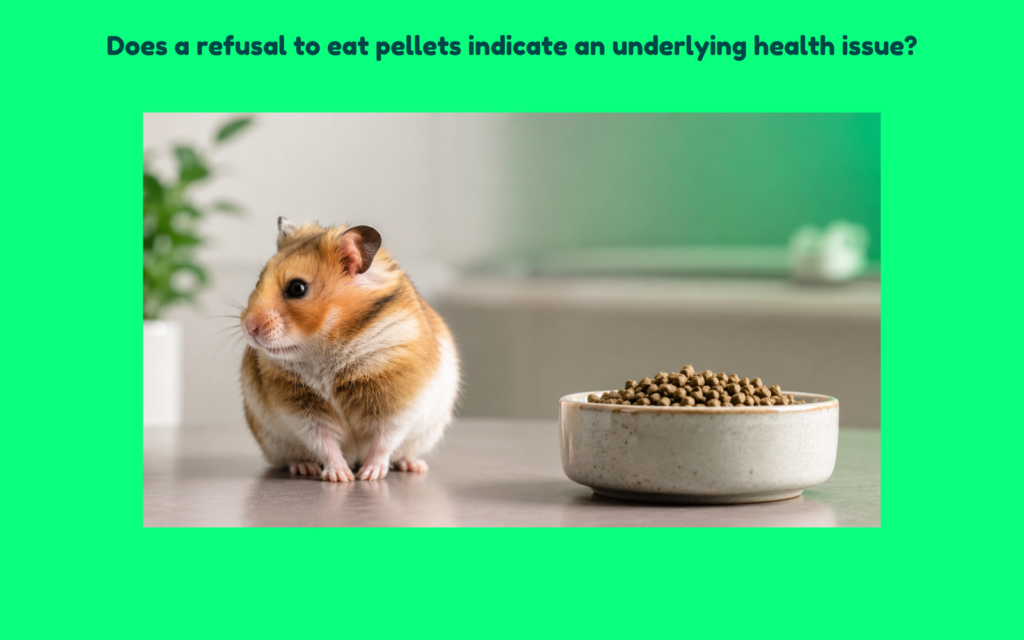
Does A Refusal To Eat Pellets Indicate An Underlying Health Issue?
Assuming a health crisis is occurring simply because they leave their pellets in the bowl completely ignores the physical reality of how they process different food shapes.
It is a very common owner panic: you look into the cage, see untouched brown blocks, and immediately assume a systemic crisis. But here’s the catch. If they are still enthusiastically eating seeds and loose mix-ins, you are not looking at a health issue; you are looking at visible sorting or a physical format barrier.
We are going to break down exactly how to read the visual clues in your food dish, the physical signs that a block is too hard to chew, and the exact steps to verify what is actually happening today.
Think of it this way: it is exactly like a toddler refusing the crust on a sandwich. Leaving the crust on the plate doesn’t equal a stomach bug; it just means they reject the physical texture of that specific part.
Why does a refusal to eat pellets typically indicate a format rejection rather than an underlying health issue?
While sudden, complete food avoidance is a serious concern, a specific rejection of only the pellet format is almost always a format rejection rather than an underlying health issue.
You must visually verify if the animal is rejecting all food or just the rigid block format before making any assumptions. Here is why that matters. Complete food avoidance means the feeding routine has stopped entirely. Selective rejection simply means the animal is actively picking out high-fat seeds and softer items.
If you panic over health when they are actively consuming loose seeds but ignoring the fortified block, you incorrectly interpret a simple sorting process as evidence of an underlying health issue. This demonstrates the strict necessity of evaluating the bowl state first.
How do you evaluate the daily bowl to distinguish between selective sorting and physical pellet rejection?
You can find out exactly why the blocks are being ignored by inspecting the feeding dish to see if the pieces are entirely untouched or partially destroyed.
A bowl completely empty save for pristine, untouched pellets proves the animal is just bypassing the foundational blocks to consume the loose mix-ins. Contrast this directly against the physical evidence of a physical pellet rejection. In this scenario, the animal actually wants to eat the food but hits a physical chewing barrier. When you look closely, you will not find pristine blocks. Instead, you will find partially chewed blocks, heavily dropped crumbs in the bedding, or pieces that have been actively water-soaked.
Chart Explanation: This breakdown shows exactly what to look for in the cage. Pristine blocks left behind mean your pet is just picking out the good stuff. Dropped crumbs and broken edges prove they actually tried to eat the base diet but hit a physical wall.
What physical signs indicate that pellet refusal is caused by block format rather than an underlying health issue?
If your pet is struggling with the physical format of the food, they will leave distinct visual clues around the cage that prove they are making an effort to eat.
Look directly at the bowl and the surrounding bedding. Finding half-eaten blocks or fine dust trails around the food dish are massive visual indicators. You might even find evidence of the hamster actively dipping pellets under the water bottle to soften them. You must strictly distinguish these active, visible attempts to break down the format from complete dietary inaction. They are eating; they just cannot process the specific block shape.
How do you fix a pellet refusal assessment error?
If you assumed complete food avoidance, you must immediately correct this assessment error by verifying their reaction when the loose seeds are removed from the environment.
Owners often assume the animal cannot eat the pellets, so they keep giving them extra seeds to compensate. This actively worsens the sorting process. To fix this, you execute a strict visual test. First, isolate the pellet format. Second, strictly remove all loose seed mix-ins from the cage for 48 hours.
Third, visually monitor the bowl for consumption attempts. Look for crumbs versus completely ignored, pristine blocks. Finally, log the exact finding to properly categorize the refusal pattern. This will tell you if you are dealing with a physical format issue or just a strict, stubborn sorting process. Because once selective sorting has been identified, the next step is improving pellet acceptance.
Chart Explanation: This sequence forces the true feeding pattern out into the open. By stripping away the loose seeds for two days, you remove the sorting option. The visual clues they leave behind during this window will instantly verify if they are dealing with a chewing barrier or just waiting for a better offer.
How do you audit your current feeding dish to diagnose a pellet refusal pattern today?
You can actively determine the exact feeding error by visually inspecting your current food bowl to verify the ratio of consumed seeds versus untouched blocks today.
- The Selective Sorting Check Target Feeding Error: Selective depletion. Visual Indicator: A dish containing exactly 100% of the daily pellet allocation while the loose seeds are completely stripped away. Required Verification Step: Execute the 48-hour seed removal protocol. Action: Stop providing loose mix-ins until visual verification confirms the pellets have been consumed.
- The Complete Avoidance Check Target Feeding Error: Complete dietary inaction. Visual Indicator: Both the loose seeds and the base pellets remain perfectly untouched in the dish for a full 24-hour cycle. Action: Acknowledge that this zero-consumption state falls entirely outside the visible bounds of selective feeding; immediately halt the isolation protocol, as the sorting troubleshooting has reached its physical limit.
Perform this bowl state audit to formally log the refusal pattern before making any assumptions or altering the base diet.
Locking down the exact visual evidence inside the dish is a practical step that clearly separates a simple sorting process from a complete zero-consumption state.