
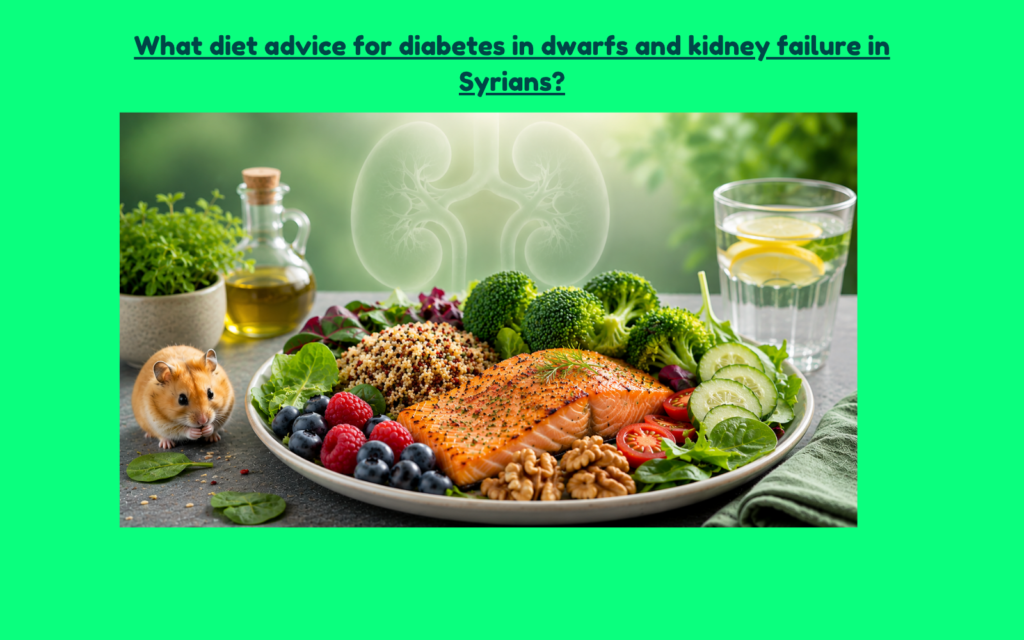
What Diet Advice For Diabetes In Dwarfs And Kidney Failure In Syrians?
Attempting to feed two entirely different metabolic profiles with a single, generalized “health diet” creates a formulation mismatch that guarantees one of your pets is receiving the wrong macronutrients.
Diagram 1: A side-by-side comparison illustrating the strict formulation divergence between a high-protein, zero-sugar dwarf requirement and a reduced-protein, renal-support Syrian requirement.
It is a highly common and stressful scenario. You manage a household with multiple hamster breeds facing distinct health profiles. Naturally, you find yourself desperately looking for a single dietary solution to make feeding time easier.
But here’s the catch. These two specific profiles sit on opposite ends of the macronutrient spectrum. Buying an all-in-one bag is a mathematical impossibility.
We are going to break down exactly why these dietary formulas can never safely overlap, how to verify a zero-sugar label for your dwarf, how to identify sub-16% crude protein for your Syrian, and how to properly classify your pantry.
Think of this label verification challenge like putting the right fuel in two different engines. You cannot put diesel in a standard engine and expect it to run, just as you cannot feed a high-protein dwarf mix to a Syrian needing a reduced-protein diet.
Why does diet advice for diabetes in dwarfs and kidney failure in Syrians require strictly divergent formulations?
These two dietary profiles demand entirely opposed macronutrient numbers, meaning a single generic diet creates a severe formulation mismatch rather than fulfilling both parameters simultaneously.
Diagram 2: The formulation mismatch zone demonstrates how balancing opposed macronutrient needs in a single generic diet fails to meet the strict safety thresholds of either profile.
You must completely abandon the idea of a universal health mix and strictly classify your food formats by breed-specific formulation requirements.
A specialized dwarf profile relies on high protein to offset the absence of simple carbohydrates. Conversely, a renal-support Syrian profile relies on strictly lowered protein to reduce the filtration load.
Here is why that matters. Taking a verified high-protein, zero-sugar dwarf formulation and feeding it to a Syrian creates a direct formulation mismatch that completely violates the low-protein requirement. Finding the right diet advice for diabetes in dwarfs and kidney failure in Syrians means accepting you are managing completely opposed macronutrient profiles.
How do you mathematically verify an ingredient profile following diet advice for a diabetic dwarf?
The primary step for evaluating a dwarf formulation requires the strict verification that all simple sugars, fructose, and molasses are absent from the ingredient list.
Diagram 3: Verifying a dwarf profile requires checking the exact ingredient list to confirm the absolute absence of restricted simple sugars and hidden sweet binders.
The reality of the pet aisle is confusing. A standard commercial omnivore mix frequently lists hidden molasses, dehydrated fruits, and sweet corn. You have to read past the marketing on the front of the packaging to explicitly confirm the absence of these sweet binders.
A bag is safely classified only when complex, high-fiber carbohydrate ingredients are the sole energy source. Applying solid diet advice for a diabetic dwarf requires you to completely ignore the promotional claims and look straight at the tiny text on the back of the bag, because even a verified daily formulation can be compromised by treats that can undermine metabolic control.
What specific guaranteed analysis limits fulfill the diet advice for kidney failure in Syrians?
Identifying a renal-supportive formulation for a Syrian means strictly verifying that the guaranteed analysis panel displays lowered crude protein percentages.
You have to map formulation constraints directly to the numbers printed on the label. Look at the back of the bag. Owners must check the crude protein line specifically.
Anything exceeding 16% falls outside the criteria for a reduced-protein formulation. Identifying these strict parameters prevents a very common mistake. It stops the owner from accidentally assigning high-protein laboratory blocks or insect-heavy mixes to the wrong profile. Accurate diet advice for kidney failure in Syrians relies entirely on these printed boundaries.
How do you fix formulation assignment errors when misapplying this specialized diet advice?
If you realize you have been accidentally feeding your low-protein Syrian a high-protein dwarf mix, you must implement a strict classification and verification process to permanently stop the overlap.
Diagram 4: A strict label assignment protocol requires physically isolating verified zero-sugar formats from verified sub-16% protein formats to completely prevent dietary overlap.
The main problem usually happens in the storage space. Owners store both diets in the same area or pour directly from unverified bags, accidentally assigning a high-protein or sugar-bound formulation to the wrong breed.
The execution fix is straightforward. First, physically isolate the specific breed’s food supply based strictly on label verification. Second, explicitly confirm the exclusion of the restricted macronutrient. This means visually confirming zero sugar on the dwarf’s bag, and checking for sub-16% protein on the Syrian’s bag.
Finally, distinctly label the storage bins, ensuring whoever feeds the pets assigns the right verified bag to the right bowl. It is easy to misapply specialized diet advice in a busy household, but this strict label assignment protocol will completely reset your routine.
How do you audit your current pantry to execute this specific diet advice today?
You can protect both of your pets’ baseline profiles by physically sorting your commercial bags, treats, and supplements into strict dietary categories based entirely on their guaranteed analysis labels today.
Pull everything out of your cupboards. Run this rapid-fire test to safely re-classify your inventory.
- Target Requirement (Syrian Reduced-Protein) Verification Target: The Guaranteed Analysis panel on the back of the bag. Label Indicator: A printed crude protein percentage exceeding 16%. Action: Classify this bag as a high-protein formulation and assign it exclusively to the dwarf’s feeding inventory.
- Target Requirement (Dwarf Zero-Sugar) Verification Target: The exact ingredient list printed below the guaranteed analysis. Label Indicator: The presence of “cane molasses,” “fructose,” “dried papaya,” or “corn syrup.” Action: Label this item as a sugar-bound format; it falls outside the specialized zero-sugar criteria and must be stored away from the dwarf’s approved pantry.
Label Verification & Nutritional Source Data
- National Research Council (NRC). (1995). Nutrient Requirements of Laboratory Animals (4th Rev. Ed.). National Academies Press. [Establishing baseline macronutrient limits and crude protein boundaries for Syrian and Dwarf hamster species].
- Quesenberry, K. E., & Carpenter, J. W. (2012). Ferrets, Rabbits, and Rodents: Clinical Medicine and Surgery (3rd Ed.). Elsevier Saunders. [Clinical dietary parameters for renal filtration load and diabetes mellitus management in small rodents].
- Mayer, J., & Donnelly, T. M. (2012). Clinical Veterinary Advisor: Birds and Exotic Pets. Elsevier Mosby. [Evaluation protocols for reading commercial rodent diet labels and identifying hidden simple carbohydrates].
- What To Feed a Pet Hamster — Foundational overview of establishing safe baseline macronutrient distribution.
- Hamster Care | Wellbeing Advice — Comprehensive guidance on navigating daily metabolic health and nutritional routines.
- What is the Best Food for Hamsters? — Comparative analysis of commercial dietary formulations versus verified raw ingredients.
To safely execute this specific diet advice, perform this comprehensive label audit to strictly classify your food formats, ensuring the exact verified formulation reaches the correct bowl.
Locking down your distinct formulations through strict label verification is a practical step that actively prevents dietary overlap and categorizes your pantry perfectly.