
How Can Owners Distinguish Eaten Food Versus Hoarded Food in Hamsters?
Assuming an empty food bowl means your pet actually ate their dinner is the fastest way to completely corrupt your daily intake tracking.
It is incredibly common to see a highly disciplined owner carefully measuring the exact amount of food going into the bowl every single evening and diligently logging that number. You check the cage in the morning, see an empty ceramic dish, and write down “15 grams consumed.” But the physical reality is that hamsters are biological hoarders. Writing down that the bowl is empty does not track ingestion; it only tracks transportation.
We are going to break down how to track exact consumption math, how to spot the physical waste of digested food versus fully intact hidden food, and how to mathematically reconcile your feeding logs today. Think of it exactly like transferring money from your checking account to your savings account. The funds have not actually been spent; they just changed physical locations. Until you audit the savings account, you have no idea what your actual expenses are.
Why is distinguishing eaten food versus hoarded food essential for accurate dietary tracking?
A depleted food bowl does not equal actual caloric intake, making it mathematically necessary to separate the volume of food ingested from the volume simply relocated.
You must completely separate the act of pouching food from the act of digesting food in your daily records. Treating an empty bowl as proof of consumption inevitably leads to severe data corruption and inaccurate intake calculations. Contrast an owner who correctly logs 3 grams of actual digestion against an owner who mistakenly logs a 15-gram daily intake because they recorded daily volumes that were only moved, not digested. This completely invalidates their data. This is why distinguishing eaten food versus hoarded food contextually is an absolute necessity.
How do you physically distinguish eaten food volumes from relocated hoarded caches?
To calculate the true rate of ingestion, you must use specific mechanical tracking methods that compare what was poured against what was physically buried.
There is a stark difference between visual perception and mathematical reality. When you look at a perpetually empty food dish, the human eye assumes a 100% consumption rate. But here is the catch. You must compare this visual deception directly to the mathematical certainty of physically weighing the dispensed volume. You then later weigh the excavated bedding cache to determine the exact grammage actually consumed. Only by doing this can you distinguish eaten food volumes from relocated hoarded caches with total accuracy.
What physical remnants help distinguish an eaten food hull from a fully hoarded item?
You can physically verify actual consumption by identifying the specific waste markers left behind, which look entirely different from perfectly intact items stored for later use.
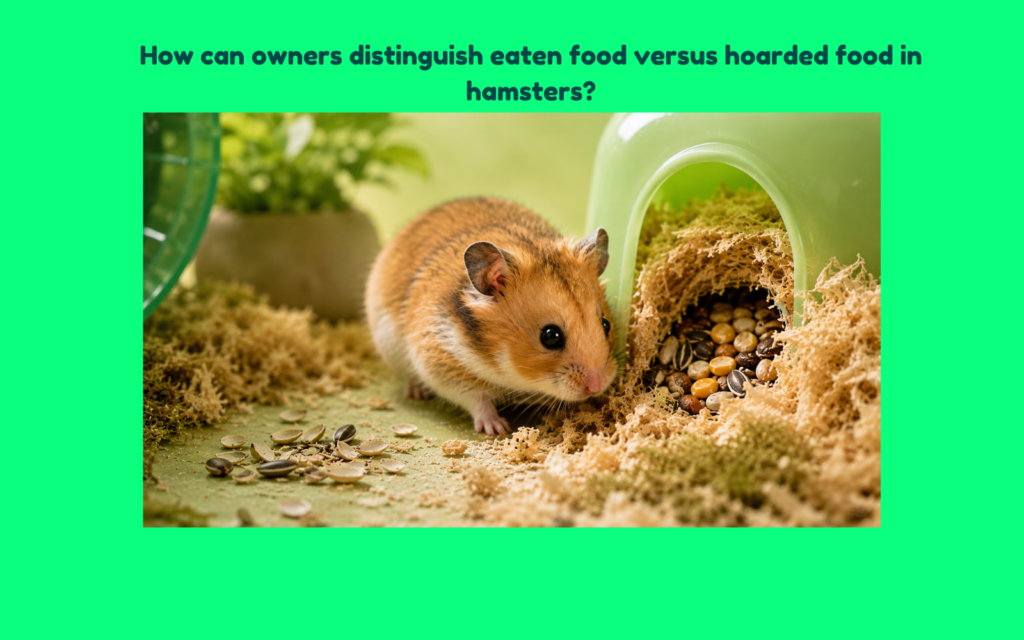
Let us map these exact visual differences. The physical remnants left behind after actual consumption are obvious: split seed husks, empty millet shells scattered near the bowl, or fine pellet crumbs. Contrast this heavily against fully hoarded items. A hidden cache consists of perfectly intact, nutrient-dense pieces packed tightly into the bedding without a single bite mark. This is exactly how you distinguish an eaten food hull from a fully hoarded item.
How do you fix tracking errors when failing to distinguish eaten food from hidden caches?
If you have been logging every empty bowl as digested food, you must correct your inaccurate consumption logs by implementing a strict mathematical reconciliation step.
Here is the problem: you check your tracking sheet and see massive, highly inaccurate daily intake numbers because you never subtracted the relocated stash. The fix is a simple, step-by-step mathematical protocol. First, weigh the food originally offered. Second, weigh the intact food physically recovered from the bedding during a spot clean. Third, calculate the true intake by subtracting the recovered weight from the offered weight. Finally, directly update your feeding records to reflect reality, resetting your baseline data. This is the only way to distinguish eaten food from hidden caches mathematically.
How do you audit the habitat to accurately distinguish eaten versus hoarded food today?
You can immediately correct your intake tracking by physically excavating the primary sleeping chamber and mathematically reconciling its contents against your weekly dispensed volume today.
The presence of a massive pile of intact pellets, seeds, and unbroken grains hidden under the substrate.
Carefully scoop out the entirely intact pieces and place them on a digital kitchen scale.
Write this exact grammage down immediately.
Empty husks, split shells, and dust left inside or directly next to the ceramic bowl.
Do not weigh the empty husks.
Acknowledge these husks as the only true physical proof of digestion.
Your written log of total food dispensed for the week.
Take the total fed weight and subtract the exact weight of the cache you just placed on the scale.
Cross out your old intake assumptions and log this newly calculated, highly accurate ingestion rate.
Perform this weekly cache audit to strictly improve your intake accuracy and prevent severe data corruption in your logs.
The tracking protocols and mathematical formulas detailed in this guide are designed to help owners monitor nutritional intake and maintain accurate wellness logs. While a sudden drop in actual food ingestion is a key behavioral indicator of potential underlying health concerns, these monitoring steps are purely educational. They do not constitute veterinary medical advice and must never be used to self-diagnose or replace an immediate, professional assessment by a qualified exotic animal veterinarian if your pet shows active signs of distress, lethargy, or illness.
Locking down the exact math between what is offered and what is swallowed is a simple, mechanical step that actively protects your feeding records and ensures true dietary accuracy.