
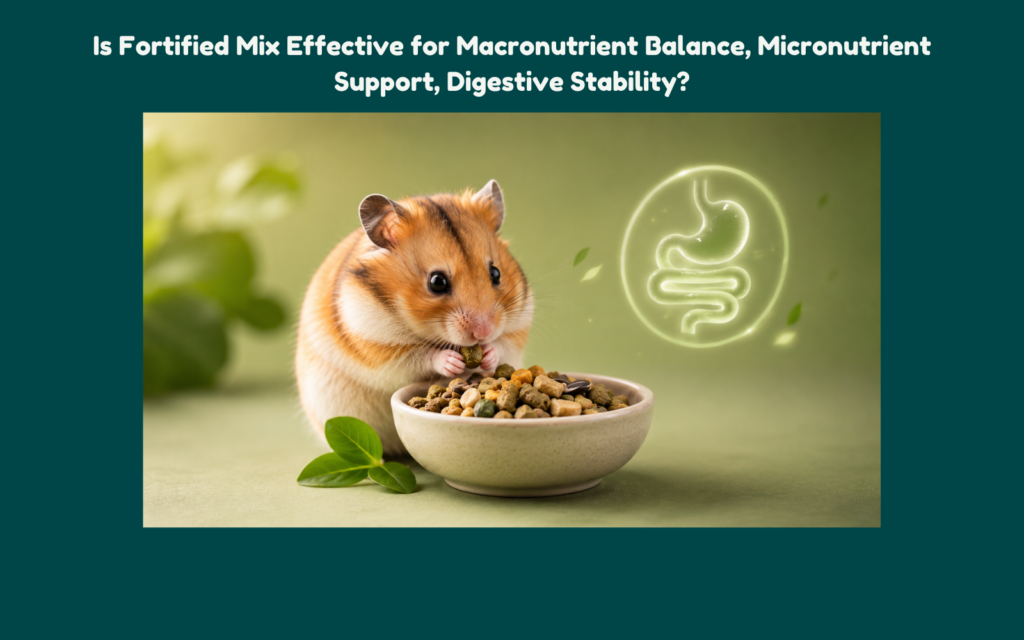
Is Fortified Mix Effective for Macronutrient Balance, Micronutrient Support, Digestive Stability?
Buying a bag of commercially formulated food feels like a nutritional safety net, but that mathematical balance only works if your pet actually eats the pieces carrying the vitamins.
It is a huge relief when you grab a bag off the shelf and see bold promises of “100% daily nutrition.” It feels like the hard work is done for you. And honestly, these bags are brilliant scientific tools. The problem is what happens when you pour that science into the bowl. These blends are often filled with competing textures that practically beg the hamster to cheat on their diet.
We are going to break down exactly how these manufactured blends lock in vital proteins, why the baked-in vitamins are an incredible insurance policy, and how to stop your pet from eating only the junk food.
Think about a fortified mix like a bowl of breakfast cereal for a toddler—one filled with bland, vitamin-coated bran flakes mixed with sweet, colorful marshmallows. The total nutrition is scientifically guaranteed to be in that bowl. But if the toddler only picks out the marshmallows and leaves the flakes behind, the science completely fails. It is the exact same concept with your pet.
Chart Explanation: A visual breakdown of selective eating, illustrating how a pet picking out sweet or fatty pieces leaves the mathematically balanced, vitamin-dense pellets behind.
How does the fortified mix format stabilize daily macronutrient balance?
These commercially formulated blends are mathematically designed to provide a safe, baseline ratio of proteins, fats, and carbohydrates that protects your pet from invisible dietary deficiencies.
A healthy feeding routine must always start with a scientifically calculated base category. Trying to guess the exact protein-to-fat ratios using only raw, unfortified ingredients is incredibly difficult and highly prone to error. You cannot just eyeball an almond and know exactly how it impacts the daily fat budget.
We often see rapid weight fluctuations and sudden muscle or protein drops in pets fed unfortified, DIY homemade diets. The math is just too hard to get right every single day. Contrast that against the steady, reliable baseline provided by a mathematically balanced fortified mix format. It acts as a hard floor for nutrition, ensuring the animal always gets enough raw fuel to survive without dangerous dips in energy.
Chart Explanation: This chart demonstrates how a formulated mix provides a stable nutritional “floor,” protecting your pet from the dangerous dietary dips commonly seen in unfortified, homemade diets.
How do fortified commercial blends guarantee essential micronutrient support?
The biggest advantage of this manufactured food category is that essential synthesized vitamins and trace minerals are baked directly into the ingredients, acting as an invisible insurance policy against age-related decline.
In the wild, animals spend all day foraging a massive variety of fresh plants to hit their vitamin quotas. In captivity, we have to replicate that. Fortified commercial blends offer a reliable, measured delivery of crucial elements, like stabilized Vitamin C and calcium, ensuring your pet gets vitamins they might otherwise miss.
Compare this directly to the highly unpredictable, variable trace mineral intake of a purely unfortified natural foraging mix. When you rely solely on natural seeds, vitamin degradation happens quickly once those seeds are harvested and sit on a shelf. The synthesized vitamins in a commercial pellet are engineered to last, guaranteeing the micro-nutrition is actually there when your pet takes a bite.
What role does the physical composition of a fortified diet play in digestive stability?
The specific fibrous binders holding these commercial blocks together serve a massive dual purpose: they lock the vitamins inside and physically push waste safely through the hindgut.
It is easy to look at a uniform brown pellet and think it is just boring filler. But that “filler” is actually vital roughage. High-quality fibrous binders, like oat hulls or Timothy meal, utilized in a fortified diet support safe, steady gut motility. They create the physical bulk needed to keep things moving and actively prevent dangerous gastrointestinal stasis.
Chart Explanation: An internal look at how high-quality fibrous binders in pellets act like a broom, physically pushing waste through the hindgut to prevent dangerous gastrointestinal stasis.
But here is the catch. Not all binders are created equal. You have to watch out for cheap formulas that are overly reliant on processed corn or grain dust. Instead of sweeping the gut clean like a high-quality fiber, these cheap starches turn to sluggish sludge in the digestive tract, causing backups and severe digestive distress.
How do you fix nutritional gaps caused by selective eating within a fortified mix?
If your pet is exclusively eating the fatty seeds or sugary fillers in their commercial blend and ignoring the vitamin-dense fortified pieces, you have to safely force a habit reset. Ultimately, the fortified pellets are intentionally designed to prevent selective eating behaviors inside commercial blends.
We see it all the time. Owners look in the cage, see the brown fortified pellets left at the bottom of the bowl, and assume the hamster “doesn’t like them.” So, out of love, they dump the healthy bits in the trash and refill the bowl with fresh, sugary seeds and fatty nuts. You are unintentionally rewarding bad behavior.
To fix this, you have to implement strict portion control. Measure out the daily portion of the fortified mix. Then, actively wait until the bowl is completely empty before you refill it. Forcing the hamster to consume the less palatable, highly fortified pieces is the only way to re-stabilize the intended nutritional profile. They will not starve; they will just complain until they realize the healthy bits are the only option left.
How do you audit a commercial label to verify fortified mix efficacy today?
You can actively protect your pet from cheap fillers and vitamin voids by taking sixty seconds to inspect the guaranteed analysis and ingredient panel on your bag today.
Do not let flashy marketing on the front of the bag fool you. The truth is always printed on the back. Here is a quick audit you can run right now to check the real fortified mix efficacy of what you are feeding:
Chart Explanation: A visual guide to auditing a commercial food bag. Checking the ingredient panel and guaranteed analysis helps you cut through front-of-bag marketing to find the true nutritional value.
Ideal Label Indicator: Whole grains (oats, wheat) and distinct protein sources listed in the first three ingredients.
Warning Sign: Heavy reliance on cheap, sugary binders like molasses, or vague “animal derivatives.” These cheap sugary binders quietly destabilize the nutritional profile inside commercial blends.
Action: Transition to a brand that prioritizes transparent, whole-food primary ingredients.
Ideal Label Indicator: Chelated minerals and stabilized vitamins clearly listed at the bottom of the panel.
Warning Sign: A long list of artificial dyes (Red 40, Yellow 5) used to make the mix look “varied” to humans. Brightly colored filler pieces often exist to attract owners rather than support nutrition.
Action: Discard blends that rely on visual tricks rather than actual nutritional density.
Ideal Label Indicator: Crude fiber listed at 8-12%, driven by quality roughage.
Warning Sign: Low fiber counts paired with high volumes of cracked corn.
Action: Upgrade to a formula that actively supports gut motility.
Use this quick label audit to look past the front-of-bag marketing and choose a highly vetted, premium commercial brand.
Sources & References
- PetMD – What Can Hamsters Eat?
- PetMD – Hamster Care Sheet
- HamsterWelfare – A-Z of Hamster Care
Holding your commercial diet to a strict scientific standard is a simple fix that protects their baseline health and ensures they thrive well into their senior years.