
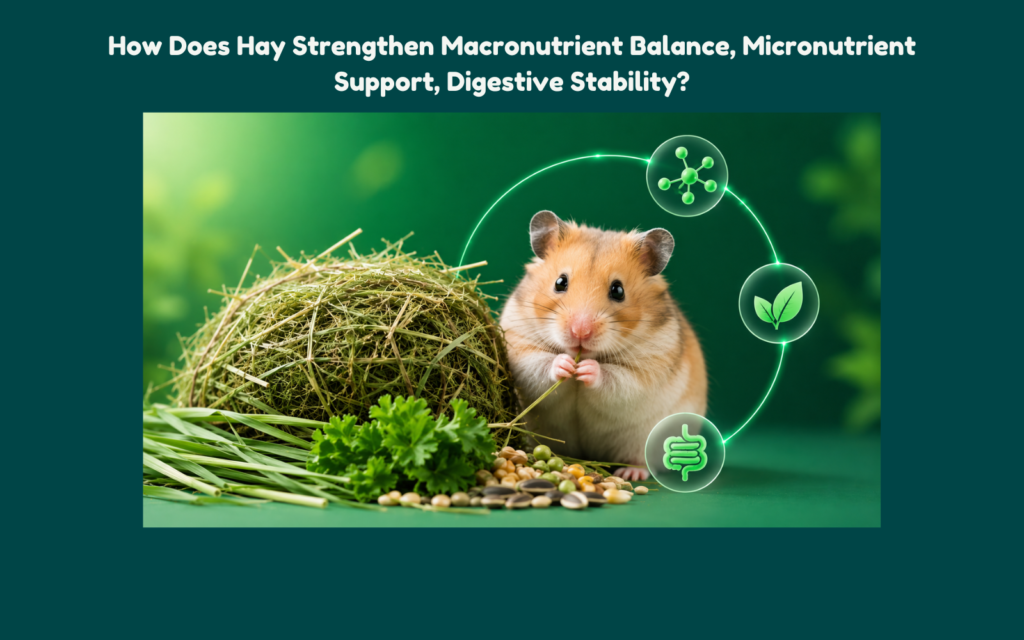
How Does Hay Strengthen Macronutrient Balance, Micronutrient Support, Digestive Stability?
While it lacks the heavy proteins and fats of a base diet, offering unlimited safe grass provides the zero-calorie foraging and mechanical roughage your pet needs to thrive.
There is a classic misunderstanding among many well-meaning owners. Because a hamster doesn’t require massive, daily piles of hay to physically survive in the exact same way a guinea pig does, many owners incorrectly assume hamsters gain no functional benefit from roughage. Providing constant access to safe grasses protects their waistline, keeps their teeth filed down, and instantly cures diet-induced boredom.
Think of it this way: giving your hamster a handful of quality hay is a lot like handing a human a bowl of raw, crunchy celery. It gives them something constant to chew on, requires physical effort to break down, and keeps their digestive system working incredibly hard. Best of all, it achieves all of this without adding a single ounce of fat to their daily intake.
How does the hay format support daily macronutrient balance without causing obesity?
Because this specific dietary format completely lacks core proteins and fats, its high-fiber nature allows hamsters to constantly graze without disrupting their carefully managed macronutrient ratios.
You can, and absolutely should, provide unlimited access to this safe, bulky format in their enclosure at all times. Although hamsters utilize hay differently than strict grazing herbivores like rabbits, they still possess an intense, biological drive to forage, dig, and chew constantly. Look at their hardwired evolutionary instincts to understand how to keep them happy.
But here’s the catch. If you try to satisfy that endless urge to graze by tossing in extra seed mixes or baked treats, they will rapidly become obese. Contrast that rapid weight gain from punching on calorie-dense sunflower seeds against the complete safety of chewing on zero-calorie orchard grass. The hay format satisfies their brain without padding their waistline.
While we’ve established that hay provides zero caloric value, that doesn’t mean it’s entirely devoid of nutritional benefits.
How do natural hay varieties deliver supplementary micronutrient support?
Beyond acting as a zero-calorie chew, this sun-cured category provides a unique delivery system for trace, soil-derived minerals and organic vitamins.
When you feed natural hay varieties, particularly those blended with safe dried herbs or botanicals, you are offering highly bioavailable, slow-release trace minerals. Compare this directly to the rapid, artificial breakdown of synthesized vitamin coatings you usually find sprayed onto dry commercial pellets. The pellet coatings process quickly, but sun-cured grass acts entirely differently in the gut.
Now, let’s look at the real-world reality. A hamster is not going to sit down and consume a giant mound of grass. They nibble it. They sort through it to find the perfect pieces for their nest. But even though they only ingest small amounts of the grass, the quality and absorption rate of those natural trace elements is exceptionally high, rounding out their daily nutritional profile.
What indispensable role does the fibrous hay category play in digestive stability?
The long, tough strands of grass serve a vital dual mechanical function: pushing waste safely through the hindgut while acting as a natural file for their teeth.
We need to talk about the severe, physical necessity of roughage for both the mouth and the intestines. When long-strand roughage mechanically sweeps waste through the digestive tract, it keeps the hindgut moving efficiently and safely processes the heavy proteins and fats left over from their core base diet, which is exactly what prevents life-threatening conditions like gastrointestinal stasis.
Simultaneously, the fibrous hay category provides constant, heavy friction in the mouth. Hamster teeth never stop growing. Chewing on stiff stalks provides the essential dental wear they need on a daily basis, naturally preventing painful, overgrown incisors.
How do you fix digestive and behavioral imbalances by introducing the hay format?
If you notice early signs of mild constipation, diet-induced lethargy, or destructive chewing behaviors, introducing this safe foraging format can instantly reset their routine. Because without continuous fibrous movement, the hindgut gradually slows down, providing that roughage offers an immediate, natural remedy.
Owners often see their hamster desperately chewing the cage bars or acting sluggish and assume they need a brand-new plastic toy or a sweeter treat to perk them up. That usually just exacerbates the problem. What they actually need is a job to do.
Here is how you rebuild their daily routine:
Take clean, dust-free grass and integrate it actively throughout their bedding—do not just drop it into a food bowl. Layer it. Hide it. Force your hamster to dig, sort, and chew the tough strands to construct their burrows. This intense physical exertion stimulates active foraging behaviors, naturally cures dietary boredom, and immediately re-stabilizes sluggish gut motility.
How do you audit your feeding routine to ensure safe hay integration today?
You can actively protect your pet’s delicate respiratory system by physically inspecting your current bag of grass for dangerous irritants or environmental degradation today.
Before you toss a handful into the enclosure, you need to run a quick, physical check of your supply. Hamsters have highly sensitive lungs and cheek pouches, making safe hay integration critical.
- Hay Type & Texture Ideal Physical Indicator: Soft, flexible, sweet-smelling strands (like Orchard grass or second-cut Timothy). Warning Sign: Stiff, yellowed, excessively sharp stalks that can poke delicate cheek pouches. Action: Sort out the sharp, woody pieces before placing the grass in the enclosure.
- Respiratory Safety Ideal Physical Indicator: Pulling a handful out creates zero visible airborne particles. Warning Sign: The bottom of the bag is filled with heavy, brown dust that makes you sneeze. Action: Discard the dusty bottom of the bag entirely; never expose a hamster’s sensitive lungs to agricultural respiratory irritants or dust.
- Environmental Quality Ideal Physical Indicator: Bright green coloring and a fresh, earthy scent. Warning Sign: Dampness, brown patches, or a sour, musty odor indicative of mold. Action: Throw the bag away immediately and replace it with a fresh, sun-cured batch.
Use this quick quality audit to check your current supply, and begin offering this safe format in unlimited, daily quantities.
Giving them a safe, natural outlet for their chewing and foraging instincts is a simple fix that drastically improves their everyday comfort and long-term health.