
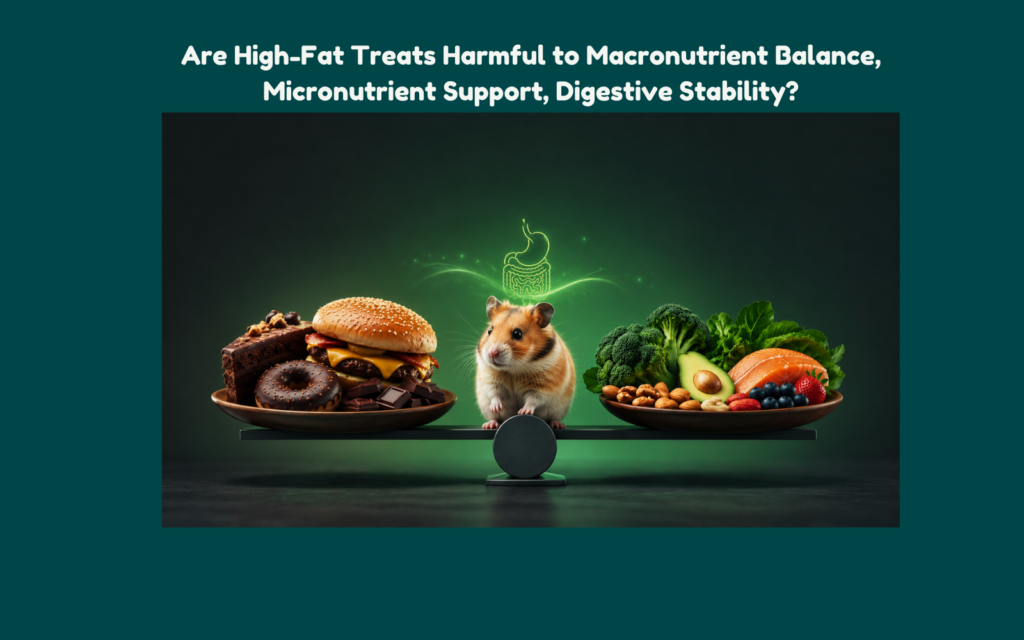
Are High-Fat Treats Harmful to Macronutrient Balance, Micronutrient Support, Digestive Stability?
Handing your pet a whole peanut or an extra pinch of sunflower seeds feels like spoiling them, but that massive influx of pure fat physically displaces the critical nutrients they actually need to survive.
It is incredibly easy to justify feeding these snacks daily. After all, nuts and seeds are heavily marketed everywhere as natural, wholesome hamster foods. But we need to look at the sheer scale of what we are offering. To a tiny rodent, a single whole walnut packs a staggering, system-altering amount of fat.
We are going to break down why these rich snacks ruin their daily appetite, how too much fat severely strains their internal organs, and how to safely force a picky eater to fall back in love with their healthy base diet.
Think of it this way: feeding a dwarf hamster an entire almond is like letting a child eat an entire large jar of peanut butter right before a balanced dinner. They are completely, uncomfortably full. But their body just took in massive amounts of lipids and has zero of the proteins or complex carbs it needs for baseline function.
Why does the high-fat treat format threaten daily macronutrient balance?
Because this extremely calorie-dense food category is incredibly filling, it physically displaces the consumption of vital proteins and complex carbohydrates, rapidly skewing the pet’s required macro ratios.
You have to treat this specific format as a rare, high-value reward, never as a daily cage addition. The reasoning is purely physical: a hamster’s stomach capacity is tiny. If they fill up completely on lipids from seeds and nuts, they are going to completely ignore the vital proteins needed to maintain their muscle mass.
Consider the difference between two setups. A hamster receiving a tiny, broken piece of sunflower seed just once a week is getting a nice little energy bump. A hamster allowed to free-feed on peanuts or pick through a bowl mostly made of sunflower seeds faces a different reality. Because free-feeding sunflower seeds rapidly leads to obesity and nutrient displacement, that second hamster develops a core protein deficiency simply because their stomach is entirely packed with fat before they even look at their staple food.
How do lipid-heavy treat formats displace essential micronutrient support?
While these rich snacks provide heavy, slow-burning energy, overfeeding them creates a massive, invisible void in your pet’s daily vitamin intake.
The problem is not just what they are eating, but what they are missing out on. A diet dominated by this high-fat category lacks broad-spectrum trace minerals. Compare that direct lipid overload against the comprehensive, bioavailable vitamin delivery of a strictly portioned, standard commercial mix. When they fill up on the fat, they skip the vitamins. A fat hamster is, very often, a malnourished hamster.
What impact does the high-fat dietary category have on gut and digestive stability?
Processing an overwhelming amount of pure fat places severe gastrointestinal strain on a tiny body, eventually overwhelming their delicate liver.
Utilizing a single, tiny piece of a seed format provides safe, slow-burning energy that their body can handle. But there is a biological tipping point. Dumping a massive fat load into the hindgut completely overwhelms their liver’s ability to process it.
This excess fat triggers severe bacterial disruption in the gut. The result is dangerously loose, noticeably greasy stools that smear around the cage, rather than the firm, dry droppings you should see.
How do you fix metabolic and digestive imbalances caused by overfeeding high-fat treat formats?
If your pet has developed “seed addiction”—refusing their healthy base diet and hoarding only the fatty pieces—you have to implement tough love to safely reset their metabolism.
Owners often cave when a hamster goes on a hunger strike for their favorite fatty seed. They incorrectly assume the animal will starve if they do not provide the exact junk food they are begging for. This is where you have to step in and manage the situation.
You need to start a strict elimination protocol immediately. Remove all supplemental nuts and high-fat seeds from the cage entirely. Check their hidden stash and clear it out, too. Implement strict portion control on their nutritionally stable pelleted base.
Then, you just wait out the protest. A healthy hamster will eventually eat their core diet when they realize the junk food is gone and not coming back. You have to be more stubborn than they are.
How do you audit your feeding routine to safely control high-fat treat integration today?
You can actively protect your pet from obesity and liver strain by measuring your supplemental nut portions against safe baselines and inspecting their bedding today.
- Treat Type & Gram-Level Portioning:
Ideal Format Indicator: A single pumpkin seed or plain peanut shell, broken into micro-pieces totaling no more than 1 to 2 grams per serving.
Warning Sign: Dropping a whole, unbroken walnut (which can weigh up to 5 grams—nearly 10% of a dwarf hamster’s total body weight) into the cage.
Action: Use a digital kitchen scale to strictly limit these items to less than 2 grams, offered a maximum of once or twice a week strictly as a high-value training reward. - Base Mix Macro Audit:
Ideal Format Indicator: A base diet where sunflower seeds and heavy nuts make up less than 5 to 8 percent of the overall visual mix, allowing complex grains to dominate.
Warning Sign: A commercial bag where the top layer is visibly dominated by whole peanuts and sunflower seeds, indicating poor mix homogenization and excessive lipid levels.
Action: Manually weigh a sample of your mix. Sift out the excess fatty pieces to hit that low percentage, or transition to a higher-quality, grain-heavy blend. - Cage Hygiene & Biological Output (The Greasy Stash):
Ideal Format Indicator: Dry, clean bedding in the nesting area alongside firm, structurally sound droppings.
Warning Sign: Greasy, oil-stained spots in the bedding, smeared stools on the exercise wheel, or a stash filled entirely with picked-over nuts while the base food rots nearby.
Action: Clear the stash immediately, sanitize the hoarding corner to remove rancid oils, and drastically reduce the fat content of their overall diet to reset their digestive tract.
Use this quick feeding audit to severely restrict this heavy format to high-value training scenarios only.
Treating fatty seeds as a rare prize rather than a daily right is a simple fix that actively protects their long-term liver health and daily mobility.