
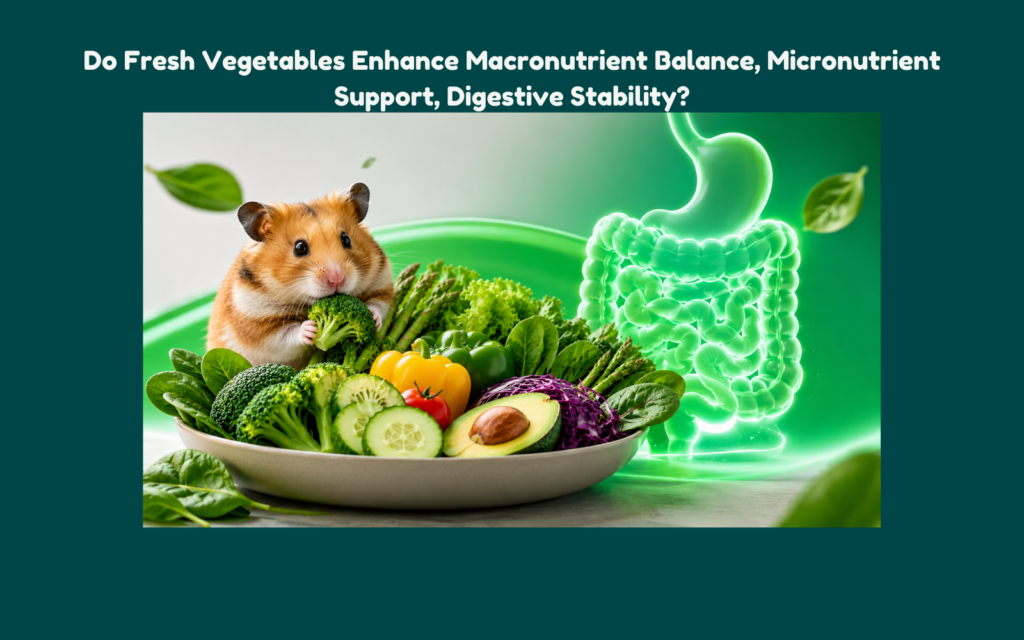
Do Fresh Vegetables Enhance Macronutrient Balance, Micronutrient Support, Digestive Stability?
Handing your pet a fresh piece of broccoli feels like the ultimate healthy treat, but getting the portion size wrong can instantly derail their baseline diet and trigger severe digestive upset. We all know the classic “Bugs Bunny” misconception: assuming that because vegetables are incredibly healthy for humans in massive quantities, we should heap them into our hamster’s bowl.
But here’s the catch—these tiny desert animals are simply not built to process heavy water volume. We are going to break down why fresh foods must be treated as tiny supplements rather than main courses, how to spot the difference between safe fiber and dangerous water-weight, and what to do the exact second you notice soft stool.
Think of it this way: feeding a hamster a giant piece of lettuce is like drinking a gallon of water right before dinner. You feel completely full, but you haven’t actually consumed any of the calories or proteins your body needs to function.
Why must fresh vegetables be strictly portioned to maintain daily macronutrient balance?
Because fresh vegetables are incredibly high in water and low in essential proteins and fats, overfeeding them physically displaces the calorie-dense core diet your pet requires for daily energy. Keep this fresh format to an absolute maximum of a thumbnail-sized portion, offered only two to three times a week.
A hamster’s stomach capacity is tiny. If they fill up on water-heavy vegetables, they will completely ignore the proteins and complex carbohydrates they need to survive the night. Contrast a Syrian hamster safely handling a thumbnail of cucumber against the reality for a Roborovski. A thumbnail-sized portion for a Syrian is a massive, system-shocking feast for a Robo. Furthermore, sweet corn and carrots can destabilize sensitive dwarf metabolism, so you should skip those entirely to avoid throwing off their sensitive macros.
When the tiny stomach fills up with the water volume from an oversized vegetable portion, there is physically no room left for the calorie-dense seeds and proteins needed for nightly energy.
How do leafy greens and raw vegetable formats deliver natural micronutrient support?
When portioned correctly, this fresh dietary category provides highly bioavailable, organic trace vitamins and antioxidants that perfectly complement a dry commercial mix. Fresh cellular absorption offers a distinct biological advantage.
Natural micronutrients, like Vitamin C and K, are absorbed rapidly and efficiently straight from the cellular plant walls of raw vegetable formats. Compare this directly to the slower, less efficient breakdown of synthesized vitamin coatings often found on dry commercial blocks.
Fibrous vegetables engage the hamster’s natural chewing mechanics and add stabilizing bulk to the digestive tract, whereas high-water formats overwhelm the system and wash away beneficial gut bacteria.
What role does the specific moisture content of supplementary vegetables play in digestive stability?
There is a delicate, critical balance between feeding soft fibers that support healthy gut motility and feeding watery vegetables that completely overwhelm a desert animal’s hindgut. Safe, fibrous options, like broccoli florets or dark kale, require significant chewing. This chewing action stimulates gut motility and adds essential solid mass to their physical stool output.
Dangerous, high-water food formats, like iceberg lettuce or celery, flood their system entirely. Since hamsters evolved in arid environments, excess water-heavy vegetables can rapidly trigger digestive collapse by flushing out healthy gut flora, rapidly leading to lethal diarrhea and severe dehydration.
How do you fix gastrointestinal upset caused by overfeeding fresh vegetable formats?
If you notice soft stools or signs of diarrhea, you must immediately halt this specific food category to re-stabilize the pet’s digestive tract. Owners often panic when they see soft stool and try to offer “soothing” wet foods or fruits. Here is why that matters: adding more moisture actually makes the bacterial imbalance much worse.
To fix this, you need a strict dry-only reset. Instantly remove all fresh moisture from the diet for 48 to 72 hours. Rely purely on their stable pelleted base, dry seed mix, and fibrous hay to rebuild healthy gut flora and absorb excess fluid in the hindgut. If the stool does not firm up rapidly within this window, a veterinary visit is mandatory.
The immediate response to soft stool is never “soothing” wet fruits. It requires a hard stop on all moisture to allow dry matter (hay and pellets) to soak up excess fluid and rebuild the natural gut flora.
How do you audit your feeding routine to ensure safe fresh vegetable integration today?
You can actively protect your pet from bacterial infections and dietary displacement by measuring your chopped portions and physically inspecting their cage stashes today.
When auditing your feeding routine, use this visual scale. Proper portioning ensures the vegetable acts as a safe micronutrient supplement rather than a dangerous, diet-displacing meal.
Vegetable Type & Moisture
- Ideal Format Indicator: Dark, fibrous greens (spinach, kale) or dense veggies (broccoli).
- Warning Sign: High water content items like iceberg lettuce or cucumber centers.
- Action: Scoop out watery centers before feeding and prioritize fibrous greens.
Portion Control
- Ideal Format Indicator: Chopped pieces roughly the size of the hamster’s ear.
- Warning Sign: Handing the hamster a full baby carrot or whole green bean.
- Action: Strictly control portion sizes based on the specific species (tiny slivers for dwarfs).
Cage Hygiene (The Stash Check)
- Ideal Format Indicator: No fresh food remaining in the cage after 12 hours.
- Warning Sign: Uneaten, wilting, or rotting hoarded pieces shoved deep into the bedding or hideout.
- Action: Remove all uneaten fresh food the morning after serving to prevent mold and deadly bacterial blooms.
Veterinary Medical Disclaimer
The nutritional guidelines and reset protocols provided in this guide are for informational, maintenance purposes only. They are not a substitute for professional veterinary diagnosis or treatment. If your pet exhibits lethargy, refusal to drink, or severe/prolonged diarrhea, bypass dietary adjustments and seek immediate emergency care from an exotic veterinarian.